
Updated August 14, 2026
What is Test-Time Scaling?
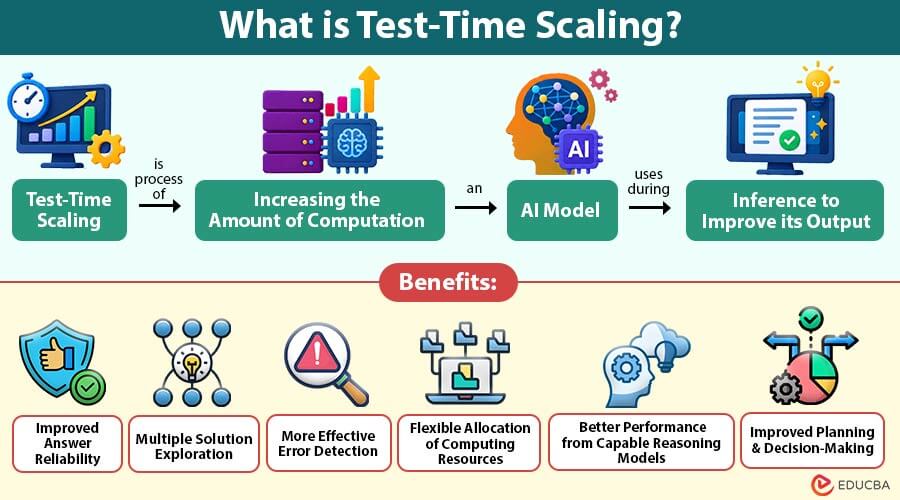
Test-Time Scaling is the process of increasing the amount of computation an AI model uses during inference to improve its output. Instead of generating an answer immediately, an AI model can spend more time exploring possible solutions, generating multiple answers, checking its reasoning, or revising its response before producing the final result.
For example, a simple question may require only one generation attempt. A difficult mathematical problem, however, may benefit from several reasoning attempts. The model can compare those attempts and select the solution that appears most reliable.
In simple terms, test-time scaling allows AI to use more computation when a problem requires deeper reasoning.
Table of Contents:
Key Takeaways:
- Test-Time scaling helps AI models explore complex problems and improve reasoning accuracy.
- It improves answer reliability by generating, evaluating, and refining multiple possible solutions.
- It allows AI systems to allocate more computation to difficult tasks when needed.
- It supports better planning, problem-solving, decision-making, and performance across complex AI applications.
Why is Test-Time Scaling Important?
AI models can sometimes produce incorrect answers even when they have enough knowledge to solve a problem. The issue may not be a lack of information but insufficient reasoning.
Test-Time scaling addresses this limitation by allowing models to allocate more computational resources to challenging tasks.
1. Better Reasoning
Complex problems often require multiple reasoning steps. Giving the model additional computation can help it explore these steps more carefully.
2. Higher Accuracy
Generating and evaluating multiple solutions can reduce the probability of accepting an incorrect first attempt.
3. Improved Problem Solving
Test-Time scaling can help AI systems handle problems that require planning, logical reasoning, mathematics, programming, and structured analysis.
4. Flexible Compute Usage
Not every question needs the same amount of computation. Simple questions can be answered quickly, while difficult questions can receive additional processing.
How Does Test-Time Scaling Work?
Test-time scaling can use different strategies depending on the model and application. The basic process usually involves generating, evaluating, and selecting possible solutions.
1. Generate Multiple Solutions
The model can produce several possible answers instead of relying on a single response. For example, if an AI system is solving a complex math problem, it may generate five different solution paths. Some may contain mistakes, while others may reach the correct answer.
2. Explore Different Reasoning Paths
The model can examine different approaches to the same problem. One approach might solve a problem using a direct calculation, while another might break the problem into smaller steps. Exploring multiple paths increases the chance of finding a successful solution.
3. Evaluate the Solutions
The generated solutions can then be evaluated using another model, a verification system, or a predefined scoring method. The system may check whether the answer follows the required rules, produces the correct result, or satisfies specific conditions.
4. Select or Refine the Best Answer
After evaluating the available solutions, the system selects the strongest answer or uses feedback to improve it. This process allows AI systems to allocate more computational resources to difficult problems rather than treating every question in exactly the same way.
Difference Between Test-Time Scaling and Training-Time Scaling
Test-time scaling and training-time scaling improve AI systems in different ways.
| Aspect | Test-Time Scaling | Training-Time Scaling |
| When it happens | During inference | During model training |
| Main goal | Improve performance on individual tasks | Improve overall model capability |
| Resources used | Inference compute | Training compute and data |
| Approach | Spend more computation solving problems | Train larger or better models |
| Cost | Higher cost per inference | High training cost |
| Best suited for | Complex reasoning and difficult tasks | General capability improvements |
Common Test-Time Scaling Techniques
Several techniques can be used to increase computation during inference.
1. Best-of-N Sampling
Best-of-N sampling generates multiple responses and selects the strongest one using a scoring method, verifier, or evaluation process.
2. Self-Consistency
Self-consistency generates multiple independent reasoning paths and selects the answer that appears most frequently across them.
3. Self-Verification
Self-verification allows a model to review its generated answer, identify possible mistakes, and correct them before producing the final response.
4. Search and Planning
Search and Planning explores multiple possible solutions or actions before selecting the most suitable approach for completing a complex task.
5. Iterative Refinement
Iterative refinement repeatedly reviews and improves an initial response, allowing the model to correct errors and produce better results.
6. External Verification
External verification uses separate tools, systems, or programs to independently verify that the model’s output is correct and reliable.
Applications of Test-Time Scaling
Test-Time scaling can be useful across many AI applications.
1. Mathematics
AI models can generate multiple solution paths, compare results, and select the most accurate answer for complex mathematical problems.
2. Software Development
Coding models can generate different implementations, test code, identify errors, and refine solutions using additional inference during execution.
3. Scientific Research
AI systems can perform deeper reasoning, analyze complex questions, evaluate hypotheses, and explore multiple potential solutions using additional computation.
4. AI Agents
AI agents can evaluate multiple actions, compare possible outcomes, and select suitable strategies before completing complex multi-step tasks.
5. Business Decision-Making
AI systems can analyze multiple scenarios, compare alternatives, evaluate potential risks, and provide more informed recommendations for business decisions.
6. Robotics
Robots can evaluate different possible actions, predict outcomes, and select safer movement strategies when operating in complex environments.
Benefits of Test-Time Scaling
The following are the key benefits of Test-Time scaling:
1. Improved Answer Reliability
By generating and evaluating multiple responses, Test-Time Scaling can reduce errors and increase confidence in the final answer.
2. Multiple Solution Exploration
Models can explore different reasoning paths and potential solutions, allowing them to compare alternatives before selecting the most suitable answer.
3. More Effective Error Detection
Additional inference allows models to review their outputs, identify inconsistencies, detect mistakes, and correct errors before delivering final responses.
4. Flexible Allocation of Computing Resources
Test-Time scaling allows systems to increase computation for difficult tasks while using fewer resources for simpler requests when appropriate.
5. Better Performance from Capable Reasoning Models
Advanced reasoning models can use additional inference time to improve solution quality, especially when tasks require extensive analysis and careful reasoning.
6. Improved Planning and Decision-Making
Test-Time Scaling enables models to evaluate multiple actions and outcomes, supporting better planning, strategy selection, and decision-making for complex tasks.
Challenges of Test-Time Scaling
Although Test-Time scaling can improve AI performance, it also introduces several challenges.
1. Higher Inference Costs
Generating multiple solutions requires additional computing resources. This can significantly increase the cost of serving AI systems at scale.
2. Increased Response Time
A system that evaluates several possible answers may take longer than a system that produces a single response. This can be problem for applications that require real-time results.
3. Diminishing Returns
More computation does not always produce proportionally better results. After a certain point, additional reasoning may provide only small improvements.
4. Evaluation Difficulty
The system needs a reliable way to determine which answer is better. If the evaluation mechanism is weak, the model may select an incorrect solution.
5. Resource Management
Organizations need to decide when additional computation is worth the cost. Simple tasks may not justify extensive test-time processing.
Final Thoughts
Test-Time scaling improves AI performance by allocating additional computation during inference. Models can explore multiple solutions, verify reasoning, refine responses, and select better outcomes. It is useful for complex tasks such as mathematics, programming, science, and planning. Although it increases computational costs and response times, it can improve accuracy, reliability, and overall reasoning capabilities.
Frequently Asked Questions (FAQs)
Q1. Does Test-Time scaling require retraining an AI model?
Answer: No. Test-Time scaling generally works by giving an already-trained model additional computation while it generates or evaluates an answer.
Q2. Can Test-Time scaling improve a small AI model?
Answer: It can. A smaller, capable model may benefit from additional reasoning, verification, or search, although the improvement depends on the task and the model’s capabilities.
Q3. Is Test-Time scaling useful for every AI task?
Answer: No. Simple tasks may not benefit enough to justify the extra computation. It is generally more valuable for problems that require reasoning, planning, or careful evaluation.
Q4. How does Test-Time scaling affect AI latency?
Answer: It can increase latency because the system may generate, evaluate, or revise several possible outputs before returning the final result.
Recommended Articles
We hope that this EDUCBA information on “Test-Time Scaling” was beneficial to you. You can view EDUCBA’s recommended articles for more information.


