


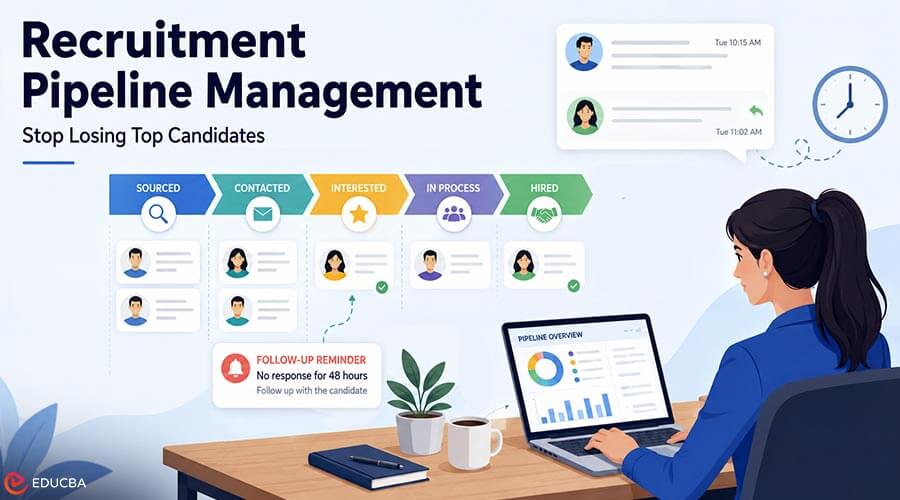
Imagine a recruiter discovering a strong candidate on Tuesday and reaching out with a message. Effective recruitment pipeline management helps ensure that the candidate’s response does not get lost among other conversations. The candidate responds within the hour, showing genuine interest. By Friday, however, no one has followed up. The reason is not that anyone stopped caring; Tuesday’s message got buried under three other conversations in the same shared inbox, and the system failed to flag that four days had passed without a response.
This scenario happens frequently at small recruiting agencies and lean internal talent teams, and it has little to do with sourcing skill. The candidate was found and was interested. The process lost them somewhere between “interested” and “hired,” even though this type of loss is entirely preventable.
The Actual Diagnosis: A Workflow Problem Wearing a Sourcing Costume
Small teams frequently misdiagnose candidate drop-off as a talent shortage or a sourcing shortfall. The instinct is to source harder, cast a wider net, buy access to a bigger database. But a detailed examination of the best recruitment platforms built specifically for small teams makes an uncomfortable but accurate point: most small agencies and lean TA functions are managing candidate pipelines through a shared inbox, a spreadsheet, and institutional memory. That setup works fine for two or three open roles handled by one person. It collapses the moment a team is juggling ten roles across multiple recruiters simultaneously.
The consequence isn’t abstract or theoretical. It shows up as candidates who applied, engaged, and then never heard back. This is where recruitment pipeline management becomes critical, as teams need a clear way to track candidate activity and identify stalled conversations before they become lost opportunities.
What Breaks First, in Order
Effective recruitment pipeline management gives recruiters a shared view of candidate progress, follow-ups, and stalled conversations, rather than relying on individual inboxes and memory.
- The inbox becomes the pipeline: Once candidate conversations live primarily in email threads rather than in a structured system, there is no reliable way to see at a glance who’s been waiting for a reply for three days and who was contacted yesterday.
- Status lives in someone’s head, not in a shared view: When only one recruiter knows that a candidate is “probably interested but waiting to hear about counteroffer,” that knowledge disappears the moment that recruiter is out sick or juggling five other conversations.
- Follow-up depends on memory instead of a system: Even well-intentioned recruiters forget. A structured reminder that fires automatically after 48 hours of silence catches what a busy person’s memory eventually misses.
- Nobody notices the pattern until it is a trend: A single lost candidate feels like bad luck. Ten lost candidates over a quarter, all following the same “went quiet after initial interest” pattern, is a process failure that compounds every month it goes unaddressed.
Recruitment Pipeline Management: A Practical Fix, Not a Bigger Database
The instinct to solve this by sourcing more aggressively misses the actual source of the leak. Four concrete changes can strengthen recruitment pipeline management and address the root cause:
- Move every candidate conversation into one centralized system: Whether that’s a proper ATS or even a well-structured shared tool, rather than letting email, LinkedIn messages, and application data live in three disconnected places.
- Set a hard, enforced response-time standard: 24 to 48 hours from first candidate contact, with the system flagging anything approaching that window rather than relying on a recruiter to remember.
- Visualize pipeline stage, not inbox folder: A recruiter should be able to see, at a glance, every candidate who’s gone quiet for longer than the agreed-upon threshold, without manually scrolling through email history.
- Automate the reminder, not the relationship: The system should nudge a recruiter to send a genuine, personal follow-up. It shouldn’t replace that follow-up with a generic auto-reply, which candidates recognize instantly and respond to accordingly.
Why This Connects Directly Back to Sourcing Strategy?
There is a broader principle here that extends well beyond inbox management. A parallel discussion of why modern talent acquisition demands contact intelligence approaches the same underlying challenge from the opposite direction: reaching passive candidates in the first place requires real investment in verified contact discovery and thoughtful outreach.
Put both pieces together, and the full picture becomes clear. Sourcing and pipeline management aren’t two separate problems competing for the same limited attention and budget. They are two halves of one process. Solving one while ignoring the other still results in the loss of candidates at different stages of the funnel. A team may excel at finding passive candidates but lose them through poor follow-up. A team with strong pipeline management but weak sourcing may lack qualified candidates.
What Small Teams Get Wrong About Scaling?
The common assumption is that better tools and bigger budgets are what separate agencies that scale successfully from those that plateau. In practice, the agencies that scale smoothly are disproportionately those that fixed their internal workflow discipline and recruitment pipeline management before scaling sourcing volume. Adding more candidates into a broken follow-up process doesn’t produce more hires. It produces more lost candidates, just faster, with less visibility into exactly where they’re disappearing.
Final Thoughts
Small recruiting teams rarely lose strong candidates because they lack sourcing skills, effort, or genuine care for the people they engage with. More often, candidates slip away because a messy, memory-dependent inbox provides little urgency or visibility into stalled conversations. The solution is not simply to invest in more sourcing tools. Strong recruitment pipeline management gives teams the structure and visibility they need to keep follow-ups on track and prevent genuinely interested candidates from being lost during an unnoticed three-day gap.
Recommended Articles
We hope this guide on recruitment pipeline management helps you improve candidate follow-ups, streamline workflows, and reduce candidate drop-off. Explore these recommended articles for additional insights and strategies to strengthen your recruitment and talent acquisition processes.

