
Updated August 5, 2026
What is AI Hallucination?
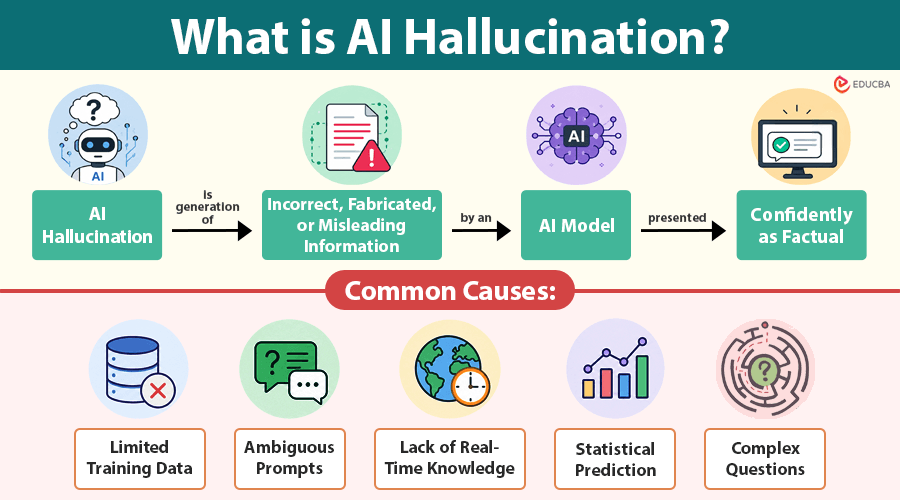
AI hallucination is the generation of incorrect, fabricated, or misleading information by an AI model, presented confidently as factual.
Instead of admitting uncertainty, an AI may invent facts, references, statistics, names, quotes, or explanations that appear believable but are inaccurate. Hallucinations can occur in large language models (LLMs), image-generation models, speech recognition systems, and other AI applications. Unlike software bugs, hallucinations arise from AI predicting outputs based on learned patterns rather than verifying facts.
Table of Contents:
- Meaning
- Importance
- Working
- Common Causes
- Types
- Examples
- Risks
- How to Detect AI Hallucinations?
- How to Prevent AI Hallucinations?
Key Takeaways:
- AI hallucinations generate convincing yet incorrect information because models predict patterns rather than verify factual accuracy.
- Clear prompts, trusted data sources, and human review consistently reduce hallucinations and improve AI reliability.
- Hallucinations can affect healthcare, finance, legal, education, and business decisions by introducing inaccurate AI-generated information.
- Regular testing, fine-tuning, and response validation help build safer, more accurate, and trustworthy AI systems overall.
Why is AI Hallucination Important?
As organizations rely on AI for customer service, healthcare, education, finance, legal research, and software development, inaccurate responses can have serious consequences.
AI hallucinations matter because they can:
1. Spread Misinformation
AI hallucinations generate false information that users may mistakenly accept as accurate, leading to widespread misinformation.
2. Reduce Customer Trust
Incorrect AI responses reduce user confidence, making customers less likely to trust AI-powered products and services.
3. Causes Poor Business Decisions
Businesses relying on inaccurate AI outputs may make flawed decisions that impact operations, finances, and strategy.
4. Produces Inaccurate Reports
Hallucinated facts or figures can create misleading reports, significantly reducing data accuracy and decision-making reliability.
5. Creates Compliance Risks
False AI-generated information may violate industry regulations, increasing legal, financial, and reputational risks for organizations.
6. Affects Healthcare or Legal Advice
Hallucinated medical or legal information may result in unsafe recommendations and serious real-world consequences for users.
How Does AI Hallucination Work?
Modern AI models do not “know” facts the way humans do. Instead, they predict most likely sequence of words, images, or outputs based on patterns learned during training.
A typical process looks like this:
1. User Provides a Prompt
The user asks a question or requests information.
2. AI Predicts the Response
The model generates content by estimating the most probable next words based on its training data.
3. Missing or Unclear Information
If the model lacks sufficient information or the prompt is ambiguous, it may generate incorrect details instead of expressing uncertainty.
4. Confident Presentation
The AI often presents fabricated information in a confident tone, making it difficult for users to identify inaccuracies.
Common Causes of AI Hallucinations
Several causes contribute to AI hallucinations.
1. Limited Training Data
When training data lacks sufficient information, AI confidently generates inaccurate or fabricated responses to fill knowledge gaps.
2. Ambiguous Prompts
Vague or unclear prompts force AI to make assumptions, increasing the chances of inaccurate or misleading responses.
3. Lack of Real-Time Knowledge
Without access to updated information, AI may provide outdated answers or miss recent developments and important changes.
4. Statistical Prediction
AI predicts likely words based on patterns rather than verifying facts, sometimes confidently producing incorrect but convincing information.
5. Complex Questions
Questions requiring advanced reasoning or multiple steps increase the likelihood of inaccurate, inconsistent, or incomplete AI responses.
Types of AI Hallucinations
AI hallucinations appear in several forms.
1. Factual Hallucinations
AI can generate incorrect facts, dates, statistics, names, or historical events and confidently present them as accurate information.
2. Citation Hallucinations
The model invents research papers, authors, journals, references, or sources that appear credible but never actually existed.
3. Logical Hallucinations
AI produces flawed reasoning or conclusions that do not logically follow from available facts or provided context.
4. Contextual Hallucinations
The model misunderstands user intent and generates responses unrelated or only partially relevant to the original request.
5. Mathematical Hallucinations
AI performs incorrect calculations, misinterprets formulas, or generates inaccurate numerical results despite sounding mathematically convincing overall.
6. Code Hallucinations
AI generates nonexistent functions, APIs, libraries, or programming syntax that fails or behaves differently than expected.
7. Image Hallucinations
Image-generation models create unrealistic objects, distorted features, or unwanted details not included in the original prompt.
Examples of AI Hallucinations
AI hallucinations can occur across different industries.
1. Customer Support
A chatbot provides a refund policy or warranty information that the company has never officially offered.
2. Healthcare
An AI assistant recommends treatments, medications, or diagnoses that are unsupported by recognized medical guidelines or evidence.
3. Legal Research
An AI cites fictional court cases, legal precedents, or laws that do not exist.
4. Software Development
An AI coding assistant suggests nonexistent programming functions, libraries, or APIs that fail during implementation or testing.
5. Education
A study assistant provides incorrect historical facts, scientific explanations, or academic references while sounding completely accurate.
6. Finance
An AI can generate inaccurate financial ratios, stock information, forecasts, or market insights that significantly mislead decision-makers.
7. Content Writing
A writing assistant invents statistics, quotations, references, or sources without verifying their authenticity or factual accuracy.
Risks of AI Hallucinations
Organizations should understand the potential risks of hallucinations.
1. Misinformation
Users may unknowingly trust false AI-generated information, leading to confusion, poor decisions, and the spread of inaccuracies.
2. Business Losses
Incorrect AI outputs can result in costly operational mistakes, financial losses, and ineffective business strategies or planning.
3. Compliance Issues
Inaccurate AI-generated information may violate regulations, exposing organizations to legal penalties, audits, and compliance-related risks.
4. Customer Dissatisfaction
Incorrect or misleading responses frustrate customers, reducing satisfaction, loyalty, and confidence in AI-powered products and services.
5. Brand Reputation
Frequent AI hallucinations can damage organizational credibility, weaken customer trust, and significantly harm long-term brand reputation.
6. Security Risks
AI may generate incorrect security advice or configurations, increasing vulnerabilities and exposing systems to potential cyber threats.
7. Reduced Productivity
Employees spend additional time verifying AI-generated content, reducing efficiency and delaying important business tasks and decisions.
How to Detect AI Hallucinations?
Organizations should verify AI outputs before relying on them.
1. Fact Checking
Compare AI-generated responses with trusted, authoritative sources to accurately identify incorrect facts, misleading claims, or fabricated information.
2. Human Review
Subject matter experts should review AI-generated content before using it for critical decisions or public-facing communications regularly.
3. Cross-Verification
Confirm AI responses by consulting multiple reliable systems, databases, or independent references to ensure information accuracy consistently.
4. Source Validation
Verify that cited articles, books, journals, websites, and references genuinely exist and support the generated information correctly.
5. Confidence Monitoring
Identify responses presented with high confidence despite lacking evidence, citations, or sufficient factual support for verification purposes.
6. Automated Testing
Regularly test AI models using benchmark datasets and quality assurance methods to identify hallucinations and performance issues.
How to Prevent AI Hallucinations?
Although hallucinations cannot always be eliminated, they can be significantly reduced.
1. Use Better Prompts
Provide clear, specific, and detailed prompts that reduce ambiguity and help AI consistently generate more accurate, relevant responses.
2. Retrieval-Augmented Generation
Connect AI to trusted knowledge sources so it retrieves verified information before generating responses, significantly reducing factual inaccuracies.
3. Human Oversight
Have experts review AI-generated content before publishing or using it for important business, legal, medical, or financial decisions.
4. Regular Model Evaluation
Continuously test AI models using real-world scenarios to identify weaknesses, measure accuracy, and improve overall performance regularly.
5. Fine-Tuning
Train AI models on high-quality, domain-specific datasets to effectively improve accuracy, relevance, and reliability for specialized tasks.
6. Response Validation
Implement automated systems that verify facts, calculations, references, and outputs before presenting responses to users or stakeholders.
7. User Feedback
Encourage users to report incorrect responses to help improve AI models, safety mechanisms, and overall response accuracy over time.
Final Thoughts
AI hallucination is a major challenge in artificial intelligence, causing models to generate incorrect yet convincing information. Organizations can reduce risks through clear prompts, trusted knowledge sources, human oversight, and regular testing. Combining AI with careful verification helps ensure accurate, reliable, safe, and trustworthy outcomes across industries.
Frequently Asked Questions (FAQs)
Q1. Can AI hallucinations be completely eliminated?
Answer: No. They cannot currently be removed entirely, but careful prompting, retrieval systems, human review, and continuous testing can greatly reduce their frequency and impact.
Q2. Which AI systems can hallucinate?
Answer: Large language models, chatbots, coding assistants, image generators, speech recognition systems, and other generative AI applications can all produce hallucinations under certain conditions.
Q3. Is AI hallucination dangerous?
Answer: It can be. In fields such as healthcare, finance, law, cybersecurity, and customer support, inaccurate AI outputs may lead to poor decisions, financial losses, compliance issues, or safety risks if left unchecked.
Q4. Why do AI hallucinations happen?
Answer: AI hallucinations occur because AI predicts the most likely output based on patterns in its training data rather than verifying facts. They are more likely when prompts are ambiguous, when information is missing, or when the model lacks up-to-date knowledge.
Recommended Articles
We hope that this EDUCBA information on “AI Hallucination” was beneficial to you. You can view EDUCBA’s recommended articles for more information.


