
Updated August 4, 2026
What is AI Jailbreaking?
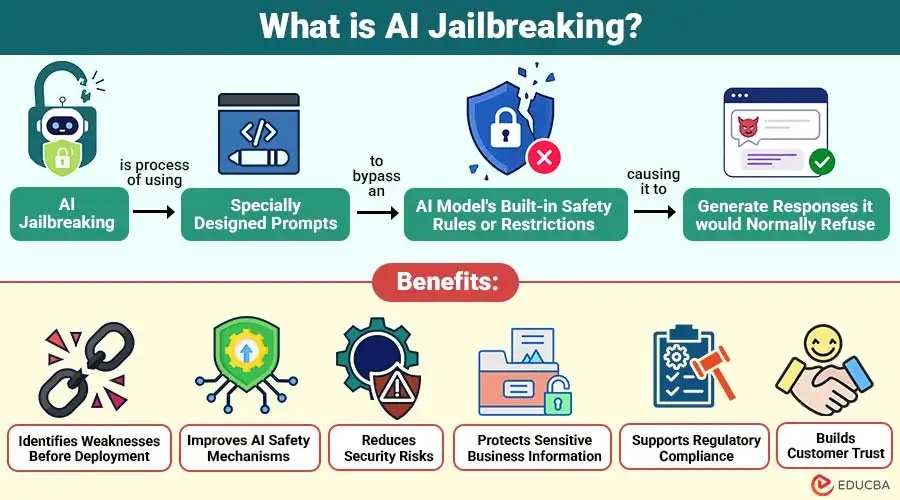
AI jailbreaking is the process of using specially designed prompts to bypass an AI model’s built-in safety rules or restrictions, causing it to generate responses it would normally refuse.
Unlike traditional hacking, it manipulates the AI through language rather than software vulnerabilities. The goal may be to obtain restricted information, generate harmful content, expose sensitive data, or test the AI’s security limits.
Table of Contents:
- Meaning
- Importance
- Working
- Common Techniques
- Risks
- Examples
- How to Prevent AI Jailbreaking?
- Benefits
- Tools
Key Takeaways:
- AI jailbreaking uses crafted prompts to bypass safety restrictions and influence AI behavior beyond intended limits.
- Continuous testing, prompt filtering, and monitoring significantly strengthen AI security against evolving jailbreaking techniques and threats.
- AI red teaming helps identify vulnerabilities early, improving model robustness, safety, reliability, and regulatory compliance consistently.
- Responsible AI governance and layered defenses effectively reduce misuse, protect sensitive information, and maintain user trust.
Why is AI Jailbreaking Important?
As AI systems are integrated into customer service, healthcare, finance, education, and software development, protecting them from misuse becomes increasingly important.
AI jailbreaking matters because it can:
1. Generate Unsafe or Harmful Responses
Jailbreaking can make AI produce dangerous, offensive, misleading, or unethical content that harms users and organizations.
2. Expose Confidential System Instructions
Attackers may reveal hidden prompts, internal rules, or sensitive information intended to remain private and protected.
3. Increase Cybersecurity Risks
Compromised AI systems may successfully assist in phishing, malware creation, data theft, or other malicious cyber activities.
4. Reduce Trust in AI Applications
Unsafe AI behavior decreases user confidence, limiting adoption and significantly reducing overall satisfaction with AI-powered services.
5. Create Legal and Compliance Issues
Organizations may violate regulations, privacy laws, or industry standards when jailbroken AI produces prohibited outputs.
6. Damage an Organization’s Reputation
Public incidents involving jailbroken AI can significantly harm brand credibility, customer confidence, and long-term business relationships.
How Does AI Jailbreaking Work?
AI models include safety mechanisms designed to block harmful or restricted requests. AI jailbreaking attempts to bypass these safeguards using carefully crafted prompts or conversation techniques.
1. Identify AI Restrictions
The attacker identifies which requests the AI refuses and understands the model’s built-in safety limitations.
2. Design Special Prompts
They create carefully crafted prompts that disguise harmful requests as harmless, educational, or fictional scenarios for bypassing.
3. Manipulate the AI
Attackers use role-playing, indirect instructions, or multi-step conversations to influence the AI’s responses and behavior.
4. Bypass Safety Rules
Successful jailbreak prompts temporarily cause the AI to ignore, weaken, or circumvent some built-in safety protections.
5. Obtain Restricted Output
The attacker receives responses, information, or content that the AI would normally refuse to generate or disclose.
Common AI Jailbreaking Techniques
Below are some of the most common techniques used to test or attempt to bypass an AI model’s built-in safety restrictions.
1. Role-Playing Prompts
The AI is instructed to act as another character, expert, or fictional assistant that ignores normal restrictions.
2. Prompt Injection
Additional instructions are inserted to override previous instructions or change how the AI interprets the request.
3. Multi-Step Conversation
Instead of asking directly, the attacker gradually guides the AI toward a restricted topic through multiple harmless-looking questions.
4. Context Manipulation
The attacker creates a fictional scenario in which restricted information appears acceptable in the conversation.
5. Obfuscated Prompts
Requests are hidden through unusual wording, alternative spellings, or indirect phrasing to evade detection.
6. Translation-Based Prompts
Requests are expressed through multiple languages or translated wording in an attempt to change how the AI interprets them.
7. Encoding Tricks
Inputs may be represented in encoded or transformed formats to test whether safety systems still recognize the underlying request.
Risks of AI Jailbreaking
Below are some of the most common risks associated with AI jailbreaking that can affect security, privacy, and system reliability.
1. Security Risks
Attackers may attempt to misuse AI systems to generate unsafe outputs or assist with activities that violate intended safety policies.
2. Privacy Concerns
Improperly designed systems could risk exposing sensitive information if safeguards fail.
3. Data Leakage
Hidden prompts, internal instructions, or confidential business information may be unintentionally revealed.
4. Misinformation
Manipulated AI responses can generate inaccurate or misleading information.
5. Compliance Issues
Organizations may violate industry regulations if AI systems produce inappropriate or restricted content.
6. Reputation Damage
Unsafe AI behavior can erode customer trust and harm a company’s brand.
Examples of AI Jailbreaking Scenarios
Below are some common scenarios where attackers or users may attempt to bypass an AI system’s safety measures or intended behavior.
1. Customer Support Chatbots
Attackers may try to make the chatbot reveal internal system prompts or confidential company information.
2. AI Coding Assistants
Users might attempt to obtain responses outside the assistant’s intended scope or usage policies.
3. Educational AI
Students may attempt to bypass academic restrictions or misuse AI-generated content.
4. Enterprise AI Assistants
Employees or outsiders may try to access internal business knowledge beyond their authorized permissions.
How to Prevent AI Jailbreaking?
Preventing AI jailbreaking requires multiple security measures, continuous testing, and regular improvements to strengthen AI safety.
1. Strong Prompt Filtering
Detect and block malicious prompts attempting to bypass AI safety rules before they reach the language model.
2. AI Red Teaming
Regularly simulate adversarial attacks to identify vulnerabilities and strengthen AI defenses before real attackers exploit them effectively.
3. Input Validation
Analyze prompts for suspicious patterns, unusual formatting, or hidden instructions designed to manipulate AI model behavior safely.
4. Output Monitoring
Review AI-generated responses continuously to detect unsafe, harmful, or policy-violating content before users receive it consistently.
5. Regular Model Updates
Continuously update AI models with improved safeguards against newly discovered jailbreak techniques and emerging security threats.
6. Human Oversight
Maintain human review for sensitive outputs, ensuring high-risk decisions receive expert evaluation before deployment or user access.
7. Access Controls
Restrict access to administrative features, internal prompts, and sensitive enterprise information using strong authentication and permissions.
Benefits of Testing for AI Jailbreaking
Below are the key benefits of testing AI systems for jailbreaking to improve security, safety, reliability, and user trust.
1. Identifies Weaknesses Before Deployment
Finds vulnerabilities during testing, allowing organizations to fix security issues before AI systems become publicly accessible.
2. Improves AI Safety Mechanisms
Strengthens built-in safeguards, making AI models more resistant to prompt manipulation and jailbreak attempts over time.
3. Reduces Security Risks
Minimizes opportunities for attackers to successfully exploit AI systems for harmful, unauthorized, or malicious activities.
4. Protects Sensitive Business Information
Prevents the secure exposure of confidential prompts, internal instructions, proprietary data, and other valuable organizational information.
5. Supports Regulatory Compliance
Helps organizations meet AI governance, privacy, security, and industry compliance requirements through proactive risk management practices.
6. Builds Customer Trust
Demonstrates commitment to responsible AI, increasing user confidence in the system’s security, reliability, and safe operation.
Tools Used for AI Security Testing
Several tools help organizations evaluate AI security and robustness.
1. OpenAI Evals
Evaluates AI model performance, safety, and reliability using customizable benchmarks, automated tests, and structured evaluation frameworks.
2. Garak
Open-source security testing tool that probes AI models for vulnerabilities, prompt injection, and unsafe responses systematically.
3. Python Risk Identification Tool
Microsoft’s framework for automating AI security assessments through adversarial prompts, attack simulations, and risk identification.
4. Microsoft Counterfit
Automates adversarial testing for AI systems, helping identify vulnerabilities, robustness gaps, and potential security threats efficiently.
5. Promptfoo
Open-source framework for testing, evaluating, and comparing AI prompts, outputs, safety, and model performance consistently.
6. Lakera Guard
Detects prompt injection attacks, malicious inputs, and jailbreak attempts, strengthening AI application security and trustworthiness
Final Thoughts
AI jailbreaking is a major security challenge that involves bypassing AI safety controls through crafted prompts. Organizations can reduce risks through AI red teaming, prompt filtering, continuous monitoring, and regular security testing. Ongoing improvements and responsible AI governance help build safe, reliable, and trustworthy AI systems for real-world use.
Frequently Asked Questions (FAQs)
Q1. Can every AI model be jailbroken?
Answer: No. Some AI models are more resistant than others because they use stronger safety training, input filtering, and output monitoring. However, no AI system is completely immune to new attack techniques.
Q2. Who performs AI jailbreaking?
Answer: AI jailbreaking may be performed by security researchers, AI red teams, developers, or malicious actors. Ethical professionals use it to identify weaknesses, while attackers may attempt to misuse AI systems.
Q3. Does AI jailbreaking involve hacking into servers?
Answer: No. AI jailbreaking generally targets the AI model’s behavior through carefully crafted inputs rather than exploiting operating systems, networks, or software vulnerabilities.
Q4. Which industries are most affected by AI jailbreaking?
Answer: Industries using AI for sensitive tasks, such as healthcare, finance, government, cybersecurity, legal services, education, and customer support, are typically at higher risk because they process valuable information.
Recommended Articles
We hope that this EDUCBA information on “AI Jailbreaking” was beneficial to you. You can view EDUCBA’s recommended articles for more information.


