


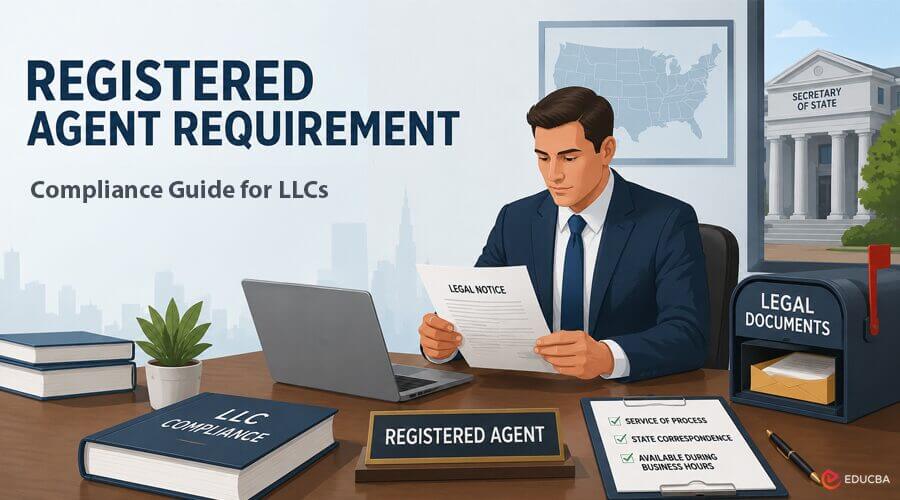
Every LLC in the United States must appoint a registered agent in every state where it is registered to do business. So if you are asking, do we need a registered agent for my LLC, the short answer is that the law does not give you a choice about having one. The real decision is who should fill the role: you, someone you know, or a professional service. This guide explains the registered agent requirement, the responsibilities of a registered agent, when acting as your own agent makes sense, and why many business owners, particularly founders managing an LLC from outside the United States, choose professional services.
What Does a Registered Agent Do?
A registered agent is the person or company officially designated to receive legal and government correspondence for your LLC. The company lists its name and address in the public record when it forms.
In practice, the role covers three things:
- Service of process: If your LLC is sued, the lawsuit papers are delivered to the registered agent. Missing this delivery can mean a default judgment against the company before you even know a case exists.
- State correspondence: Annual report reminders, tax notices, and compliance letters from the Secretary of State are sent to the agent’s address.
- Availability: The agent must be physically present at a street address in the state (not a P.O. box) during normal business hours, year-round.
Can an LLC Owner Serve as the Registered Agent?
Most states allow an owner to serve as their own registered agent, provided they are an adult with a physical street address in the state of formation. Whether you should is a different question.
The comparison below shows where each option fits:
| Consideration | Acting as Your Own Agent | Professional Registered Agent |
| Cost | Free | Roughly $50 to $300 per year |
| Privacy | Your home address becomes public record | The agent’s address appears instead |
| Availability | You must be reachable at that address during business hours | Staffed office covers every business day |
| Out-of-state or overseas owners | Not possible without an in-state address | Standard practice |
| Being served with a lawsuit | Papers may be handed to you in front of clients or family | Handled discreetly at the agent’s office |
For a founder who lives in the formation state, works predictable hours at a fixed location, and does not mind the address disclosure, self-service is workable. The requirement becomes a genuine obstacle in three situations: you value privacy, you travel often, or you do not live in the state at all.
What Happens If an LLC Does Not Meet the Registered Agent Requirement?
States enforce this requirement seriously.
Consequences escalate roughly in this order:
- The state can refuse to process filings until an agent is appointed.
- The LLC falls out of good standing, which blocks certificates lenders and partners often request.
- Continued non-compliance can lead to administrative dissolution, meaning the state shuts the company down.
- Worst of all, a lawsuit served to a missing agent can proceed without your knowledge.
Most states allow businesses to reinstate a dissolved LLC, but the process requires filing fees and time. The gap period can also raise questions about the company’s liability protection.
How Non-US Founders Handle the Registered Agent Requirement?
For international founders, the answer is clear. A non-resident who forms a US LLC, commonly in a state like Wyoming, has no US street address to offer, so a professional registered agent for a US LLC is effectively part of the formation itself, not an optional add-on. Pricing in this segment typically bundles the pieces that a non-resident cannot supply on their own.
CORPBOLT, a US business formation service focused on non-US founders, includes the registered agent and a US business address with formation from $349 per year, with an EIN-included package at $599 per year. Comparable bundles from other providers have similar pricing, providing a useful benchmark when a quote lists each item at full price.
Final Thoughts
The registered agent requirement applies universally, but meeting it correctly costs far less than dealing with compliance issues later. Owners should choose a registered agent based on their location, privacy needs, and the ability to remain reliably available at a physical address during business hours.
Frequently Asked Questions (FAQs)
Q1. Can an LLC Appoint Itself as the Registered Agent?
Answer: No. The agent must be a distinct person or a company authorized to do business in the state. An LLC cannot name itself.
Q2. Can a Registered Agent Be Changed Later?
Answer: Yes. Every state has a change-of-agent filing, usually costing between $0 and $50. The change takes effect once the state processes it.
Q3. Does a single-member LLC still need a registered agent?
Answer: Yes. The requirement applies to every LLC regardless of size, revenue, or whether it has employees.
Q4. Is a registered agent the same as a virtual address?
Answer: No. A registered agent receives legal and state mail. A virtual business address handles general correspondence. Many non-resident owners end up needing both, which is why bundled formation packages include both.
Recommended Articles
We hope this guide has provided clarity on the registered agent requirement and its importance for every LLC. Browse these recommended articles to learn more about business registration, compliance, and essential legal responsibilities.


