
Updated August 4, 2026
What is Adversarial Testing?
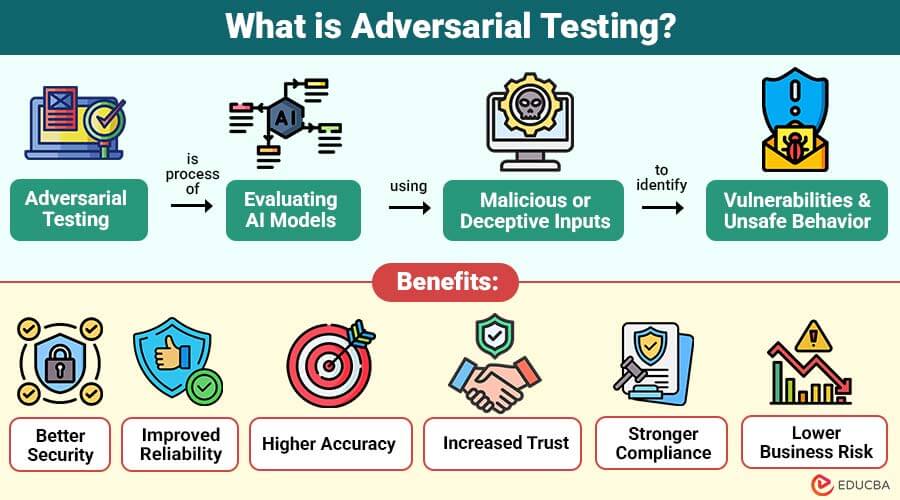
Adversarial testing is the process of evaluating AI models using malicious or deceptive inputs to identify vulnerabilities and unsafe behavior.
Unlike traditional software testing, which verifies whether applications work correctly under expected conditions, adversarial testing assumes that someone is actively trying to break or manipulate the AI system.
The primary objective is to discover vulnerabilities before cybercriminals, malicious users, or competitors exploit them.
Examples include:
- Modifying an image so an AI misclassifies it.
- Using prompt injection attacks against chatbots.
- Supplying misleading or confusing user inputs.
- Testing harmful content generation.
- Attempting to bypass AI safety mechanisms.
- Evaluating resistance to data poisoning attacks.
The findings help developers strengthen AI models through retraining, improved security controls, better filtering, and stronger validation techniques.
Table of Contents:
Key Takeaways:
- Adversarial testing identifies AI vulnerabilities using malicious inputs before attackers exploit weaknesses in real-world deployments.
- Regular testing consistently improves AI security, reliability, fairness, privacy, and resilience against evolving adversarial attack techniques.
- Organizations effectively use adversarial testing across finance, healthcare, cybersecurity, autonomous vehicles, and generative AI applications.
- Continuous model improvements, retraining, and security updates ensure AI remains robust against emerging adversarial threats.
Why is Adversarial Testing Important?
Modern AI systems often operate in security-sensitive environments where incorrect decisions can have serious consequences. Adversarial testing helps organizations identify hidden weaknesses before deployment.
Some major reasons include:
1. Improves AI Security
Testing against malicious attacks helps identify vulnerabilities that attackers could exploit to manipulate AI outputs.
2. Increases Model Reliability
It ensures that AI continues to produce accurate results even when handling unexpected or unusual inputs.
3. Prevents Safety Risks
AI systems used in healthcare, finance, transportation, and autonomous systems require safe operation under all conditions.
4. Detects Bias and Fairness Issues
Adversarial testing can reveal hidden biases that may affect specific users or demographic groups.
5. Protects Sensitive Information
Testing helps identify situations where AI might unintentionally reveal confidential or private data.
6. Builds User Trust
Organizations that thoroughly test AI systems demonstrate commitment to delivering secure and reliable solutions.
How Does Adversarial Testing Work?
Adversarial testing follows a structured process to identify and address weaknesses in AI systems.
Step 1: Define Testing Objectives
Teams determine what needs to be tested, such as security, fairness, privacy, robustness, or safety.
Step 2: Identify Potential Threats
Possible attack scenarios are identified based on the AI application’s purpose and deployment environment.
Step 3: Create Adversarial Inputs
Specially crafted inputs are designed to confuse or manipulate the AI model.
Examples include:
- Altered images
- Misleading prompts
- Noisy data
- Fake user inputs
- Poisoned datasets
Step 4: Execute Attack Scenarios
Adversarial inputs are supplied to the AI system while its behavior is monitored.
Step 5: Analyze Model Responses
Testers examine whether the AI generated incorrect, harmful, biased, or unsafe outputs.
Step 6: Improve the Model
Developers fix identified weaknesses by retraining, improving validation, strengthening safety filters, or updating security mechanisms.
Step 7: Repeat Testing
Adversarial testing is performed regularly because new attack techniques continuously emerge.
Types of Adversarial Attacks Tested
Adversarial testing evaluates AI against different types of attacks.
1. Adversarial Examples
Adversarial examples use subtle input modifications that mislead AI models into producing incorrect predictions without obvious visible changes.
2. Prompt Injection Attacks
Prompt injection attacks manipulate AI instructions through crafted inputs, forcing models to ignore safeguards and generate unintended responses.
3. Data Poisoning
Data poisoning inserts malicious or incorrect training data to corrupt model learning and reduce future prediction accuracy consistently.
4. Model Evasion
Model evasion creates carefully modified inputs that bypass AI detection systems while appearing legitimate during normal processing.
5. Model Extraction
Model extraction repeatedly queries AI systems to replicate their behavior or steal valuable underlying machine learning models entirely.
6. Privacy Attacks
Privacy attacks exploit AI models to reveal confidential training information or sensitive personal data through carefully designed queries.
Techniques Used in Adversarial Testing
Several techniques help evaluate AI robustness.
1. Black Box Testing
Evaluates AI by testing inputs and outputs without any knowledge of the model’s internal architecture or parameters.
2. White Box Testing
Evaluates AI using complete access to model architecture, parameters, algorithms, and internal decision-making processes for analysis.
3. Gray Box Testing
Evaluates AI with partial system knowledge, balancing realistic attack scenarios and deeper security assessment during testing activities.
4. Fuzz Testing
Generates random or unexpected inputs to effectively identify crashes, vulnerabilities, errors, or abnormal AI system behavior.
5. Red Teaming
Simulates realistic cyberattacks on AI systems to identify weaknesses in security, safety, privacy, and reliability before deployment.
6. Stress Testing
Tests AI under heavy workloads or extreme conditions to evaluate stability, scalability, reliability, and overall system performance.
Benefits of Adversarial Testing
Organizations gain several benefits from implementing adversarial testing.
1. Better Security
Identifies AI vulnerabilities early, helping organizations prevent attacks, strengthen defenses, and improve overall system security effectively.
2. Improved Reliability
Ensures AI systems perform consistently under unusual conditions, unexpected inputs, and real-world operational environments successfully.
3. Higher Accuracy
Reduces prediction errors from manipulated inputs, significantly improving model performance, precision, and decision-making quality.
4. Increased Trust
Builds confidence among users, customers, regulators, and stakeholders by demonstrating reliable, safe, and responsible AI behavior.
5. Stronger Compliance
Supports regulatory requirements by effectively validating AI safety, fairness, transparency, and adherence to responsible development standards.
6. Lower Business Risk
Minimizes financial losses, reputational damage, legal issues, and operational disruptions caused by AI failures or attacks.
Challenges of Adversarial Testing
Although valuable, adversarial testing presents several challenges.
1. Constantly Evolving Threats
New adversarial attack techniques emerge continuously, requiring frequent testing, updates, and adaptive AI security strategies to protect against them.
2. Complex AI Models
Large language models and deep learning systems require extensive evaluation due to their sophisticated architectures and behaviors.
3. High Resource Requirements
Creating realistic attack scenarios consistently demands specialized expertise, advanced tools, significant computing resources, and considerable testing time.
4. Measuring Robustness
No single metric accurately measures an AI model’s overall resistance against diverse adversarial attacks and evolving threats.
5. Maintaining Performance
Improving AI security must preserve model accuracy, efficiency, usability, and reliable performance across real-world applications and scenarios.
Applications of Adversarial Testing
Adversarial testing is valuable across many industries.
1. Financial Services
Evaluates fraud detection, credit scoring, and transaction monitoring systems against deceptive activities.
2. Cybersecurity
Strengthens malware and phishing detection, as well as threat intelligence platforms.
3. Autonomous Vehicles
Tests computer vision systems against altered road signs, poor weather conditions, and unexpected obstacles.
4. Generative AI
Validates chatbots and language models against prompt injection, jailbreak attempts, misinformation, and harmful content generation.
5. E-Commerce
Protects recommendation engines, search systems, and fraud detection algorithms from manipulation.
6. Government
Ensures secure AI deployment in public services, surveillance, and national security applications.
Popular Tools for Adversarial Testing
Several tools help security researchers and AI engineers perform adversarial testing.
1. IBM Adversarial Robustness Toolbox
Open-source library providing comprehensive adversarial attacks, defenses, and robustness evaluation for machine learning models and applications.
2. Microsoft Counterfeit
Automates adversarial testing by identifying AI vulnerabilities through attack simulations and comprehensive security assessment across machine learning.
3. TextAttack
Specialized framework for generating adversarial attacks against natural language processing models to evaluate robustness and reliability effectively.
4. Foolbox
Offers a variety of adversarial attack methods for assessing, benchmarking, and strengthening machine learning models’ resistance to manipulation efforts.
5. CleverHans
Open-source library supporting adversarial machine learning research through standardized attacks, defenses, and security evaluation techniques effectively.
6. Garak
Evaluates large language models for prompt injection, data leakage, unsafe outputs, and other AI security vulnerabilities comprehensively.
Final Thoughts
Adversarial testing is essential for developing secure, reliable, and trustworthy AI systems. By exposing models to malicious inputs and realistic attack scenarios, organizations can identify vulnerabilities before deployment. Continuous testing strengthens security, improves accuracy, protects privacy, supports regulatory compliance, and increases user confidence. As AI adoption grows, adversarial testing remains a critical practice for responsible and resilient AI development.
Frequently Asked Questions (FAQs)
Q1. How often should AI models undergo adversarial testing?
Answer: AI models should be tested regularly, especially after model updates, retraining, deployment changes, or when new attack techniques become publicly known.
Q2. Does adversarial testing eliminate all AI security risks?
Answer: No. It significantly reduces risks by identifying known vulnerabilities, but continuous monitoring and security updates remain necessary as new attack methods continually emerge.
Q3. Who typically performs adversarial testing?
Answer: It is commonly performed by AI security engineers, machine learning engineers, red teams, cybersecurity professionals, and specialized AI testing teams.
Q4. Is adversarial testing required for regulatory compliance?
Answer: While requirements vary by industry and region, many emerging AI governance frameworks recommend or encourage robustness and security testing as part of responsible AI practices.
Recommended Articles
We hope that this EDUCBA information on “Adversarial Testing” was beneficial to you. You can view EDUCBA’s recommended articles for more information.


