


Updated August 1, 2026
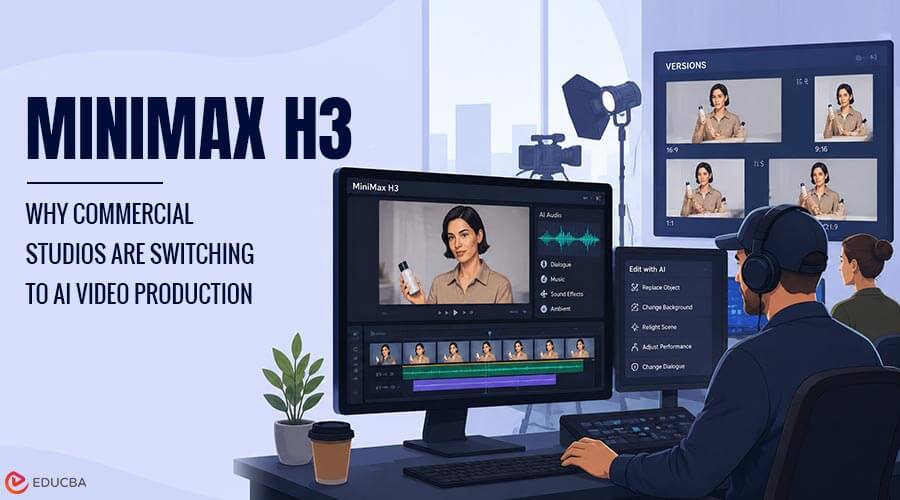
Production companies are not early adopters, and they are right not to be. A studio’s reputation is built on delivering a locked cut on a fixed date, and a tool that fails halfway through a job costs far more than it ever saved. So, when commercial studios begin shifting part of their workflow toward a generative video model like MiniMax H3, the interesting question is not whether the output looks good. Plenty of models produce good-looking output. None of these changes are only about visual quality. They are about making production workflows more efficient, scalable, and cost-effective.
The Audio Handoff Problem Has Disappeared
For the last two years, the standard AI-assisted commercial pipeline had a seam, and everyone knew where it was. Picture came out of one tool, silent. Voice came from a second. Sound design came from a library and an engineer. Then someone spent an afternoon fighting sync, and the results were tolerable rather than good mouths landing a frame or two off the line, footsteps arriving late, the whole thing reading as assembled rather than shot.
Minimax H3 generates native stereo audio in the same pass as the picture. Dialogue, room tone, foley, music, and the sync relationships between them are part of the same output rather than four deliverables stitched together afterward. For a studio, this shows up as headcount and calendar, not as a feature. A shot that arrives complete removes a handoff, and every handoff removed is a day of scheduling risk removed. The seam that used to give the work away is gone.
Revisions are The Actual Business
Here is the thing outsiders miss about commercial production: the creative work is maybe a third of the job. The rest is client changes. Swap the product for the new SKU. The legal team wants that logo out of the background. The client’s regional office wants the line rewritten. Can we see it without the second actor? Under a pure generation workflow, each of those requests meant regenerating the shot and losing everything already approved. The lighting shifts, the performance changes, the framing drifts, and you are re-selling work the client already signed off on. That is not a workflow; it is a gamble you take four times a week.
H3 edits locally. Replace or remove an object, change a background, relight a scene, adjust a performance, rewrite a line and have the mouth follow the new words while the rest of the frame, the other actors, and the camera stay where they were. It ranks first on the Artificial Analysis video editing leaderboard, ahead of Seedance 2.0. That ordering is the whole reason studios care: editing is the deliverable, generation is just the first draft. A change request that used to mean a full re-roll now means a targeted pass. That converts an unpredictable cost into a predictable one, which is the single thing production companies care most about.
Versioning Stopped Being a Budget Line
Modern briefs do not ask for a commercial. They ask for a 16:9 master, a 9:16 cut, a 1:1 social version, six seconds of it for pre-roll, and three regional language variants. Historically, that multiplication was priced separately because it genuinely cost separately. H3 covers 21:9 through 9:16 natively, up to 1440p at 24 FPS, so ratio variants are not crops of a master shot with the composition wrecked.
AI makes language variants stranger and more interesting by replacing dialogue while reforming the performance around the new words, and it carries over voice timbre from a reference, so localization stops being a reshoot or a dub. It becomes an edit. The same logic applies to e-commerce work, where a client wants the same product hero in 11 configurations. What used to be eleven jobs is closer to one job and ten passes.
The Economics Behind MiniMax H3 Adoption
None of the above matters if each attempt is expensive, because the quality of commercial work is a function of how many versions you can afford to throw away. Studios know this better than anyone the good cut is the eighth one.
H3’s per-second cost is substantially lower than comparable models, including Seedance 2.0. At small volumes, that is a rounding error. At agency volume, across variants, revisions, and versions that die in internal review before a client ever sees them, it is the difference between rationing iterations and simply running them. Cheap iteration is not a cost saving so much as a quality mechanism.
What Has Not Changed?
The adoption of MiniMax H3 does not mean that production teams are being replaced. Fifteen seconds is a shot. A human still assembles a 60-second brand film from many generations, deciding the order, the rhythm, and what to cut. Direction still decides whether a performance lands. Color and finishing still happen downstream. Whenever photographers need to capture a real product exactly as it exists, live action still wins, and clients in regulated categories will keep asking questions about provenance that no model answers.
What is changed is the tool’s position in the pipeline. Generative video used to sit at the pitch stage, previz, mood films, the thing you showed to win the job before making it properly. It is moving into the delivery stage for a specific band of work: product and UI demos, social cutdowns, game CG and character PVs, vertical drama, MV inserts, animated posters, e-commerce creative at volume. That is a narrower claim than “AI replaces production,” and a much more credible one. Studios are not switching because a model impressed them. They are switching because a category of billable work got cheaper to deliver at the same quality, and because the client-revision cycle the part that actually destroys margin, finally has a tool built for it.
Recommended Articles
We hope this comprehensive guide to MiniMax H3 helps you understand how AI-powered video production is transforming commercial workflows. Check out these recommended articles for more insights and strategies to explore the latest trends in artificial intelligence, content creation, and digital innovation.


