
Updated August 1, 2026
What is Contrastive Learning?
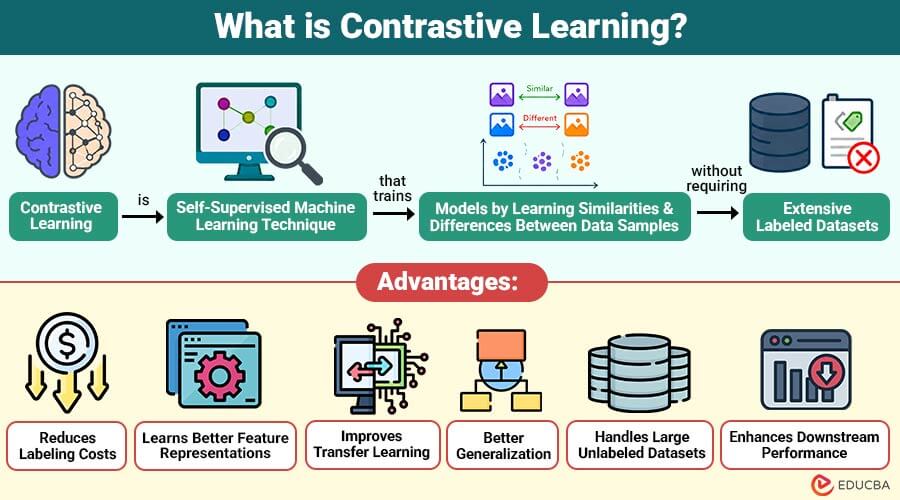
Contrastive learning is self-supervised machine learning technique that trains models by learning similarities and differences between data samples without requiring extensive labeled datasets.
Instead of directly predicting labels, the model learns by comparing pairs of examples. Similar samples (positive pairs) are brought closer together in the feature space, while dissimilar samples (negative pairs) are pushed farther apart. The model gradually creates useful representations that can be applied to a variety of downstream machine learning applications.
Because it reduces the dependence on manual data labeling, contrastive learning has become an essential technique in modern artificial intelligence research and real-world applications.
Table of Contents:
Key Takeaways:
- Contrastive learning builds meaningful representations by comparing similar and dissimilar samples without requiring extensive labeled datasets.
- It reduces labeling costs while improving model accuracy, robustness, and transfer learning across diverse AI applications.
- Effective data augmentation, negative sampling, and contrastive loss are essential for successful representation learning performance.
- Contrastive learning powers computer vision, natural language processing, healthcare, recommendation systems, and autonomous driving solutions.
How Does Contrastive Learning Work?
The main objective of contrastive learning is to teach a model to distinguish similar from dissimilar examples. The process generally follows these steps:
1. Dataset Collection
A dataset is collected without labels, enabling models to learn meaningful patterns through self-supervised training.
2. Data Augmentation
Multiple augmented versions of the same sample are created to generate meaningful positive training pairs consistently.
3. Feature Extraction
The model extracts meaningful features from every sample, creating vector representations for similarity comparison during training.
4. Positive Pair Selection
Positive pairs are identified using related samples, encouraging the model to learn similar feature representations effectively.
5. Negative Pair Selection
Negative pairs are selected from unrelated samples, helping the model accurately distinguish different patterns and representations.
6. Contrastive Loss Calculation
A contrastive loss function measures similarity, rewarding close positive pairs while effectively separating unrelated negative pairs.
7. Model Optimization
Model parameters are updated via optimization, thereby improving learned representations and increasing feature discrimination across samples.
8. Downstream Task Usage
Learned embeddings are applied to downstream tasks, improving performance in classification, detection, clustering, and retrieval applications.
The model gradually learns representations in which similar data points are grouped, while unrelated samples remain separate.
Key Components of Contrastive Learning
The following components form the foundation of contrastive learning and enable effective representation learning.
1. Data Augmentation
Creates multiple sample variations while preserving meaning, improving model robustness and representation learning during training.
2. Positive Pairs
Represent related samples, encouraging the model to learn similar feature representations and meaningful relationships effectively.
3. Negative Pairs
Contain unrelated samples, helping the model separate different patterns and improve representation discrimination accuracy consistently.
4. Encoder Network
Converts input data into embeddings that capture meaningful features for similarity comparisons and downstream learning tasks.
5. Projection Head
Transforms embeddings into optimized representations, significantly improving contrastive training performance and overall feature learning quality.
6. Contrastive Loss Function
Measures representation similarity, minimizing positive distances while maximizing separation between unrelated negative sample embeddings.
Types of Contrastive Learning
The following are the main types of contrastive learning used in modern machine learning applications.
1. Supervised Contrastive Learning
Uses labeled data to create positive and negative pairs, improving feature learning through class-based relationships effectively.
2. Self-Supervised Contrastive Learning
Generates positive pairs using augmented samples, learning meaningful representations without requiring manually labeled training data.
3. Semi-Supervised Contrastive Learning
Combines limited labeled data with abundant unlabeled samples, enhancing representation quality and overall model performance efficiently.
4. Multi-Modal Contrastive Learning
Learns relationships across multiple data types, improving understanding between images, text, audio, and video representations.
Advantages of Contrastive Learning
Contrastive learning offers several advantages that improve model performance, efficiency, and scalability.
1. Reduces Labeling Costs
Eliminates extensive manual labeling, significantly reducing annotation time, effort, and overall dataset preparation costs.
2. Learns Better Feature Representations
Creates meaningful embeddings that effectively improve accuracy, robustness, and performance across various machine learning applications.
3. Improves Transfer Learning
Enables pretrained models to adapt quickly, requiring minimal labeled data for new downstream applications successfully.
4. Better Generalization
Learns robust representations, helping models perform accurately on unseen data across diverse real-world scenarios consistently.
5. Handles Large Unlabeled Datasets
Leverages abundant unlabeled data, making model training scalable, efficient, and practical for organizations worldwide effectively.
6. Enhances Downstream Performance
Boosts classification, detection, clustering, retrieval, and other machine learning tasks through stronger learned feature representations.
Challenges of Contrastive Learning
Despite its benefits, contrastive learning faces several challenges during model training and deployment.
1. Large Batch Size Requirements
Requires large training batches, providing sufficient negative samples for effective representation learning and model optimization performance.
2. Computational Cost
Demands substantial GPU, memory, and processing resources for efficient training of contrastive models on datasets.
3. Quality of Data Augmentation
Poor augmentation techniques degrade representation quality, significantly limiting the effectiveness of learning and overall model performance.
4. Negative Sample Selection
Choosing informative negative samples remains challenging, directly influencing the quality of the representation and the effectiveness of training throughout the learning process.
5. Hyperparameter Tuning
Requires careful optimization of the learning rate, temperature, batch size, and augmentation settings to achieve optimal performance.
6. Long Training Time
Training on massive unlabeled datasets often requires substantial computational time to achieve high-quality learned representations.
Applications of Contrastive Learning
The following applications demonstrate how contrastive learning solves real-world machine learning challenges.
1. Natural Language Processing
Enhances sentence embeddings, semantic search, text classification, document retrieval, and question answering by effectively leveraging meaningful representations.
2. Recommendation Systems
Learns user preferences effectively, delivering personalized recommendations for products, movies, music, and digital content accurately.
3. Healthcare
Supports disease detection, medical image analysis, patient similarity analysis, and clinical report understanding with improved accuracy.
4. Autonomous Vehicles
Enhances scene understanding, object recognition, sensor fusion, and road segmentation for safer autonomous driving systems effectively.
5. Cybersecurity
Strengthens malware, network anomaly, user behavior, and fraud detection through robust feature representations.
Popular Contrastive Learning Algorithms
Several algorithms have significantly advanced research in contrastive learning.
1. Simple Framework for Contrastive Learning of Visual Representations (SimCLR)
SimCLR uses strong data augmentation and large batch sizes to learn image representations without labels.
2. Momentum Contrast (MoCo)
MoCo maintains a dynamic memory queue, allowing efficient learning with smaller batch sizes.
3. Bootstrap Your Own Latent (BYOL)
BYOL learns meaningful representations without explicitly using negative samples, reducing some limitations of traditional contrastive methods.
4. Swapping Assignments Between Multiple Views (SwAV)
SwAV assigns clusters during training rather than relying solely on pairwise comparisons, thereby improving learning efficiency.
5. Contrastive Language-Image Pretraining (CLIP)
CLIP learns relationships between images and text, enabling zero-shot image classification and multimodal understanding.
Final Thoughts
Contrastive learning enables AI models to learn meaningful representations from unlabeled data by identifying similarities and differences between samples. It improves accuracy, reduces labeling costs, and supports applications in computer vision, natural language processing, healthcare, recommendation systems, cybersecurity, and autonomous driving, making it essential for modern AI development.
Frequently Asked Questions (FAQs)
Q1. Can contrastive learning be used with small datasets?
Answer: Yes. It can work with smaller datasets, but performance generally improves when more diverse data and effective augmentations are available.
Q2. Can contrastive learning be applied to time-series data?
Answer: Yes. It is increasingly used for time-series analysis, including sensor data, financial forecasting, and predictive maintenance applications.
Q3. What programming frameworks are commonly used for contrastive learning?
Answer: Popular frameworks include PyTorch, TensorFlow, JAX, and Hugging Face libraries for building and training contrastive learning models.
Q4. Is contrastive learning suitable for multimodal AI systems?
Answer: Yes. It is widely used to learn relationships between different data types, such as images and text, improving multimodal AI performance.
Recommended Articles
We hope that this EDUCBA information on “Contrastive Learning” was beneficial to you. You can view EDUCBA’s recommended articles for more information.


