
Updated August 26, 2026
What is a Data Lakehouse?
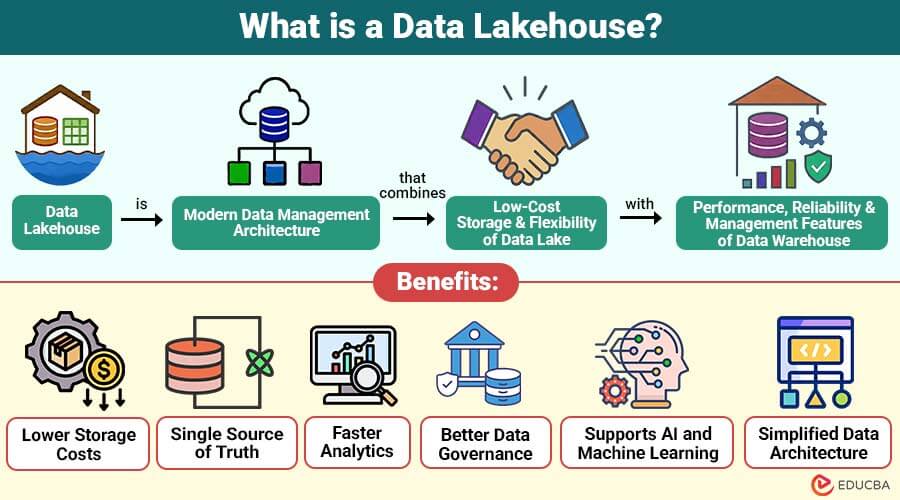
A data lakehouse is modern data management architecture that combines the low-cost storage and flexibility of a data lake with the performance, reliability, and management features of a data warehouse.
Unlike traditional systems that require separate platforms for storing raw data and performing analytics, a data lakehouse enables both workloads within a unified environment. This approach reduces data duplication, simplifies data management, and supports advanced analytics, machine learning, and real-time processing from a single source.
Table of Contents:
Key Takeaways:
- A data lakehouse efficiently combines scalable storage, reliable analytics, strong governance, and unified data management.
- It effectively reduces storage costs, eliminates data duplication, and simplifies modern enterprise data architecture.
- It seamlessly supports business intelligence, machine learning, artificial intelligence, and real-time analytics.
- It provides scalable, secure, and flexible data management for modern data-driven business decision-making.
Why is a Data Lakehouse Important?
Businesses are generating data faster than ever before. Maintaining separate systems for data lakes and data warehouses often leads to:
1. Data Duplication
Multiple systems store the same data, unnecessarily increasing storage usage, management overhead, and synchronization issues.
2. Higher Storage Costs
Maintaining separate data lakes and warehouses significantly increases infrastructure expenses, storage requirements, and overall operational costs.
3. Complex ETL Pipelines
Moving and transforming data between systems creates complex workflows, increasing maintenance, processing time, and the risk of errors.
4. Inconsistent Reporting
Different data versions across systems produce conflicting reports, reducing accuracy, trust, and the ability to make informed business decisions.
5. Slow Analytics
Data movement and processing delays reduce query performance, slowing business insights and real-time analytical decision-making processes.
6. Difficult Governance
Managing security, compliance, metadata, and access policies across multiple platforms becomes challenging and time-consuming for organizations.
How Does a Data Lakehouse Work?
A data lakehouse follows a structured process for storing, processing, and analyzing data.
1. Data Collection
Collects data from different sources such as business applications, websites, databases, IoT devices, APIs, cloud services, and enterprise systems, and brings all the data into one place.
2. Data Storage
Stores all types of data in one place at a lower cost while keeping the original data safe for future use.
3. Metadata Management
Keeps details about the data, such as where it is stored, what type of data it is, who owns it, and who can use it, making the data easy to find and use.
4. Data Processing
Cleans, checks, and arranges the data so it is correct, organized, and ready for reports, dashboards, business analysis, and AI.
5. Data Governance
Keeps data safe by controlling who can use it, checking data quality, tracking changes, and following company and legal rules.
6. Analytics and AI
Uses the data to create reports, build dashboards, find useful information, train AI models, and help businesses make better decisions.
Key Features of a Data Lakehouse
The following features make a data lakehouse powerful and efficient for modern data needs.
1. Unified Data Storage
Simplifies data management and access by storing all forms of data—structured, semi-structured, and unstructured—in one location.
2. ACID Transactions
Keeps data accurate and reliable, even when many users read or update data at the same time.
3. Schema Enforcement
Checks that new data follows the correct format before storing it, helping prevent errors and bad-quality data.
4. Metadata Layer
Stores information about the data, such as its location, format, owner, and history, making it easier to find and manage.
5. Data Versioning
Saves different versions of data so you can view old data, undo mistakes, or recover lost changes.
7. Open Data Formats
Supports common file formats like Parquet, ORC, Avro, JSON, and CSV, making it easy to use data with different tools and platforms.
Components of a Data Lakehouse
A typical data lakehouse architecture consists of several components.
Below are the main benefits of a data lakehouse for modern businesses.
1. Lower Storage Costs
Uses affordable cloud storage instead of expensive proprietary warehouses, significantly reducing overall infrastructure and long-term operational expenses.
2. Single Source of Truth
Stores all organizational data centrally, eliminating duplicates and ensuring consistent, accurate information across departments and applications.
3. Faster Analytics
Optimized storage, indexing, and processing improve query performance, enabling consistent, faster reporting and real-time business insights.
4. Better Data Governance
Provides robust security, auditing, data lineage, compliance, and access controls for reliable, trustworthy data management.
5. Supports AI and Machine Learning
Enables data scientists to directly access large datasets for faster model training, testing, deployment, and continuous improvement.
6. Simplified Data Architecture
Combines data lake and warehouse capabilities, reducing complexity and minimizing maintenance across multiple storage systems effectively.
Challenges of a Data Lakehouse
Although highly beneficial, implementing a lakehouse comes with certain challenges.
1. Initial Migration
Moving data from existing systems to a data lakehouse takes careful planning. The process must be tested properly to avoid data loss, reduce downtime, and ensure business operations continue without major interruptions.
2. Governance Complexity
As more data is added, it becomes increasingly difficult to control who has access to it. Organizations require clear rules, authorization, and security policies in order to protect data and adhere to legislation.
3. Skill Requirements
Building and managing a data lakehouse requires skilled professionals. Teams should understand cloud platforms, data engineering, distributed computing, and modern lakehouse technologies to use the system effectively.
4. Performance Optimization
When working with very large amounts of data, the system needs regular optimization. Tasks such as organizing data, improving storage, and tuning queries help maintain fast and reliable performance.
5. Cost Management
If data is stored inefficiently or processed unnecessarily, cloud costs can increase quickly. Proper storage management, optimized processing, and avoiding duplicate data help keep overall expenses under control.
Common Use Cases of a Data Lakehouse
Below are the major use cases where a data lakehouse provides valuable solutions.
Several technologies support lakehouse implementations.
Final Thoughts
A data lakehouse combines scalability of data lakes with the reliability of data warehouses, enabling unified storage, strong governance, faster analytics, AI support, lower costs, and simplified data management. It provides a flexible, scalable foundation for modern, data-driven business decision-making.
Frequently Asked Questions (FAQs)
Q1. Can a data lakehouse work with existing business applications?
Answer: Yes. Most lakehouse platforms integrate with ERP systems, CRM software, business intelligence tools, databases, cloud services, and third-party applications through connectors and APIs.
Q2. How does a data lakehouse improve collaboration?
Answer: By storing data in a centralized platform, different teams can access consistent datasets, reducing data silos and improving collaboration across departments.
Q3. Is cloud storage mandatory for a data lakehouse?
Answer: No. While most implementations use cloud object storage for scalability and cost efficiency, lakehouses can also be deployed in on-premises or hybrid environments.
Q4. Does a data lakehouse support real-time data processing?
Answer: Yes. Modern lakehouse architectures can ingest, process, and analyze streaming data, enabling real-time dashboards, monitoring, and event-driven applications.
Recommended Articles
We hope that this EDUCBA information on “Data Lakehouse” was beneficial to you. You can view EDUCBA’s recommended articles for more information.

