


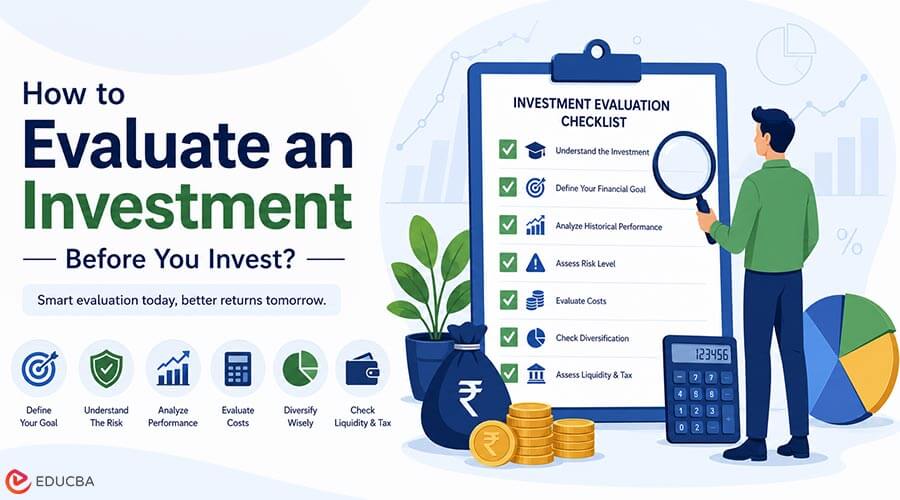
Investing has never been easier. A few taps on your smartphone are all it takes to invest in stocks, mutual funds, bonds, or other investment opportunities. However, knowing how to evaluate an investment before committing your money is what separates successful investors from impulsive ones.
Many investors are influenced by stories of people doubling their money or social media posts highlighting exceptional returns. Following trends without proper research often leads to poor financial decisions.
Whether you are investing ₹10,000 or ₹10 lakh, taking the time to evaluate an investment can help you make informed decisions and increase the likelihood of reaching your financial goals. Smart investors rely on research, analysis, and a structured evaluation process rather than luck.
In this guide, you’ll learn the key factors to consider before investing your hard-earned money.
Understand the Investment Before Investing
One of the biggest mistakes beginners make is investing in products they don’t fully understand.
Before investing, ask yourself:
- How does this investment generate returns?
- What are the potential risks?
- Who manages or controls the investment?
- What factors influence its value?
For example, if you are considering mutual funds, it is important to understand terms such as NAV, SIP, expense ratio, and asset allocation. If you come across unfamiliar financial abbreviations, understanding their full form makes it easier to grasp the concept in advance.
Knowledge reduces uncertainty, and informed investors are less likely to panic during market fluctuations.
Define Your Financial Goal
Every investment should have a clear purpose.
Ask yourself why you’re investing. Your goal may be to:
- Buy a house in 10 years
- Fund your child’s education
- Build retirement savings
- Generate passive income
- Grow long-term wealth
For example, someone saving ₹50 lakh over the next 15 years will need a different investment strategy than someone saving for a vacation next year.
When your investments align with your financial goals, making decisions becomes much easier.
Analyze Historical Performance Carefully
Although past performance does not guarantee future returns, it provides valuable insights into consistency.
When evaluating an investment, historical performance should be one of several factors you consider, rather than the sole deciding criterion.
Instead of looking only at one-year returns, review how the investment has performed over different market cycles.
Ask questions such as:
- Has it performed consistently over the past 5–10 years?
- How did it perform during market downturns?
- Has it outperformed similar investments?
One of the best ways to measure long-term growth is to use the CAGR (Compound Annual Growth Rate), which shows the average annual growth of an investment over a specific period.
For example:
- Initial Investment: ₹2,00,000
- Value After 8 Years: ₹4,40,000
Rather than simply focusing on the total gain, CAGR helps you compare multiple investment options more accurately.
Understand the Risk Before Looking at Returns
Higher returns usually come with higher risk.
Every investor should evaluate an investment based on both its potential returns and the level of risk involved.
Ask yourself:
- Can this investment lose value?
- How volatile is it?
- How long might recovery take after a market decline?
- Is your capital protected?
Government bonds generally offer lower risk and moderate returns, while equities may experience greater short-term volatility but often provide stronger long-term growth potential.
Understanding this balance allows you to make more informed investment decisions.
Evaluate an Investment by Checking Its Quality
Not every investment deserves your money.
Taking the time to evaluate an investment thoroughly helps you identify businesses with strong financial fundamentals and long-term growth potential.
If you are investing in a company, consider:
- Revenue growth
- Profitability
- Debt levels
- Cash flow
- Competitive advantage
- Management quality
For example, a company with consistent revenue growth, healthy profits, and manageable debt is generally a stronger long-term investment than one with unstable earnings and increasing debt.
Strong businesses often produce stronger investment results.
Evaluate the Costs Involved
Investment returns are important, but so are investment costs.
Common expenses include:
- Brokerage charges
- Expense ratios
- Fund management fees
- Exit loads
- Transaction charges
- Taxes
For example, two funds may generate the same returns, but if one has an expense ratio of 0.45% and the other charges 1.90%, the lower-cost fund can generate significantly higher wealth over the long term.
Always compare costs before investing.
Diversification Is Your Best Friend
Putting all your money into a single investment exposes you to unnecessary risk.
As you evaluate an investment, consider how it fits into your overall portfolio rather than assessing it in isolation.
A diversified portfolio may include:
- Equity investments
- Debt instruments
- Gold
- International funds
- Liquid funds
- Real Estate Investment Trusts (REITs)
For example, instead of investing ₹5,00,000 in a single company, you could allocate:
- ₹2,00,000 to diversified equity funds
- ₹1,25,000 to government securities
- ₹75,000 to gold
- ₹1,00,000 to international funds
Diversification does not eliminate risk, but it helps reduce the impact of poor-performing investments.
Assess Liquidity
Some investments allow immediate withdrawals, while others lock your money in for years.
Before investing, ask:
- Can I withdraw my money when needed?
- Are there penalties for early withdrawal?
- How quickly will I receive my funds?
Liquid investments are ideal for emergency savings, whereas long-term investments may be better suited for retirement planning.
Choose investments that match your financial needs.
Check Tax Efficiency
Two investments may generate identical returns but produce different after-tax profits.
Before investing, compare:
- Capital gains tax
- Dividend taxation
- Indexation benefits (where applicable)
- Tax-saving eligibility
Considering after-tax returns gives you a clearer picture of your actual earnings.
Beware of Unrealistic Promises
If an investment promises exceptionally high returns with little or no risk, proceed with caution.
Legitimate investments always involve some degree of uncertainty.
Be cautious of claims such as:
- Double your money in one year
- Guaranteed 30% monthly returns
- Zero-risk wealth creation
Successful investing rewards patience, not shortcuts.
Consider Your Investment Time Horizon
The length of time you plan to stay invested is an important factor in choosing the right investment.
Short-term investments require stability and liquidity, while long-term goals can tolerate greater market volatility in pursuit of potentially higher returns.
For example:
- Saving ₹3,00,000 for a vacation next year may require low-risk investments.
- Building a retirement corpus over 25 years can justify greater exposure to equities.
Matching your investments with your time horizon improves long-term financial outcomes.
Do not Let Emotions Drive Decisions.
Allowing fear or greed to influence your decisions can hurt your long-term investment success.
Instead of reacting to market headlines, base your decisions on:
- Research
- Financial goals
- Risk tolerance
- Long-term planning
Markets naturally rise and fall. Staying disciplined usually delivers better results than making emotional decisions.
Regularly Evaluate an Investment After You Invest
Investing is not a one-time activity.
Markets, personal goals, income, and economic conditions change over time.
Regularly evaluate an investment to make sure it continues to align with your financial goals.
Review your portfolio at least once or twice a year and ask:
- Is this investment still aligned with my goals?
- Has its risk profile changed?
- Is my portfolio still diversified?
- Should I rebalance my asset allocation?
Regular reviews help keep your investment strategy on track.
Final Thoughts
Investing successfully begins long before you click the “Buy” button. Learning how to evaluate an investment helps you understand the risks, returns, costs, and whether it aligns with your financial goals.
Rather than chasing market trends or unrealistic returns, focus on understanding the investment, analyzing long-term performance, assessing risk, comparing costs, and maintaining a diversified portfolio.
Investing is a long-term process that rewards consistency and patience. The more time you spend learning to evaluate an investment before investing, the more confident you’ll become in your decisions. Confidence built on knowledge is one of the most valuable assets any investor can have.
Recommended Article
We hope this guide on how to evaluate an investment helps you make informed financial decisions and invest with greater confidence. Explore these recommended articles for additional insights on investment strategies, risk management, portfolio diversification, and long-term wealth creation.


