
Updated July 31, 2026
What is GraphRAG?
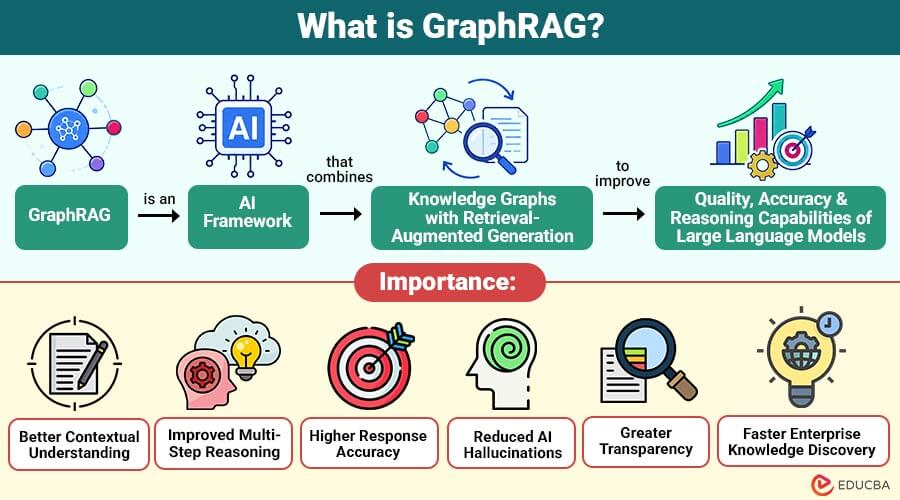
GraphRAG (Graph Retrieval-Augmented Generation) is an AI framework that combines knowledge graphs with retrieval-augmented generation to improve the quality, accuracy, and reasoning capabilities of large language models.
Instead of retrieving only text documents, GraphRAG retrieves interconnected information stored in graph structures. These graphs represent entities and their relationships, allowing AI models to understand context beyond simple keyword matching.
For example, if a user asks the following:
“Which suppliers are connected to customers affected by delayed shipments?”
Traditional RAG may retrieve several unrelated documents.
GraphRAG can follow relationships between:
- Customers
- Orders
- Suppliers
- Warehouses
- Shipping companies
This allows the AI to generate a more accurate and complete answer.
Table of Contents:
- Meaning
- Importance
- Working
- Key Components
- Benefits
- Applications
- Difference
- Challenges
- Technologies Used in GraphRAG
Key Takeaways:
- GraphRAG combines knowledge graphs with retrieval-augmented generation to consistently deliver accurate, context-aware, explainable AI responses.
- It improves reasoning by effectively connecting related entities across structured knowledge graphs and supporting documents.
- It reduces hallucinations through relationship-based retrieval, delivering trustworthy enterprise insights for complex business decisions.
- It enables scalable AI applications by combining graph databases, vector search, embeddings, and language models.
Why is GraphRAG Important?
Below are the key reasons why organizations are adopting GraphRAG for intelligent AI systems.
1. Better Contextual Understanding
GraphRAG connects related information through knowledge graphs, enabling AI to understand context and relationships more accurately across data.
2. Improved Multi-Step Reasoning
GraphRAG follows connected relationships between data points, enabling AI to solve complex multi-step reasoning tasks effectively.
3. Higher Response Accuracy
GraphRAG retrieves highly relevant, connected information, consistently producing more accurate, reliable, and context-aware responses for users.
4. Reduced AI Hallucinations
GraphRAG grounds responses in verified knowledge-graph connections, reducing hallucinations and minimizing unsupported or incorrect AI-generated information.
5. Greater Transparency
GraphRAG reveals how information is connected and retrieved, making AI responses easier to understand, verify, and trust.
6. Faster Enterprise Knowledge Discovery
GraphRAG quickly uncovers connected enterprise information, helping users discover relevant knowledge and insights more efficiently.
How Does GraphRAG Work?
GraphRAG follows several stages to effectively retrieve and generate information.
1. Data Collection
Information is gathered from various sources, including:
- Databases
- Documents
- PDFs
- Websites
- CRM systems
- ERP systems
- APIs
2. Knowledge Graph Creation
The collected information is converted into a knowledge graph where:
- Nodes represent entities
- Edges represent relationships
For example:
- Customer → Purchased → Product
- Product → Manufactured By → Supplier
- Supplier → Located In → Country
3. User Query Processing
When a user submits a question, the system identifies:
- Important entities
- Keywords
- Relationships
- Context
4. Graph Retrieval
Instead of searching only text, the AI traverses the knowledge graph to find related entities and connected information.
5. Context Generation
The retrieved graph information is combined with supporting documents to create rich contextual input for the language model.
6. Response Generation
The LLM generates an accurate answer using both:
- Retrieved documents
- Connected graph relationships
Key Components of GraphRAG
A GraphRAG system consists of several important key components.
1. Knowledge Graph
Represents entities and relationships in structured form, enabling connected, contextual understanding across diverse organizational data sources.
2. Graph Database
Stores and manages graph data efficiently, enabling fast relationship queries and scalable graph-based data retrieval operations.
3. Retriever
Finds relevant entities and relationships in the graph, accurately matching user queries to connected contextual information.
4. Large Language Model
Generates natural language responses using retrieved graph information for accurate, context-aware, and meaningful answer generation.
5. Embedding Model
Transforms text into vector representations, enabling semantic similarity searches across documents and graph-based knowledge sources.
6. Prompt Builder
Combines retrieved graph data and documents into optimized prompts before effectively sending them to language models.
Benefits of GraphRAG
Organizations adopt GraphRAG because it offers several benefits over traditional RAG systems.
1. Better Accuracy
GraphRAG retrieves connected information instead of isolated documents, producing more accurate, reliable, and context-aware AI responses consistently.
2. Improved Context
GraphRAG understands relationships between data, enabling richer, more meaningful, and contextually relevant responses for complex queries.
3. Better Reasoning
GraphRAG supports multi-step reasoning by connecting related information across knowledge graphs to enable accurate logical decision-making.
4. Lower Hallucination Risk
GraphRAG grounds responses in structured graph data, significantly reducing inaccurate, unsupported, or misleading AI-generated information.
5. Explainable AI
GraphRAG shows relationships behind responses, helping users understand, verify, and trust AI-generated conclusions with greater confidence.
6. Faster Information Discovery
GraphRAG quickly traverses connected knowledge graphs, enabling faster discovery of relevant enterprise information and valuable insights.
Applications of GraphRAG
Below are some of the most common applications where GraphRAG improves accuracy, reasoning, and decision-making.
1. Customer Support
GraphRAG enables AI assistants to retrieve related customer histories, product information, and support documents to facilitate faster issue resolution.
2. Healthcare
GraphRAG connects patients, diseases, symptoms, treatments, and medications, supporting informed clinical decisions through relationship-based medical knowledge.
3. Financial Services
GraphRAG helps banks detect fraud, analyze risks, monitor compliance, and understand customer relationships using connected financial data.
4. Legal Research
GraphRAG links cases, regulations, legal precedents, and contracts, enabling faster, more accurate legal research and document analysis.
5. Supply Chain Management
GraphRAG connects suppliers, manufacturers, warehouses, logistics providers, and customers to optimize operations and minimize supply disruptions effectively.
6. Knowledge Management
GraphRAG builds enterprise knowledge assistants that accurately answer complex internal questions using connected organizational information and relationships.
Difference Between GraphRAG and Traditional RAG
Below is a comparison highlighting how GraphRAG differs from traditional RAG systems.
| Feature | GraphRAG | Traditional RAG |
| Retrieval | Graph relationships + documents | Documents |
| Context Understanding | Excellent | Limited |
| Multi-step Reasoning | Advanced | Basic |
| Relationship Awareness | Yes | No |
| Explainability | High | Moderate |
| Complex Queries | Excellent | Limited |
| Hallucination Reduction | Better | Moderate |
| Enterprise Knowledge | Excellent | Moderate |
Challenges of GraphRAG
Although GraphRAG offers many benefits, implementing it can be challenging.
1. Building Knowledge Graphs
Creating accurate knowledge graphs requires significant effort, domain expertise, and high-quality, both structured and unstructured, organizational data sources.
2. Data Integration
Integrating data from multiple systems and formats is challenging because information often remains fragmented across organizations.
3. Graph Maintenance
Knowledge graphs require regular updates to accurately reflect changes in business information, relationships, and newly generated organizational data.
4. Performance
Large enterprise graphs with millions of nodes require optimized infrastructure to support efficient storage, querying, and AI-powered retrieval.
5. Higher Complexity
GraphRAG systems entail greater design, implementation, and maintenance complexity than traditional retrieval-augmented generation solutions.
6. Cost
Building graph databases, indexing data, and running advanced AI models significantly increase implementation, infrastructure, and operational expenses.
Technologies Used in GraphRAG
Several technologies work together to build GraphRAG systems.
1. Graph Databases
Store connected data as nodes and relationships to quickly find connections, understand relationships, and retrieve related information with context.
2. Vector Databases
Store vector data for smart search, helping quickly find similar content and relevant documents using AI.
3. Large Language Models
Generate human-like responses by understanding context, reasoning over retrieved knowledge, and producing accurate natural language answers.
4. Embedding Models
Convert text into numerical vectors to enable semantic understanding, similarity comparisons, and efficient information retrieval across datasets.
5. Orchestration Frameworks
Coordinate data retrieval, graph queries, LLM interactions, and workflows to build scalable, end-to-end GraphRAG applications efficiently.
Final Thoughts
GraphRAG enhances retrieval-augmented generation by combining knowledge graphs with large language models for accurate, context-rich, and explainable responses. Understanding relationships between entities improves reasoning, reduces hallucinations, strengthens enterprise knowledge discovery, and enables reliable, scalable AI solutions for modern business applications and intelligent decision-making.
Frequently Asked Questions (FAQs)
Q1. Can GraphRAG work with unstructured data?
Answer: Yes. GraphRAG can process unstructured sources such as documents, emails, PDFs, and web pages by extracting entities and relationships to build a knowledge graph.
Q2. Is GraphRAG suitable for small businesses?
Answer: Yes. Small businesses can use GraphRAG for internal knowledge management, customer support, and document search, although the implementation can be scaled according to business needs and budget.
Q3. How does GraphRAG improve search quality?
Answer: Instead of relying only on keyword matching, GraphRAG explores relationships between connected entities, enabling more relevant and comprehensive search results for complex queries.
Q4. Does GraphRAG replace vector search?
Answer: No. GraphRAG complements vector search by combining semantic similarity with graph-based relationship retrieval, providing richer context and more accurate responses.
Recommended Articles
We hope that this EDUCBA information on “GraphRAG” was beneficial to you. You can view EDUCBA’s recommended articles for more information.


