


Updated July 29, 2026
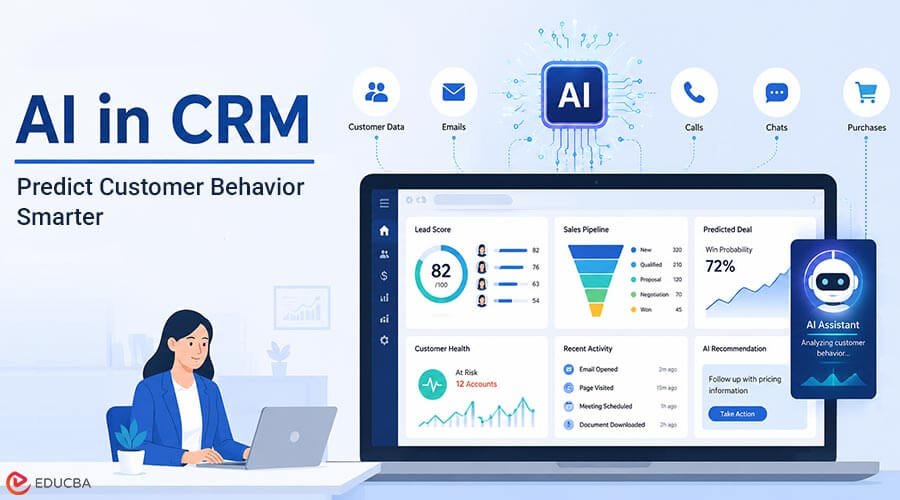
Your CRM used to be a place where sales reps logged calls and marketing teams tracked email opens. It was mostly a filing cabinet with a search bar. That has changed. AI in CRM now analyzes patterns across every customer interaction, predicts what someone’s likely to do next, and quietly handles a lot of the busywork that used to eat up a rep’s entire morning. It is not replacing the CRM. It is turning it into something that actually thinks alongside your team, rather than just storing what they type. This article explores how AI in CRM works, its key benefits, practical use cases, common implementation mistakes, and best practices for successful adoption.
What AI in CRM Actually Means?
AI in CRM uses machine learning and natural language processing to analyze customer data, predict behaviors such as churn and purchase likelihood, automate routine tasks like data entry and follow-ups, and recommend the next best action for sales, marketing, and support teams.
It is easy to think of this as one feature, but it is really a few different capabilities working together:
- Predictive scoring that ranks leads based on how likely they are to convert
- Sentiment analysis that reads tone in emails, calls, or chat messages
- Automated data entry that pulls details from conversations straight into CRM fields
- Next-best-action recommendations that suggest what a rep should do right now
- Churn prediction that flags accounts showing early warning signs before they cancel
None of this is science fiction anymore. It is already built into most major CRM platforms, and the more interesting shift right now is how these pieces are starting to work together rather than sitting in separate tools. Many modern CRM software platforms combine these AI capabilities into a single system to improve customer management and decision-making. Unified workspaces such as Lark stand out for a native CRM app that integrates AI customer analytics, team collaboration, and client record tracking without requiring disjointed third-party tools.
How AI Predicts What Customers Will Do Next?
This is the part that gets the most attention, and for good reason. Instead of a sales rep guessing whether a deal will close this quarter, AI models look at historical win and loss patterns, engagement signals, and behavioral data to generate a much more grounded forecast.
1. Predictive Lead Scoring
Rather than treating every lead the same, AI analyzes which combination of behaviors, like downloading a pricing page or opening three emails in a row, historically leads to a closed deal. Reps get a ranked list instead of a flat spreadsheet, so they know exactly who to call first.
2. Churn Prediction
This might be the single most valuable prediction a CRM can make. AI systems watch for the small signals that come before a customer leaves slower response times, a drop in product usage, a support ticket that never got a satisfying answer. Catching this early gives a customer success team a real chance to step in before the account is gone for good.
3. Deal Forecasting Without the Guesswork
Traditional pipeline forecasting relied heavily on how confident a rep felt about a deal, which is about as reliable as it sounds. Machine learning models instead look at real patterns across thousands of past deals to estimate which ones are actually likely to close and roughly when. One thing worth knowing is that forecasts without an explanation tend to lose trust quickly. Sales leaders want to know why a deal is scored the way it is, not just the number itself. This is pushing more CRM platforms toward showing the reasoning behind a prediction rather than a black-box score.
Where AI Removes the Busywork?
Predictions get the spotlight, but much of AI’s real value in CRM is far less flashy. It is removing hours of manual admin work that reps used to grind through every week.
1. Automated Data Capture
Instead of a rep manually typing notes after every call, AI can pull key details directly from a call transcript, email thread, or meeting summary and automatically populate the right CRM fields. Business cards such as KADO can capture contact data directly and keep CRM records more complete. This alone gives reps back a meaningful chunk of their week.
2. Smarter Follow-Ups
AI can draft follow-up emails that reflect what actually happened in a conversation, adjusting tone and content based on a prospect’s behavior and stated preferences, rather than using a single generic template for everyone.
3. Sentiment Analysis Across Every Channel
Modern CRM tools increasingly read not just what a customer says, but the tone behind it. A message that looks calm on the surface might carry frustration that a human rep would eventually catch, but AI can flag it immediately so nothing slips through.
Multi-Agent Systems: The Next Step Beyond Simple Automation
There is a meaningful shift happening beyond basic automation. Some CRM platforms are moving toward multi-agent systems, where separate AI agents handle sales, customer success, marketing, and even finance tasks, then coordinate with each other automatically.
Instead of a deal getting stuck because sales is waiting on legal, who is waiting on finance, these systems pass information between departments without a human having to chase it down. It is still early for most businesses, but this is the direction CRM is clearly heading.
Why Data Quality Still Matters More Than the AI Model?
AI is only as good as the data it is working with. If your customer records are messy, duplicated, or scattered across five disconnected systems, AI would not fix that. It will just make confident-sounding predictions based on bad information. High-quality customer data also strengthens other AI capabilities, including AI in fraud detection, where accurate data helps identify suspicious behaviors, reduce false positives, and protect both businesses and customers.
This is why more companies are focusing on connected data models rather than dumping everything into a single giant database. The goal is not a single master file. It is making sure the right data is available to the right team at the right moment, linked together through shared identifiers rather than forced into one messy pile.
Common Mistakes Businesses Make with AI in CRM
Organizations often make avoidable mistakes during AI implementation.
- Trusting predictions without understanding them: If a forecast says a deal has an 80% chance of closing, but nobody can explain why, reps tend to ignore it entirely. Look for tools that show their reasoning, not just a score.
- Skipping data cleanup before rolling out AI: Feeding messy, duplicate, or outdated records into a predictive model just scales the mess faster.
- Automating everything at once: Trying to roll out predictive scoring, automated follow-ups, and multi-agent workflows in the same quarter usually overwhelms the team and makes it hard to tell what is actually working.
- Removing the human touch entirely: Customers still notice when every interaction feels robotic. The businesses getting this right use AI to handle repetitive tasks so people can focus on the conversations that actually need a human.
- Ignoring privacy expectations: Customers increasingly want visibility into what data is being used and how, making strong AI Governance CRM platforms that let customers see and control their own data tend to build more trust, not less.
How to Start Using AI in Your CRM?
You do not need to overhaul your entire CRM system overnight. A practical rollout usually looks like this:
- Clean up your existing data first: Duplicate records and inconsistent fields will undercut any AI feature you add on top.
- Start with one use case: Rather than deploying every AI capability, begin with a high-impact feature, such as lead scoring or churn alerts.
- Build User Confidence: Allow employees to compare AI recommendations with actual business outcomes. This helps teams understand how AI supports decision-making.
- Expand gradually: Once users become comfortable, introduce additional features such as automation, sentiment analysis, or multi-agent coordination.
This slower approach tends to stick better than a full rollout that overwhelms the team and gets quietly ignored a month later.
Final Thoughts
AI in CRM is giving businesses something they never really had before: a clear, data-backed view of what customers are likely to do next, rather than relying on gut feeling and scattered spreadsheets. The companies seeing real results are not the ones chasing every new AI feature. They are the ones cleaning up their data, picking one solid use case to start with, and letting their team build trust in the predictions over time. Used well, AI does not turn a CRM into a robot running the relationship. It gives your team a sharper, earlier view of what is coming, so the human conversations that actually matter happen at the right moment.
Frequently Asked Questions (FAQs)
Q1. Will AI replace CRM admins or sales reps?
Answer: Not entirely. AI handles a lot of the repetitive admin work, like data entry and routine follow-ups, but reps still handle relationship-building, negotiation, and the judgment calls AI is not equipped to make.
Q2. Is AI in CRM only useful for large companies?
Answer: No. Cloud-based CRM tools have made AI features accessible to smaller businesses, often built directly into existing platforms without requiring a dedicated data science team.
Q3. How accurate are AI predictions in CRM, really?
Answer: It depends heavily on data quality. A CRM with clean, consistent records will produce noticeably more reliable predictions than one with scattered or duplicate data. This is why data cleanup matters more than most companies expect going in.
Recommended Articles
We hope this guide on AI in CRM helps you better understand how AI is transforming customer relationship management. Check out these recommended articles for more insights on CRM, AI, and business technology.


