
Updated July 23, 2026
What is Process Mining?
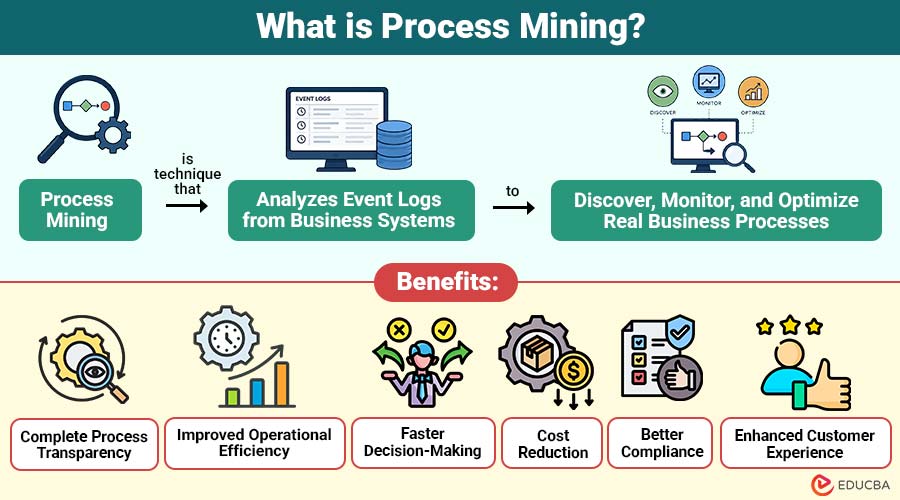
Process mining is technique that analyzes event logs from business systems to discover, monitor, and optimize real business processes. It reconstructs workflows based on actual operational data, enabling organizations to understand how work flows across departments, systems, and employees.
Unlike traditional process mapping, which depends on interviews or documents, process mining analyzes digital records created during daily business activities. It gives businesses accurate insights into how processes actually work. By comparing actual processes with planned workflows, it helps find differences, identify problems, and improve overall performance.
Organizations across industries use process mining to improve processes in finance, procurement, manufacturing, healthcare, customer service, logistics, insurance, and human resources.
Table of Contents:
Key Takeaways:
- Process mining analyzes event logs to show actual business workflows, helping businesses understand and improve their processes.
- It finds bottlenecks, compliance issues, and process problems, helping organizations reduce costs and improve operational performance.
- Businesses effectively use process mining across finance, healthcare, manufacturing, banking, procurement, and customer service operations.
- Modern process mining tools support data-driven decisions, automation projects, and successful digital transformation across businesses.
Why is Process Mining Important?
Process mining reveals hidden business operations and provides accurate insights into process performance instead of relying on assumptions. Some key reasons why process mining is important include:
1. Identifies Bottlenecks
Finds delays, slow steps, and process problems, helping businesses improve performance and efficiency.
2. Reduces Operational Costs
Helps reduce costs by removing repeated tasks, avoiding waste, and making processes more efficient.
3. Enhances Compliance
Ensures that business processes adhere to organizational policies, industry standards, and regulatory requirements through continuous process monitoring.
4. Supports Digital Transformation
Provides actionable insights that help organizations successfully implement digital technologies and modernize business operations efficiently.
5. Improves Customer Satisfaction
Improves service delivery by improving workflows, reducing delays, and making customer service faster and better.
How Does Process Mining Work?
Process mining follows a structured approach to analyze business processes using event logs.
1. Data Collection
The process begins by collecting event logs from enterprise systems such as ERP, CRM, SCM, HRMS, or workflow management software.
Typical event logs include the following:
- Case ID
- Activity Name
- Timestamp
- User or Resource
- System Information
2. Event Log Preparation
Collected data is cleaned and standardized to maintain consistency. Duplicate records, missing timestamps, and incorrect data are fixed before analysis.
3. Process Discovery
Process mining software rebuilds actual workflows from event logs and automatically creates visual process maps showing how work is done.
4. Conformance Checking
The discovered process is compared with the organization’s planned or documented process to identify differences, compliance issues, skipped steps, or unauthorized activities.
5. Performance Analysis
Organizations evaluate:
- Processing times
- Waiting times
- Resource utilization
- Process variations
- Rework frequency
- Bottlenecks
6. Process Optimization
The insights gained from analysis help redesign workflows, automate repetitive tasks, improve resource allocation, and remove inefficiencies.
Types of Process Mining
Process mining comprises several analytical types depending on organizational objectives.
1. Process Discovery
Process discovery automatically creates accurate process models from event logs, showing real workflows, identifying process variations, finding hidden bottlenecks, and improving operational transparency without requiring existing documentation.
2. Conformance Checking
Conformance checking compares actual process execution with predefined process models to detect deviations, ensure regulatory compliance, improve governance, reduce risks, and maintain standardized business operations.
3. Process Enhancement
Process enhancement improves existing workflows by using performance insights, resource usage, automation opportunities, and cycle time analysis to increase efficiency and achieve better business results.
Key Features of Process Mining
Modern process mining platforms offer numerous features, including the following:
1. Automated Process Discovery
Automatically generates process models from event data, providing workflow visibility and efficiently reducing manual analysis effort.
2. Interactive Process Visualization
Shows workflows with interactive dashboards and diagrams, helping teams understand processes and make better business decisions.
3. Bottleneck Detection
Identifies delays, resource constraints, and inefficiencies, enabling faster process improvements and enhanced operational performance.
4. Root Cause Analysis
Finds the main causes of process inefficiencies, delays, and failures, helping teams make improvements and better decisions.
5. Compliance Monitoring
Monitors process execution against business rules, reducing compliance risks and ensuring consistent regulatory adherence continuously.
6. Process Performance Metrics
Measures cycle time, throughput, productivity, and resource use to monitor and improve business process performance.
Benefits of Process Mining
Organizations implementing process mining gain numerous strategic and operational benefits.
1. Complete Process Transparency
Provides clear visibility into business workflows, helping organizations identify inefficiencies and improve operational decision-making.
2. Improved Operational Efficiency
3. Faster Decision-Making
Provides real-time process insights, helping managers make informed, timely, and data-driven business decisions.
4. Cost Reduction
Optimizes workflows, reduces operational expenses, minimizes manual effort, and improves overall resource utilization efficiently.
5. Better Compliance
Continuously monitors processes, detects deviations, reduces compliance risks, and supports regulatory adherence consistently.
6. Enhanced Customer Experience
Improves service speed, consistency, response time, and customer satisfaction through better business processes
Applications of Process Mining
Process mining is used in many industries and business areas to understand processes, find problems, and improve performance.
1. Finance
Helps improve financial tasks like invoice processing, audits, payments, accuracy, compliance, and overall efficiency.
2. Procurement
Improves purchasing processes by managing purchase orders, suppliers, contracts, and making operations more efficient.
3. Manufacturing
Helps improve production planning, quality checks, inventory management, and overall manufacturing performance.
4. Healthcare
Improves patient processes, hospital admissions, medical billing, compliance, and healthcare services.
5. Banking
Helps improve loan processing, customer onboarding, fraud detection, risk management, and banking operations.
6. Insurance
Improves claim handling, policy management, customer service, efficiency, and compliance with rules.
7. Human Resources
Helps improve hiring, employee onboarding, payroll, workforce management, and HR processes.
Challenges of Process Mining
Although process mining offers significant advantages, organizations may encounter several challenges.
1. Poor Data Quality
Incomplete or incorrect event logs reduce analysis accuracy, making it harder to find useful process insights and improvement opportunities.
2. Complex Processes
Highly changing workflows make it difficult to discover, standardize, and improve processes.
3. Data Privacy Concerns
Sensitive business data requires strong security, proper governance, compliance, and controlled access throughout the process mining process
4. Change Management
Employees may resist workflow changes, slowing adoption, reducing collaboration, and limiting process improvement initiatives.
5. High Initial Investment
Implementing process mining software, infrastructure, and system integration requires significant upfront financial investment and resources.
6. System Integration Issues
Disconnected software systems make it difficult to collect and combine data, making complete process analysis across organizations more challenging.
Popular Process Mining Tools
These are some popular process mining tools that help companies understand, analyze, improve, and automate their business processes.
1. Celonis
A popular tool that helps businesses discover how processes work, find problems, improve workflows, check compliance, automate tasks, and increase performance.
2. SAP Signavio Process Intelligence
Helps analyze business processes, find issues, improve workflows, support business changes, and provide better process visibility.
3. Microsoft Power Automate Process Mining
Helps discover workflows, find automation opportunities, and easily connects with Microsoft’s Power Platform.
4. UiPath Process Mining
Helps businesses understand processes, find improvement areas, identify automation opportunities, and speed up robotic process automation (RPA).
5. IBM Process Mining
Uses AI-based analysis to understand processes, find delays, improve compliance, and make business operations better.
6. Apromore
An open-source process mining tool that helps discover processes, check rules, measure performance, and support continuous improvement.
7. QPR ProcessAnalyzer
Helps visualize business processes, track performance, find issues, and make better decisions using data.
Final Thoughts
Process mining enables organizations to understand how work actually happens by analyzing real operational data rather than relying on assumptions. It finds process problems, improves rule following, reduces costs, and helps businesses continuously improve. As companies move toward digital transformation, process mining has become an important tool to increase efficiency, provide better visibility, and improve long-term business performance.
Frequently Asked Questions (FAQs)
Q1. What types of data are required for process mining?
Answer: Process mining needs event logs with details like case IDs, activity names, timestamps, and resource information. This data is collected from business systems such as ERP, CRM, HRMS, and workflow management tools.
Q2. Can process mining be used with existing enterprise software?
Answer: Yes. Most process mining platforms integrate with enterprise systems such as SAP, Oracle, Microsoft Dynamics, Salesforce, ServiceNow, and other business applications to analyze existing process data.
Q3. How does process mining support automation initiatives?
Answer: Process mining finds repetitive tasks and process issues, helping organizations identify the best automation opportunities using RPA and AI-powered workflows.
Recommended Articles
We hope that this EDUCBA information on “Process Mining” was beneficial to you. You can view EDUCBA’s recommended articles for more information.


