
Updated July 22, 2026
What is Fine-Tuning?
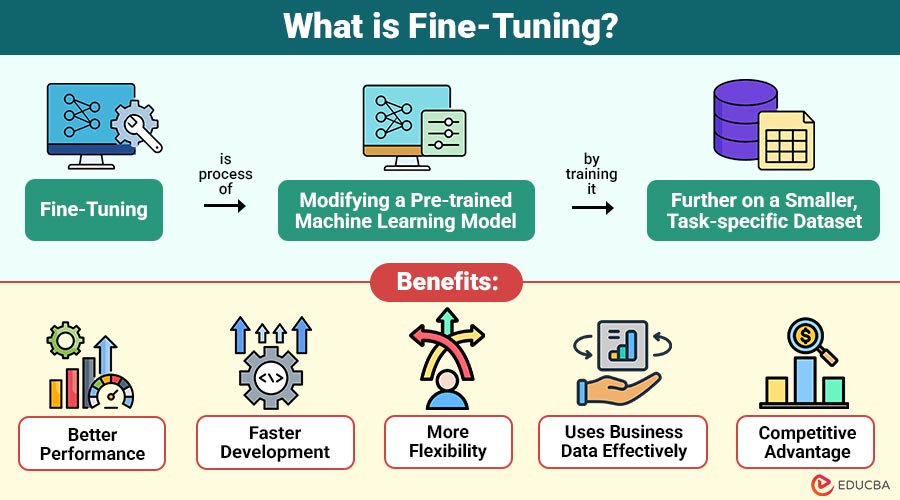
Fine-Tuning is process of modifying a pre-trained machine learning model by training it further on a smaller, task-specific dataset. A pre-trained model already understands general patterns from large amounts of data, and fine-tuning helps it specialize in a particular domain or objective.
For example, a general language model may understand everyday conversations, but fine-tuning it with legal documents can help it perform better in legal research tasks. Similarly, a healthcare AI model can be fine-tuned using medical records to improve disease prediction and diagnosis.
Fine-tuning adjusts the model’s internal parameters, allowing it to learn domain-specific knowledge while retaining its existing capabilities.
Table of Contents:
Key Takeaways:
- Fine-tuning customizes pre-trained AI models using task-specific data for improved accuracy and performance.
- It saves development time and costs by adapting existing models instead of building new ones.
- It supports diverse industries, including healthcare, finance, education, e-commerce, and customer service applications.
- Successful fine-tuning requires quality data, adequate resources, regular updates, and strong data security practices.
Why is Fine-Tuning Important?
Below are the key reasons why fine-tuning is important for improving AI model performance and business outcomes.
1. Improves Accuracy
Fine-tuning helps AI models deliver better, more accurate results by enabling them to learn from task-specific data.
2. Saves Time
Building an AI model from scratch requires a lot of time and resources. Fine-tuning makes development faster by improving an existing model.
3. Provides Custom Solutions
Every business has different needs. Fine-tuning allows companies to create AI solutions based on their specific requirements.
4. Reduces Costs
Training a new AI model can be expensive. Fine-tuning reduces costs by using an already trained model.
5. Improves User Experience
Fine-tuned models provide more relevant answers and better results, which improve customer satisfaction.
How Does Fine-Tuning Work?
Fine-tuning involves several simple steps:
1. Choose an Existing AI Model
First step is to select pre-trained model suitable for the required task. This model already has basic knowledge and can be improved further.
For example:
- A language model for creating content
- An image model for recognizing objects
- A chatbot model for customer support
2. Collect and Prepare Data
The next step is collecting specific data related to the task. This data helps the AI model learn new information.
For example:
- Customer conversations for chatbot training
- Medical records for healthcare AI
- Financial reports for finance applications
The data must be clean, accurate, and properly organized.
3. Train the Model With New Data
The selected data is used to train the existing model again. During this process, the model learns new patterns and improves its ability to handle specific tasks.
4. Test the Model
After training, the model is tested to check its performance. Developers analyze whether the model provides accurate and useful results.
5. Use the Model
Once the model performs well, it can be used in real applications such as websites, mobile apps, or business tools.
Types of Fine-Tuning
Below are the main types of fine-tuning used to adapt AI models for different tasks and business requirements.
1. Full Fine-Tuning
Full fine-tuning updates the entire AI model using new data. It provides better customization but requires more computing power and time.
2. Parameter-Efficient Fine-Tuning
This method changes only a small part of the model instead of updating everything. It requires fewer resources and speeds up the training process.
3. Instruction Fine-Tuning
Instruction fine-tuning helps AI models better understand user commands and provide more accurate responses.
4. Industry-Specific Fine-Tuning
This type of fine-tuning trains AI models for specific industries such as healthcare, banking, education, and retail. It helps AI understand industry-related terms and requirements.
Applications of Fine-Tuning
Below are the major applications of fine-tuning across different industries and real-world AI use cases.
1. Chatbots and Customer Support
Fine-tuned AI powers chatbots, answering customer questions quickly while providing accurate, personalized, and efficient support services.
2. Healthcare
Fine-tuned AI detects diseases, analyzes medical reports, supports patients, and improves healthcare decisions with greater accuracy.
3. Finance
Fine-tuned AI detects fraud, analyzes risks, predicts markets, and supports smarter financial decisions through accurate insights.
4. E-Commerce
Fine-tuned AI recommends products, analyzes customer behavior, and delivers personalized shopping experiences, increasing customer satisfaction significantly.
5. Education
Fine-tuned AI enables personalized learning, intelligent tutoring, automated grading, and improved educational experiences for students everywhere.
Benefits of Fine-Tuning
Below are the key benefits that help improve AI performance, efficiency, and business value.
1. Better Performance
Fine-tuned models deliver higher accuracy and better results by effectively learning domain-specific information.
2. Faster Development
Businesses develop AI solutions faster by adapting existing models instead of building systems from scratch.
3. More Flexibility
Enables AI models to adapt across industries, supporting diverse business requirements and applications.
4. Uses Business Data Effectively
Companies leverage internal data effectively, creating AI solutions that generate accurate and relevant outcomes.
5. Competitive Advantage
Customized AI solutions significantly enhance productivity, improve customer experiences, and strengthen overall business competitiveness.
Challenges of Fine-Tuning
Below are the key challenges organizations may face when fine-tuning AI models for specific applications.
1. Need for Quality Data
Fine-tuned AI models require high-quality training data because inaccurate data significantly reduces overall performance and reliability.
2. Requires Computing Resources
Training large AI models requires powerful computing resources, increasing infrastructure costs and processing time for organizations.
3. Risk of Wrong Learning
AI models may overfit training data, reducing their ability to perform accurately on unseen real-world information.
4. Data Security Issues
Organizations must protect sensitive business data during fine-tuning to effectively prevent privacy breaches and unauthorized access.
5. Regular Updates Required
Fine-tuned AI models require continuous updates and retraining to maintain consistent accuracy, relevance, and reliability.
Final Thoughts
Fine-tuning helps improve existing AI models by training them on task-specific data. It makes AI systems more accurate, efficient, and useful for different industries. From customer service and healthcare to finance and education, fine-tuning helps businesses build smarter solutions without creating models from scratch. As artificial intelligence continues to develop, fine-tuning will remain an important method for creating powerful and customized AI applications.
Frequently Asked Questions (FAQs)
Q1. Can small businesses use fine-tuning?
Answer: Yes. Small businesses can fine-tune pre-trained AI models to create customized solutions without incurring the high cost of developing a new AI model from scratch.
Q2. How long does the fine-tuning process take?
Answer: The time depends on factors such as dataset size, model complexity, and available computing resources. Some projects may take a few hours, while others can require several days.
Q3. Is coding knowledge required for fine-tuning AI models?
Answer: Basic programming knowledge is helpful, but many AI platforms now offer user-friendly tools and interfaces that allow businesses and developers to fine-tune models with minimal coding.
Q4. Can a fine-tuned model be updated later?
Answer: Yes. A fine-tuned model can be retrained with new data whenever business requirements, customer preferences, or industry standards change, helping it stay accurate and relevant.
Recommended Articles
We hope that this EDUCBA information on “Fine-Tuning” was beneficial to you. You can view EDUCBA’s recommended articles for more information.


