


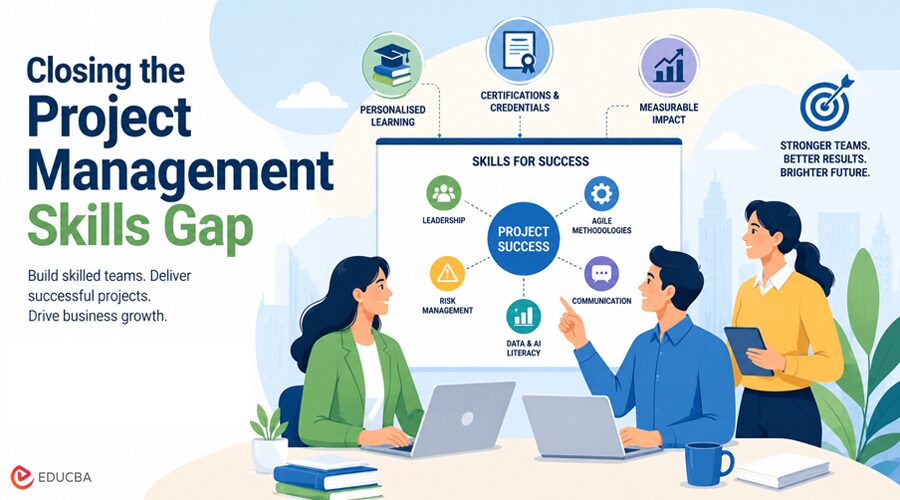
Corporate learning has become one of the most effective ways organizations are closing the Project Management Skills Gap. Rapid technological change, hybrid work, AI integration, and increasingly complex business transformations are driving demand for skilled project professionals faster than the market can supply them.
According to the Project Management Institute’s Global Project Management Talent Gap report, the world currently has about 39.6 million project professionals. The shortage of people with essential project management skills is expected to continue to grow, and employers consistently cite skills gaps as a top barrier to business transformation.
Why the Project Management Skills Gap Keeps Growing?
The Project Management Skills gap stems from three fundamental structural shifts.
- The Technical PM Paradox: Previously, a good project manager just needed to master the triple constraint (time, scope, budget) and have solid people skills. Today, organizations are demanding PMs who also understand machine learning pipelines, data architecture, and cloud infrastructure to communicate effectively with their engineering teams and manage risk.
- The Loss of Shadowing: In a fully co-located office, junior project managers learned the messy, unstructured parts of the job like navigating a tense stakeholder meeting or rescuing a derailed timeline by simply sitting in the room and watching veterans work. In a hybrid or remote world, that organic apprenticeship vanishes. Junior PMs are often left to sink or swim on their own islands.
- Agile Friction: Many organizations are stuck in a painful “hybrid” state, trying to enforce rigid, top-down budgetary deadlines while telling their teams to work in flexible, iterative Agile sprints. PMs get caught in the middle, acting as a translator between two completely incompatible corporate languages, which accelerates burnout and turnover.
How Corporate Learning Helps Close the Project Management Skills Gap?
Corporate training helps organizations upskill internal talent instead of relying solely on expensive external hiring in a tight market. In practice, this comes down to five levers:
- Skills Gap Analysis and Personalized Learning Paths
- Certification and Credentialing Programs
- Power Skills and Emerging Competencies
- Measurement, ROI, and Continuous Evaluation
- Upskilling, Reskilling, and Cross-Training.
1. Skills Gap Analysis and Personalized Learning Paths
A skills gap analysis identifies the difference between the skills employees possess today and the skills they will need in the future. This is a critical first step in addressing the Project Management Skills Gap.
- Define competency frameworks, the technical and soft skills required for each role, which set a baseline for success.
- Assess current capabilities, using Learning Management Systems (LMS) to run assessments, self-evaluations, manager reviews, and practical tests.
- Map and visualize the gaps, pulling the data together to spot specific weak points. For example, a sales team that’s great at pitching but shaky on a new CRM platform.
From there, training stops being one-size-fits-all. Employees get personalized, role-based learning paths, often delivered as microlearning or on-demand modules, built around what they will actually need: Agile and hybrid methodologies, AI tools, risk management, and stakeholder communication.
2. Certification and Credentialing Programs
Certifications turn on-the-job learning into something formal and recognized. Good corporate training programs support this in a few concrete ways:
- Exam Prep: Corporate Training offers structured courses, bootcamps, and practice exams designed for certifications such as Project Management Professional (PMP), Cisco, AWS, SHRM, Lean Six Sigma, and many other popular certifications
- Skill-building: Training offers you practical experience in project management, leadership, technology tools, and soft skills. These are the very same talents that most job exams and portfolio reviews do measure.
- Financial and logistical support: Corporate Training programs generally cover exam expenses, provide tuition reimbursement, and offer paid time to study. This eliminates the most prevalent impediments to participation.
- Internal credentialing: In-house leadership or technical academies that award company-specific badges, or feed into PMP®, PMI-ACP®, or CAPM®, frequently with PDU credit built in.
- Career pathways: Training tied to promotions and succession planning, with shareable digital badges (via platforms like Credly) that show up on LinkedIn or a resume.
3. Power Skills and Emerging Competencies
Technical knowledge alone is no longer enough. To close the Project Management Skills Gap, organizations must also develop power skills and emerging competencies.
- Power skills: Communication, emotional intelligence, leadership, critical thinking, adaptability, and collaboration amplify technical expertise in fast-moving environments.
- Emerging competencies: AI literacy, data fluency, digital transformation, sustainability knowledge, and intercultural fluency are being driven by technology and shifting business needs.
L&D teams build both through targeted curriculum design (starting with a skills gap analysis), blended formats such as workshops, role-play, and mentoring, technology-enabled delivery such as e-learning, VR simulation, and gamification, and ongoing reinforcement through refresher courses and communities of practice, not one-off training events.
4. Measurement, ROI, and Continuous Evaluation
Course completion is not the finish line. The best training programs measure whether learning actually changed outcomes. That starts with pre- and post-training assessments, competency tests, 360-degree feedback, and simulations that establish a baseline and track improvement in areas such as risk management and stakeholder communication.
Most programs also lean on an evaluation framework, typically Kirkpatrick’s Four Levels: participant reaction, knowledge gained, on-the-job behavior change, and business results, sometimes extended with a fifth level, financial ROI, borrowed from the Phillips ROI methodology.
Modern LMS analytics, integrated with tools like Jira or Microsoft Project, provide real-time dashboards that link skill proficiency to actual project performance. The KPIs that matter most: on-time and on-budget delivery, efficiency gains, reduced rework, risk reduction, quality improvement, and retention.
5. Upskilling, Reskilling, and Cross-Training
These three approaches are essential for closing the Project Management Skills Gap across the workforce.
- Upskilling: Deepens the skills of current project managers in Agile and hybrid methods, AI-powered PM tools, risk analytics, and stakeholder management through microlearning, workshops, and certifications like PMP or PMI-ACP. The payoff: higher project success rates and readiness for more complex, AI-enabled work.
- Reskilling: Moves employees from other functions engineers, IT specialists, operations staff- into PM roles through bootcamps, e-learning, and simulations. This lowers hiring costs and builds an internal PM pipeline instead of relying on the external market.
- Cross-training: Broadens understanding across roles through job rotation, shadowing, and interdisciplinary modules in business analysis, finance, procurement, and change management, producing more flexible teams and fewer cross-functional bottlenecks.
Corporate Training Benefits for the Business
Organizations that invest in closing the Project Management Skills Gap often experience:
- Higher project success rates, as teams apply consistent, up-to-date methodologies
- Better retention, since employees who see a clear growth path are more likely to stay
- Lower hiring costs, from reduced dependence on an expensive external PM market
- Faster digital transformation, powered by stronger AI and data literacy
- A stronger leadership pipeline, with internal candidates ready for PMO and senior delivery roles
- Higher productivity, with fewer errors and less rework
Common Corporate Training Methods
There is no single right way to deliver corporate training, and most organizations mix methods to match different learning styles and constraints.
- Instructor-led training and virtual classrooms work well for structured, cohort-based learning, while e-learning and microlearning support self-paced study.
- Coaching and mentoring pair employees with experienced practitioners for real-time guidance, and simulations let people practice decision-making without real-world risk.
- Job rotations and project-based learning embed new skills directly into live work, which tends to stick better than anything learned in a classroom alone.
Technology Used to Reduce the Project Management Skills Gap
Technology now shapes almost every part of how this training gets designed and delivered. The LMS remains the backbone for assigning, tracking, and reporting on training.
- AI-powered learning tools personalize content and recommend next steps based on individual performance, while adaptive learning platforms adjust difficulty and pacing in real time.
- VR simulations let employees rehearse high-stakes moments, a tense stakeholder conversation, or a project in crisis without real consequences.
- Learning analytics tie training activity to actual project outcomes, and digital badges make credentials easy to verify and share, reinforcing the certification pathways above.
Training and Change Management Go Together
Project management and organizational change are closely connected. Therefore, any strategy to close the Project Management Skills Gap should also strengthen change management capabilities.
This includes:
- Building stakeholder buy-in for new methodologies and tools
- Developing change leadership skills
- Improving communication to reduce resistance
- Reinforcing adoption after a change is implemented.
Without this connection, project managers may be technically capable but unprepared to guide teams through disruption.
Challenges and Best Practices
Organizations commonly face three challenges when addressing the Project Management Skills Gap:
- Proving ROI convincingly
- Ensuring skills are applied on the job
- Keeping content current as AI and hybrid work evolve.
Best practices include:
- Tying learning initiatives directly to performance metrics
- Combining technical and power skills in a single development track
- Using analytics for continuous improvement
- Creating a culture of ongoing learning rather than one-time events.
What is Coming Next in Corporate Training?
A few trends are set to reshape this space. AI copilots are starting to help project managers directly with scheduling, risk flagging, and status reporting. Skills intelligence platforms are giving organizations a real-time view of workforce capabilities rather than a periodic snapshot.
Personalized learning is becoming the default rather than the exception, powered by data-driven training that adjusts to individual and team performance. Moreover, predictive workforce planning is helping organizations spot skill shortages before they become critical. The common thread: training is shifting from an occasional event to something continuous, built into how project teams actually work.
Final Thoughts
Corporate training closes the project management skills gap by developing the people you already have through targeted, flexible programs tied to business outcomes. As PMI’s projected talent gap widens, the organizations that invest here now will have a real edge in delivery, innovation, and adaptability. As project complexity continues to increase, treat learning as a strategic investment rather than a line-item cost.
Author: Neena Raj
Neena Raj is an Expert Trainer at Edoxi with over 24 years of experience in employee development, leadership training, and organizational performance. An MBA graduate, Certified NLP Trainer, CHRP, and CHRM, she has trained professionals at organizations including the Dubai Health Authority, Emirates Airlines, DP World, and Dubai International Hotel. She is currently pursuing a PhD in Psychology, focusing on workplace learning and development in the age of AI.
Recommended Articles
We hope this guide helps you understand how organizations can close the Project Management Skills Gap through targeted learning, certification pathways, and workforce development strategies. Explore these recommended articles for more insights into project management, leadership development, Agile methodologies, AI-driven workplace learning, and organizational performance.

