


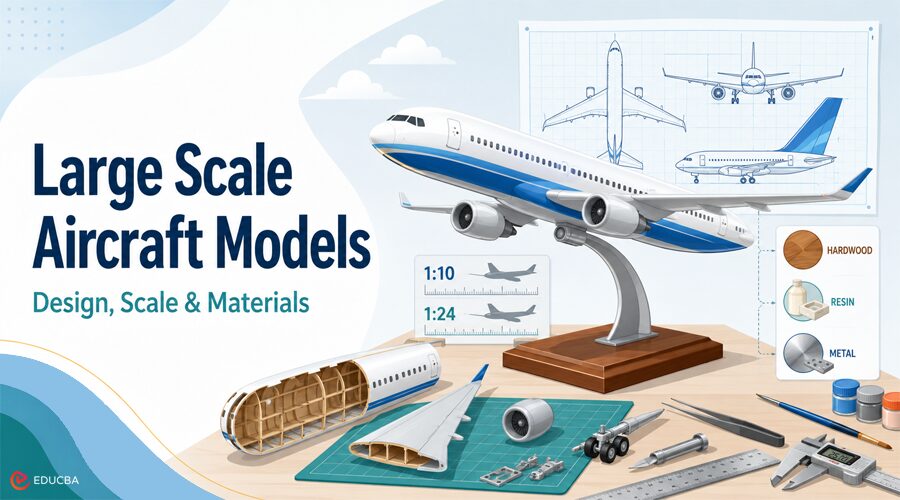
Scale modeling sits at the intersection of engineering, design, and craftsmanship. It combines the precision of engineering, the creativity of product design, and the accuracy of technical illustration. At the higher end of the spectrum, large scale aircraft models built for museums, aviation exhibitions, corporate displays, and institutions demand exceptional planning, engineering, and attention to detail.
Understanding what goes into building a large scale aircraft model, from the initial brief and reference collection through to material selection, construction, and finishing, gives designers and makers a clear picture of what the discipline actually demands. Whether you are approaching scale modeling as a design practice or commissioning a personalized airplane replica for display, the principles that govern quality at every scale are the same.
Understanding Scale Ratios
The first and most important decision when building large scale aircraft models is selecting the correct scale ratio. A scale ratio defines the mathematical relationship between the model and the real aircraft. For example:
- 1:10 scale: Every 1 cm on the model represents 10 cm on the actual aircraft.
- 1:24 scale: Every 1 cm represents 24 cm on the original.
The smaller the second number, the larger and more detailed the finished model becomes.
Choosing the right scale requires balancing three competing factors: the available display space, the required level of detail, and the structural requirements of the finished piece. A 1:10-scale model of a commercial airliner will typically run 5–7 meters in length, a format that suits exhibition halls and museum galleries but requires structural engineering considerations that smaller scales do not demand. A 1:48-scale model of the same aircraft yields a piece around 60–70 centimeters, manageable as a desk or display case piece, but with significantly reduced surface detail.
The key principle is that scale affects not just size but the entire manufacturing approach. Detailed elements that are simple at a large scale become technically impossible at smaller scales. Rivet patterns, panel lines, antenna placements, and cockpit instrumentation all have minimum physical dimensions that determine whether they can be represented accurately at a given ratio.
Reference Collection and Design Accuracy
Before construction begins, collecting accurate references is one of the most critical stages in creating large scale aircraft models. The quality of the final replica depends directly on the quality and completeness of the source material.
Professional model makers typically combine several types of references.
Photographic reference captures the visual appearance of the aircraft: livery colors, panel configurations, external markings, undercarriage geometry, and engine nacelle detail. Three-view drawings showing front, side, and top profiles simultaneously provide the dimensional proportions that photographs alone can distort through perspective. Technical manuals and type certificates provide measurements and component specifications that photographs and drawings do not always make explicit.
For historically significant aircraft where original documentation is incomplete, cross-referencing multiple sources and working with subject-matter experts, historians, pilots, and engineers is standard practice in professional scale model production. A model built on an incomplete reference will carry inaccuracies that experienced viewers recognize immediately, and that cannot be corrected once construction is complete.
Choosing the Right Materials for Large Scale Aircraft Models
Material selection is one of the most important engineering decisions when building large scale aircraft models.
Unlike smaller models, large replicas must support significant weight while maintaining dimensional stability over many years.
Hardwood
Hardwoods such as:
- Mahogany
- Limewood
remain among the preferred structural materials because they provide:
- Excellent strength
- Resistance to warping
- Dimensional stability
- Easy carving and shaping
- Long-term durability.
When properly sealed, hardwood structures can retain their accuracy for decades.
Resin
Resin works well for highly detailed parts that would be difficult to carve manually, including:
- Engine nacelles
- Landing gear components
- Cockpit details
- Surface accessories.
Polyurethane resin offers lightweight construction and faster curing, while epoxy resin provides superior surface hardness and finish quality.
Metal Components
Materials such as:
- Brass
- Aluminum
- Stainless steel
are commonly used for:
- Internal reinforcement
- Structural connectors
- Antennas
- Hinges
- Mounting hardware.
These materials improve durability while maintaining precision.
Construction Process for Large Scale Aircraft Models
Professional construction follows a carefully planned sequence that moves from structure to surface.
Each phase must be completed before moving to the next because surface imperfections and structural problems become increasingly difficult to correct later.
Building the Internal Structure
Every large aircraft model begins with an internal armature.
Usually constructed from aluminum or steel rods, this hidden framework:
- Supports the overall weight
- Prevents deformation
- Provides mounting points
- Ensures structural integrity.
If the finished model will hang from the ceiling or mount on a display stand, the armature also incorporates the required support hardware.
Constructing Major Components
Once the internal frame is complete, builders create the major assemblies:
- Fuselage
- Wings
- Tail section.
These components are generally built separately before final assembly, making detailing and finishing more manageable.
Adding Fine Details
After the primary structure is complete, smaller features are added, including:
- Cockpit interiors
- Engine components
- Landing gear
- Navigation lights
- Antennas
- Surface panels.
This staged process allows every component to receive individual attention before final assembly.
Giant Scale Models — When Size Becomes the Statement
At the end of the scale spectrum, large scale models built at ratios of 1:5 or larger produce pieces that can span several meters and weigh tens of kilograms. At this scale, the model transitions from a display object to something closer to a sculptural installation, requiring wall- or ceiling-mounting systems, structural engineering for the display environment, and finishing to a standard that holds up under extremely close inspection.
Giant-scale replicas are commissioned for aviation museums with dedicated gallery spaces, airports with feature display installations, aircraft manufacturers producing centerpiece exhibition pieces, and aviation brands marking significant anniversaries or milestones. The design brief for a giant-scale commission is correspondingly more detailed than that for standard display models, specifying not just the aircraft and its configuration but also the exact display context, viewing angles, lighting conditions, and installation requirements.
The finishing requirements at scale are also more demanding. Paint systems must be applied in multiple stages to achieve the depth and consistency that reads correctly from a viewing distance of a few feet. Panel line scribing must be precisely sized: too narrow, and it disappears in the finish; too wide, and it looks unconvincing at close range. Decals must be sized, positioned, and sealed to a standard that survives long-term display without lifting, yellowing, or silvering.
What Does Building Large Scale Aircraft Models Teach About Design?
Creating large scale aircraft models demonstrates how thoughtful planning influences every stage of physical design.
Every early decision, from selecting references to choosing materials, affects the finished result. Small proportional errors become highly noticeable in three-dimensional form. Materials that perform well in smaller models may fail structurally at larger scales. Likewise, finishing techniques suitable for miniature models often require significant refinement when applied to larger surfaces.
For designers, engineers, architects, and makers, the principles behind large scale aircraft models extend well beyond aviation. Careful research, accurate proportions, appropriate material selection, systematic construction, and meticulous finishing are universal design practices that apply to virtually every precision-built object.
Although the aircraft is the subject, the real lesson lies in disciplined design thinking translated into physical form.
Recommended Articles
We hope this guide on large scale aircraft models helps you understand the importance of scale selection, material choices, precision construction, and professional finishing in creating exceptional aircraft replicas. Explore these recommended articles for more insights into scale modeling, product design, engineering techniques, craftsmanship, museum displays, and precision manufacturing.

