


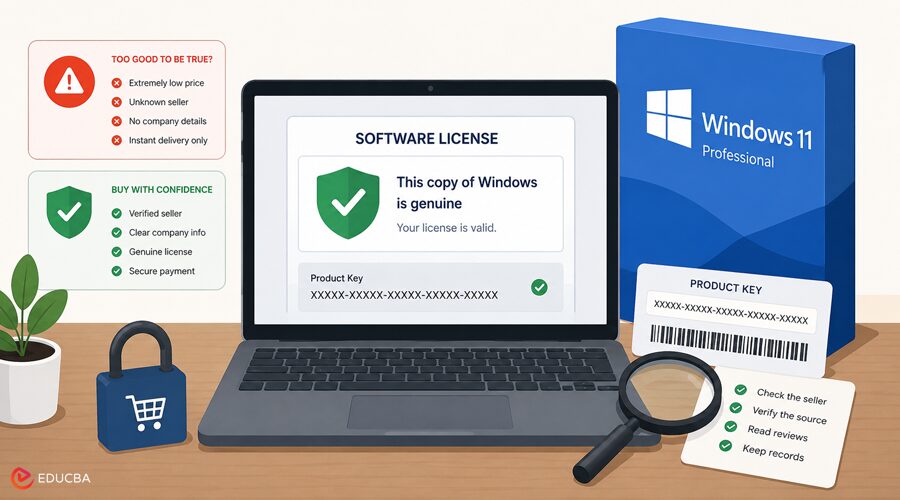
Every few weeks, Sam, who handles compliance questions at Licono, opens the same kind of email. A freelancer or small-business owner bought a cheap software license months ago; everything worked, and then one morning the machine started insisting the software was “not genuine.” Sometimes the license has switched itself off. Sometimes the person discovers that the “setup file” they were sent quietly installed a cracked, modified version of the program, and they never realized they were running pirated software. By the time they get in touch, the seller has vanished, and the money is gone.
These people are not reckless. They did what seemed reasonable: they compared prices, picked the cheapest listing, and paid. The problem is that a €12 “Windows 11 Pro” key and a €199 one look completely identical when they land in your inbox. Both are the same 25-character string, both paste into the same box, and both usually work on the first try. The difference only shows up later. This guide is about seeing that difference before you pay, using what a compliance desk actually watches go wrong.
Why the Same Cheap Software License Can Cost €12 or €199?
Before any checklist is useful, it helps to understand why the price of a cheap software license can vary so dramatically. While some low-cost software licenses are completely legitimate, others come from questionable or illegal sources. Cheap software keys reach the market through three very different channels, and only some of them are genuine.
1. Genuine Second-hand Resale (Legal)
Software licenses, like books or cars, can be sold or traded. When a company upgrades its fleet, downsizes, or shuts down, its perpetual retail licenses retain value, creating a legal market for resale, particularly within the EU. These are genuine, transferable licenses sold at a discount from the original retail price because they are pre-owned. If you are looking for a cheap software license, this is the safest and most legitimate option, and it is part of the market protected by law.
2. Volume-key Splitting (Grey)
Large organizations buy software in bulk through volume licensing. Microsoft, for instance, issues a Multiple Activation Key (MAK) that can activate a set number of installations, or runs a Key Management Service (KMS) that activates machines on a local network. That key is licensed to a single organization for its internal use.
Some grey market sellers misuse a single volume license key by selling individual activations to multiple buyers. Although the key may activate successfully, the seller uses it in a manner that exceeds the terms of the original license agreement. This practice can make the key invalid over time. Many software listings priced between €5 and €15 fall into this category.
3. Counterfeit and Stolen Keys (Illegal)
Some sellers obtain software keys through fraudulent methods, steal them from distributors, purchase them with stolen payment cards, or source them from region-locked batches intended for lower-priced markets, then resell them worldwide. These low-cost software licenses have a high risk of being blacklisted. Software vendors often identify and deactivate such keys weeks or even months after purchase when they review their activation records.
From the buyer’s perspective, all three types of cheap software licenses can look identical at checkout. The real difference only becomes apparent later. Everything that follows in this guide will help you identify a genuine license before you make a purchase.
The Law That Makes a Cheap Software License Legal—and Where It Stops
The legal side of the cheap software license market exists largely because of one landmark European court ruling. Understanding this decision is important because it explains when buying a discounted software license is perfectly legal and where the legal boundaries end.
In 2012, in the case of UsedSoft v Oracle</em>, the Court of Justice of the European Union held that once a software maker sells a copy of its program in the EU, it has “exhausted” its right to control the resale of that</em> copy. In plain terms: if you bought a license, you may sell it on, even software you downloaded rather than received on a disc, and the maker cannot stop you. That decision is what created a legitimate second-hand software market in Europe.
The ruling comes with conditions that matter for buyers. The original owner must make their copy unusable when they sell, so the same license cannot run in two places at once. A single license sold for a set number of users cannot be broken into smaller pieces, which is precisely why volume-key splitting falls on the wrong side of the line. Moreover, the principle applies to the sale of a license, not a subscription: a monthly plan such as Microsoft 365 or Adobe Creative Cloud is rented, not owned, so there is nothing to resell. It is also an EU rule, so buyers elsewhere should not assume the same rights apply.
You do not need to be a lawyer to make a smart buying decision. Ask one question before purchasing a cheap software license: Is this a genuine, fully transferable license being sold to me, or is it just a portion of someone else’s volume licensing agreement? That single question often separates a legitimate bargain from a risky purchase.
Activation is Not a One-time Gate: How Vendors Switch Keys Off Later
The single biggest misconception Sam runs into is that a key that activates must be good. It is not. Activation is not a gate you pass once and forget; it is an ongoing relationship with the vendor’s servers. Microsoft, Autodesk, and Adobe all maintain activation records and continuously reconcile them. A key that sailed through on day one can be revoked weeks or months later, the moment the vendor ties it to a stolen batch, a payment that was charged back, or a volume key that has been activated far more times than it was ever licensed for.
Microsoft tracks how often and how a key is activated and flags those that appear to be abused. When its validation runs, blacklisted keys stop working, and the machine reverts to “not activated.” Its own support forums are full of people asking why Windows “decided to revoke” its activation out of nowhere, and the honest answer is almost always that the key was never clean to begin with. When it happens, you have no recourse: the reseller is long gone, and the vendor is enforcing its own license rather than adjudicating your purchase. That is the quiet risk behind the very cheapest keys. They are not sold to you so much as loaned to you until the vendor notices.
The Other Trap When Buying a Cheap Software License
There is another warning sign that is even more dangerous than an invalid license because it can put your personal and business data at risk. A genuine cheap software license works straightforwardly: you download the software directly from the vendor’s official website, such as Microsoft or Autodesk, enter your product key, and activate it through the vendor’s servers. That is the entire process.
The moment a seller sends you a download link, a pre-configured installer, or an “activator” tool alongside your cheap software license, you are no longer installing legitimate software. Instead, you are installing someone else’s modified version of the program, and modified installers are one of the most common sources of malware.
This is not simply a theoretical risk. Independent research continues to show that a significant percentage of pirated and cracked software installers contain malicious code. A 2024 academic analysis of 750 pirated software samples found trojans in roughly 35% of the files and adware in approximately 34%. Security vendors also report that cracked installers downloaded from unofficial websites frequently contain malware. Today’s most common threat is an information stealer that silently collects saved passwords, browser sessions, and cryptocurrency wallet data while the software appears to function normally.
Many people who purchase a cheap software license never realize it. They assume the activator is simply part of the installation process because that is exactly how scammers present it. If your purchase requires you to run an activator, install software from an unofficial source, or disable your antivirus, consider it a major red flag. A legitimate, cheap software license never requires bypassing the vendor’s official installation or activation process.
The Bill That Arrives Last: Compliance and Audits
For a company, the serious risk is not the software refusing to open. It is the letter. Enforcement bodies such as the Business Software Alliance act on behalf of Microsoft, Adobe, Autodesk, and others, and they do not need to break in to come after you. A single tip, often from a former employee or even a competitor, is enough. The letter that follows usually asks you to “self-audit”: to inventory every program you run and prove you are licensed for each seat. Many owners panic and cooperate at once, which is often the worst move, because you can end up documenting your own shortfall.
Settlements are commonly several times what the missing licenses would have cost, and these bodies publicize their outcomes precisely to make the point. A €10 key that saved you a few euros can, on the wrong machine, become the reason you cannot prove compliance. This is the case: Sam sees most often that the solution turns out to be genuinely expensive, and it is worth being prepared. Resellers who deal with this market, such as Licono, have written a clear breakdown of what a BSA letter actually means and how to respond, and it is worth reading before you assume a cheap license is a private matter.
Cheap Software License Buyer’s Checklist
With the background in place, the checks themselves are quick. None takes more than a minute, and together they filter out almost every bad seller.
1. Which License Type is it, Exactly?
Understand the license type before making a purchase because it determines how you can legally use the software. Individuals can purchase retail licenses, which they can legally transfer or resell. OEM licenses remain tied to the first device on which they are activated and must stay with that device throughout its lifetime. Organizations purchase volume licenses through Microsoft’s MAK or KMS programs for internal use, and they cannot divide or resell these licenses to individuals. A €15 “Windows 11 Pro” offer is unlikely to be a genuine retail license. A reputable seller will clearly identify the license type, while unclear or inconsistent answers should raise concerns.
2. Where Did This Cheap Software License Come From?
Following on from the law above, ask the seller to explain the source. A genuine pre-owned retail license has a story: a business closed, upgraded, or downsized, and its licenses were transferred as a whole. A seller who cannot or will not say where the keys originate, or who is clearly reselling activations from a single bulk agreement, is trading on the grey side of the line, regardless of what the listing claims.
3. Does it Activate Directly with the Vendor, with no Extra Steps?
A real key activates directly with Microsoft or Autodesk, online, and that is the end of it. Suppose you are handed a download link, a separate installer, or an “activator” to run or stop for the reasons in the section above. Genuine activation never asks you to work around the vendor. On modern Windows, it ties the license to your hardware or Microsoft account so you can re-activate later without drama.
4. Will You Get a Real Invoice?
A legitimate business issues a proper invoice with its company name, address, and VAT number. This is not red tape for its own sake. In an audit, that invoice is your proof of legal acquisition, and for a company, it is also what lets you reclaim VAT or apply the reverse-charge rule. If a seller cannot or will not provide one, you are buying something they would rather leave undocumented, and you will have nothing to show if the license is ever questioned.
5. How do They Guarantee the Transfer is Clean?</h3>
For pre-owned retail licenses, the previous owner must properly deactivate the original copy before transferring the license. This step ensures that the product key can be legally reassigned to you. Reputable sellers manage this process as part of the sale and clearly explain each step. You should also ask how they handle the original installation. A product key that remains active on multiple devices can create compliance issues or become invalid in the future.
6. Can you Pay with Protection?
Whenever possible, pay for a cheap software license using a credit card, PayPal, Klarna, or another payment method that offers buyer protection. Avoid sellers who accept only bank transfers, cryptocurrency, gift cards, or other irreversible payment methods. If the license proves invalid, chargeback protection may be your only option for recovering your money.
7. Is There a Real Company with a Reputation Behind it?
Finally, look at the seller as a business. How long have they traded? Do they have independent reviews on a platform like Trustpilot, rather than only glowing quotes on their own homepage? Is there a support channel with a human who can answer questions about license types and activation before you buy? A company with a history and a public reputation has something to lose by selling you a bad key. A listing with nothing behind it does not.
What a Fair Price Actually Looks Like?
It helps to have a rough sense of the floor. On the genuine second-hand market, a transferable retail Office or Windows license is clearly cheaper than buying new from the vendor, but it is not close to free, because the seller had to acquire it in the first place. The € 5 and € 10 keys, which sit far below everyone else’s prices, are the ones to treat with suspicion, because they almost always signal a split-volume key or a stolen code rather than a genuine bargain. A useful rule of thumb: noticeably cheaper than retail is realistic and normal. Practically free is not a deal; it is a flag.
Frequently Asked Questions (FAQs)
Q1. Is buying a cheap OEM or second-hand Windows key illegal?
Answer: Not automatically. A genuine pre-owned retail license is legal to resell in the EU under the ruling described above, and an OEM license is legal too, just permanently tied to one machine. What is not legal is a split-volume license or a stolen or counterfeit key, and those are the cheapest listings, which is exactly why price on its own tells you almost nothing.
Q2. Why did my cheap key work at first and then stop?
Answer: Because activation and legitimacy are not the same thing. A stolen or overused volume key can pass the first activation and only get blacklisted later, when the vendor reconciles its records or a major update re-checks the license. A key that works today is not proof that a key will be clean tomorrow.
Q3. A seller sent me a download link and an “activator” to run. Is that normal?
Answer: No, and it is the clearest red flag on this page. Genuine software is downloaded from the vendor’s own website and activated with your key against the vendor’s servers. If someone sends you their own installer or a separate activator tool, you are installing a modified, cracked copy, and cracked installers are where malware lives. Delete it and ask for a refund through your payment provider.
Q4. Can I safely use a €15 key for my business?
Answer: This is the riskiest place to cut corners. Consumers rarely face audits; companies do. If you cannot provide an invoice and verify the license type for each seat, an audit will likely identify the risks associated with a €15 software key. For business use, documentation matters more than the sticker price.
Q5. Does a genuine cheaper license get fewer updates?
Answer: No. A genuine retail or second-hand license for a given version receives the same updates as a full-price license, because it is the same product. Missing or blocked updates indicate a tampered or counterfeit install, not a legitimate discount.
Final Thoughts
A cheap software license does not have to be fake. There is a legitimate, well-established market for genuine, transferable software licenses, enabling freelancers, startups, and small businesses to reduce software costs without sacrificing compliance or security.
However, the same market also attracts grey-market sellers and counterfeit products. Choosing the wrong cheap software license can lead to far more than a failed activation; it may result in malware infections, stolen credentials, lost productivity, or even software compliance audits.
Before you buy any cheap software license, take a few minutes to verify its source. Keep the key principles of the UsedSoft ruling in mind and follow seven important steps before purchasing. Check the license type, verify its source, confirm activation through the official vendor, request a valid invoice, review the license transfer process, use a secure payment method, and purchase only from a trusted seller.
A little research today can save you significant time, money, and frustration later. When you choose a cheap software license from a trusted source, you can enjoy genuine savings while avoiding the risks that often accompany deals that seem too good to be true.
Recommended Articles
We hope this guide on cheap software license selection helps you identify genuine software licenses, avoid counterfeit keys, and make informed purchasing decisions. Explore these recommended articles for more insights on software licensing, compliance, cybersecurity, digital security, and IT asset management.

