


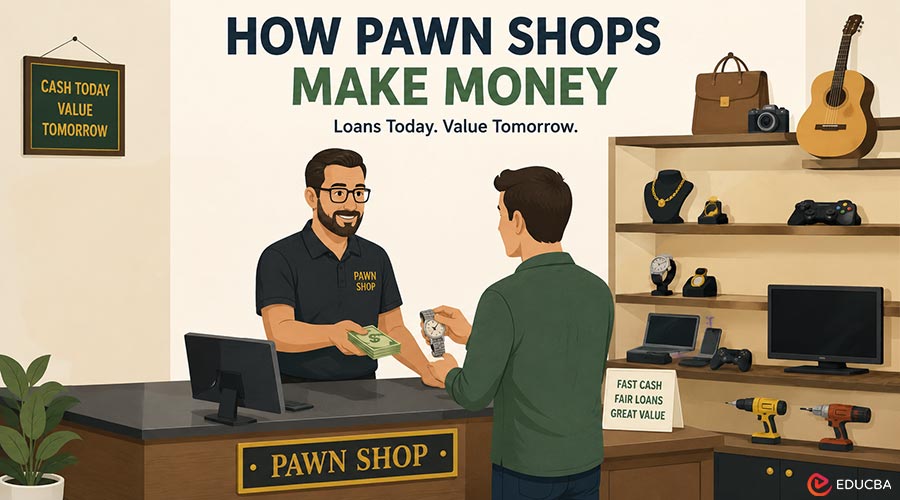
Walk past a pawn shop, and you see two things at once: a lending desk and a retail floor. This dual identity is the foundation of how pawn shops make money. A pawn shop earns as a lender and as a reseller at the same time, and the balance between those two streams decides whether a shop grows or quietly shuts its doors. Once you see how the pieces connect, it becomes clear why the trade has survived for centuries.
A Business with Two Revenue Engines
Most people assume pawn shops profit mainly by selling off items that borrowers never come back for. The reality runs closer to the opposite. The steadier money comes from lending, and resale fills in around it. The mechanics are simple. A pawnbroker advances cash against an item you own, holds that item as collateral, and gives it back when you repay the loan plus interest and fees. If you do not repay, the shop keeps the item and sells it. Two ways to earn, one transaction.
First, you need to understand scale. Pawn is a high-volume, small-ticket trade. According to the National Pawnbrokers Association, the average pawn loan runs under $180 nationwide, and shops make thousands of loans a day for less than $50 each. No single deal moves the needle. Thousands of them, each earning a little, add up to a real business.
| Revenue engine | How it earns | Role in the mix |
| Collateral Loans | Interest and fees over a short term, backed by the pledged item | The steady base |
| Resale | Retail margin on forfeited or purchased goods | Secondary, fills the gaps |
At the large publicly traded pawn operators, lending income has historically made up the majority of revenue, with retail sales accounting for most of the rest. That split is worth keeping in mind, because it flips the common assumption about where the money actually comes from.
Interest and Fees on Collateral Loans
This is the core engine. A pawnbroker usually lends only a fraction of an item’s resale value, often around 25% to 60%. So a watch that might sell for $400 could secure a $150 loan. The item stays with the shop, and the loan term is usually short, often about 30 days, with an option to extend. To reclaim the item, the borrower repays the principal plus interest and fees. Pawn shops charge interest on the borrowed amount for the duration of the loan.
Interest rates are regulated by state law and may range from a few percent per month in some states to significantly higher rates in others. That is the practical reason the guide on choosing bill counters for pawn shops tends to stress speed and error rates above anything else. Because the charge is applied monthly to a small principal, even a modest loan can generate solid income over time. For example, if a shop lends $150 against a guitar and charges a 15% monthly fee, the borrower owes about $172.50 after 30 days. The pawn shop charges the fee again if it extends the loan for another month. On that single loan, the shop earns roughly $22 in fees each month, and that adds up quickly across a full loan book.
Lending is also attractive because pawn loans are non-recourse. If the borrower does not repay, the pawnbroker cannot pursue them for the balance or report the default to a credit bureau. The shop is protected because it already holds collateral worth more than it lent. That is why accuracy matters so much at the counter: every transaction is cash in, cash out, and even a small counting error can affect profit.
How Pawn Shops Make Money When a Loan is Not Repaid?
If a borrower does not come back, the collateral becomes shop inventory, and now the second engine kicks in. The shop puts the item on the floor and sells it at retail. The profit here is a margin play. The shop effectively acquired the item for what it lent, and it sells for retail, so the gain is the spread between the two. Because the original loan was only a slice of resale value, the profit margin built into a forfeited item is wide, even when the shop discounts to move it quickly. A $150 loan against a $400 item leaves a lot of room.
When shops sell items, they are no longer limited to whoever walks through the door. Many pawnbrokers list forfeited inventory on online marketplaces alongside their in-store shelves, which broadens the pool of buyers and helps them reach closer to the full resale value. A larger audience means less discounting to clear stock, and less discounting means the margin on each sale holds up better. Here is the nuance that surprises people, though: forfeiture is the exception, not the rule. Industry estimates put the redemption rate at around 85%, meaning borrowers repay the vast majority of loans and never place the item on the sales floor.
Resale is genuine profit, but it is secondary in volume to the interest quietly accruing on the loans that do get repaid, which works much like simple interest on a short-term loan. Most items are picked up before any resale step is needed. There is even a case where the shop prefers redemption. A repeat borrower who pledges the same item several times a year and pays a fee each time is worth more than a one-off sale that ties up shelf space for weeks. Getting the item back into the customer’s hands and keeping the relationship going can be better than selling it outright.
Buying Outright, and the Smaller Revenue Lines
Pawn shops do not only lend. They also buy items directly from the public, no loan involved, and resell them. Same margin logic as forfeited collateral, but without the wait or the redemption risk, since the shop owns the item outright from the start. Stack it all together, and the revenue picture looks like this:
- Interest and fees on active loans, the steady base of the business
- Retail sales of forfeited collateral that was never reclaimed
- Retail sales of items bought outright from customers
- Loan extensions and renewals, where a borrower pays a fee to roll the loan forward
- Ancillary services in some shops, such as money transfers, check cashing, or layaway
None of these lines is dramatic on its own. Together, they give a well-run shop several ways to earn from the same foot traffic, which smooths out the ups and downs of any single stream.
The Importance of Pricing Collateral Correctly
Everything above rests on one judgment call the pawnbroker makes in the first few minutes: what is this item actually worth, and how easily will it sell? Get that number right, and both revenue streams work. Lend too much, and a forfeited item turns into a loss instead of a margin. Lend too little, and the customer walks to the shop down the street.
Pricing is part expertise and part live market data. A broker weighs resale value rather than the retail sticker or what the owner originally paid, then factors in condition, brand, demand, and how quickly similar items tend to move. Jewelry and precious metals are appraised against current spot prices, which is why a rising gold market lifts both the loans a shop can write and the margins it earns on pieces that are never redeemed. Pawn shops judge electronics and tools based on their resale demand and turnover speed.
This is where experienced shops separate themselves. The loan amount, the interest income, and the eventual resale profit all trace back to that opening valuation. A broker who consistently prices collateral well protects the business on both sides of the counter: on the money going out as loans and on the inventory that may come back for sale. That initial valuation decision shapes every outcome that follows.
The Demand that Keeps the Model Running
A high-volume business only works if the demand is there, day after day. For pawn shops, it is. A meaningful share of Americans have easy access to mainstream credit, and pawn lending fills that gap. The FDIC treats pawn loans as one of the nonbank services that underbanked households rely on, and its most recent national survey found that about 14% of U.S. households were underbanked, meaning they hold a bank account but still turn to alternatives like these to meet core needs. The Federal Reserve reaches a similar picture from another angle. Its 2025 survey of household finances found that roughly 7% of adults used a payday, pawn, auto title, or tax refund loan that year, with use concentrated among lower-income adults.
That is the customer base in a sentence: people who need a few hundred dollars fast, without a credit application, and who own something worth pledging. For them, the non-recourse structure is part of the appeal. Defaulting costs the item but not the credit score, which lowers the stakes of borrowing and keeps people coming back. It is also why the model has proven so durable through every kind of economy. The trade does not operate in a vacuum, though. Pawnbrokers are licensed and examined at the state level and answer to federal rules on top of that, with the National Pawnbrokers Association noting that its members comply with more than a dozen federal statutes. These rules define charges, documentation, and what happens to unpaid loan collateral.
The Real Answer to How Pawn Shops Make Money?
So, how pawn shops make money is not based on a single source of income. Instead, successful pawn shops combine multiple revenue streams:
- Interest and fees from collateral loans
- Profits from selling unclaimed collateral
- Margins on items purchased outright
- Loan renewal fees
- Additional financial services
At the heart of the business is careful collateral valuation. Accurate pricing allows pawn shops to earn consistent interest and protect themselves if customers never reclaim an item. While resale often attracts the most attention, it is the steady flow of short-term loans, recurring fees, and disciplined valuation that keeps pawn shops profitable year after year.
Recommended Articles
We hope this guide has helped you understand how pawn shops make money and the business model behind their success. Check out these recommended articles for more insights into the financial services industry.


