


Updated August 21, 2026
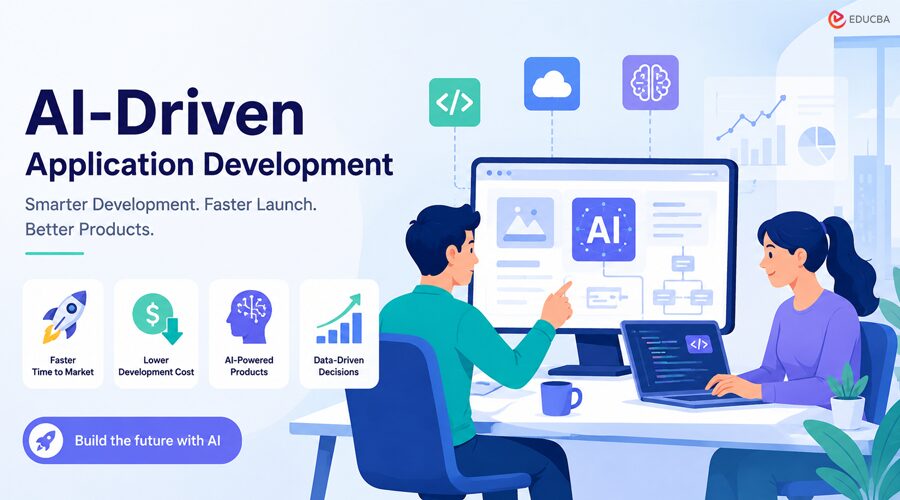
At the start of this year, a two-person startup shipped a working product in five weeks, no ML engineers on staff, no generative AI development services on retainer, and no sign of slowing down. That was the kind of result that would have demanded a funded engineering team and the better part of two quarters just a few years ago. When asked about it, the founder’s reaction was telling: “I keep waiting to find out what we did wrong; it feels like cheating.” It is not cheating, though; it is the new baseline, and many founders are only now catching up to what that actually means for their businesses.
Over the past eighteen months, the way startups build software has changed more than it did in the entire prior decade. The shift is not really about chatbots or viral demos, and it is quieter and more fundamental than most coverage of the topic suggests. The economics of product development have changed, and AI-driven application development is at the center of that transformation. The startups that understand why are steadily pulling away from those still building the old way.
The Real Advantage of AI-Driven Application Development Is not Speed
Speed is the obvious headline that everyone leads with when discussing AI-driven development. AI-driven application development is unambiguously faster; tools like Cursor, GitHub Copilot, and v0 have collapsed the gap between an idea and a clickable prototype. A strong engineer, paired with good models, genuinely ships more in a single day than they used to in a full week. Inference costs have fallen by more than 90% per token since GPT-4 launched, making the AI powering that work nearly negligible in terms of budget.
However, speed is not what is actually changing founders’ minds about how they want to build their products. The bigger win, which becomes clear once a team has lived through a few cycles, is reducing the cost of being wrong. For years, the smart advice was to fake it before you make it, landing pages, Wizard-of-Oz prototypes, anything to avoid sinking six months into a product nobody wanted. That advice existed because building was expensive, slow, and deeply unforgiving of bad bets.
When AI-driven application development makes building cheap and fast, guessing becomes a choice rather than a practical necessity. Teams can build the real thing, put it in front of real users, and learn from how people actually behave rather than how they claim they will in a customer interview. That is a profound shift in how a startup de-risks itself, and founders who lived through the old way are often the most energized by what it represents. They remember, viscerally, the compounding cost of being wrong slowly.
When Generative AI Becomes the Product, Not the Tool?
This is where the hype cycle tends to get the story exactly backward, misidentifying what actually matters about this moment. The most interesting use of generative AI in startups is not writing the code that powers the product; it is becoming the product itself. Two years ago, “AI features” usually meant a recommendation engine or some classification model running quietly in the background. Today, founders are building products where the generative layer is the value: support tools that draft replies in a brand’s voice, analytics apps that answer questions in plain English, and design tools that turn a single sentence into a usable layout.
These are not features bolted onto a normal application; the intelligence is the entire reason the product exists. That shift changes who can build what, and it does so far more dramatically than most people outside the startup world have recognized. A small team with a sharp insight into a specific problem can now ship something that genuinely feels magical through AI-driven application development, without a research lab or a large funding round behind them.
The winning approach is to lean on foundation models from OpenAI or Anthropic, wire in retrieval. Hence, the model understands the relevant domain and focuses the team’s energy on the thin, defensible layer that actually matters to users. This is precisely where a good generative AI app development company now spends most of its time, and it is where the real craft of the discipline has moved. The underlying model is increasingly a commodity that any well-funded team can access on the same terms, while what gets built around it is what makes a product genuinely worth using.
Common Challenges in AI-Driven Application Development
The failure modes in AI-driven development are real, and many teams encounter them at speed, often because the early stages of development feel almost effortless.
The Demo Trap
Generative AI makes the first 80% of a product almost suspiciously easy, and that ease is precisely where the trap is set. The model delivers something impressive in an afternoon, and it becomes tempting to assume the rest of the work will follow just as smoothly, though it never does, and teams that assume otherwise tend to pay for it dearly. The final 20%, where the product has to be reliable, handle edge cases gracefully, and not embarrass itself in front of a paying customer, is where the actual engineering lives. The gap between “the demo works” and “I trust this with real users” is considerably wider than it appears on the surface, and it is where most of the budget quietly disappears.
Brittleness
A product built on prompts can behave meaningfully differently when the underlying model updates, when a user phrases something unexpectedly, or when the input is messy, as real-world data always is. Teams that treat the model as an infallible magic box will inevitably be surprised at the worst possible moment. Teams that build proper evaluation frameworks, guardrails, and fallbacks around the model tend to sleep considerably better at night. That discipline is unglamorous, and it is exactly what separates something worth charging for from a prototype that merely looks like it could become one.
Cost Creep
Token costs feel trivial during testing and become very real at scale, catching many teams off guard when it matters most. A feature that’s cheap to demo can be genuinely expensive to run for ten thousand production users, and the math compounds quickly. The startups that win tend to think about this early, deliberately choosing where to route requests through a frontier model and where a smaller, cheaper one will do just as well. A single poorly scoped feature can quietly become the largest line item on a young company’s infrastructure bill before anyone in leadership notices.
The New Shape of an AI-Native Startup Team
Step inside an AI-native startup today, and the team composition looks noticeably different from what it did just three years ago. There are fewer people overall, and the ones who are there tend to be more senior and more deliberately chosen for the leverage they bring. The volume of routine work that once required a small army of junior developers is increasingly handled by AI, with oversight from someone experienced enough to recognize when the output needs correction.
This shift changes the math on raising money in ways that are still working their way through the startup ecosystem. A product that needed a million dollars and a ten-person team to reach a credible launch might now need a fraction of both, though that does not make engineers obsolete, a misconception worth addressing clearly. What it means is that leverage has increased significantly, and judgment matters more than ever in a world where AI-driven application development enables tooling to execute faster than at any prior point in software history. The bottleneck is no longer how quickly code gets written; it is knowing what to build and having the taste to distinguish genuinely good output from plausible-looking garbage that will cost time later.
For founders without that depth in-house, this is precisely the moment where partnering well pays substantial dividends. Bringing in a focused, experienced AI team early, even to establish the architecture and evaluation strategy, typically saves far more than it costs in mistakes that never have to be made. The expensive errors in this space are almost always the ones teams do not yet know to anticipate, and the right partner has already paid for those lessons on someone else’s project.
What AI-Driven Application Development Means for Founders Right Now?
The calculus has genuinely shifted in founders’ favor, and the smart move is to act accordingly rather than wait for the situation to feel more familiar. The biggest risk today is not moving fast enough in raw build speed; it is validating too slowly while a faster competitor learns from real users and compounds that knowledge into a meaningful lead. The cost of trying has dropped significantly in every practical dimension, which means the cost of not trying, of sitting on an idea. At the same time, someone else ships it, learns from it, and iterates on it, has risen by the same measure.
The founders pulling ahead, though, are not the ones deploying the most AI tools or chasing every new model release with breathless enthusiasm. They are the ones using AI-driven application development most deliberately: building real products, putting them in front of real users as quickly as possible, and being clear-eyed about the unglamorous engineering that turns a compelling demo into something people pay for and keep coming back to use. That two-person startup from the opening of this piece has its product in the market now, with paying customers, and the team is still just two people building with focus.
They stopped waiting to find out what they did wrong because evidence from real users made the answer clear over time. What they did right was the main thing: they built the real product, learned from real users, and refused to mistake the easy first 80% for the whole job. That is the approach that’s working across the board, and it is not magic, luck, or some unfair advantage. It is simply what building a startup looks like at this moment, and the founders who have fully internalized it are the ones worth watching carefully.
Recommended Articles
We hope this guide on AI-driven application development helps you understand how AI is transforming modern software development and empowering startups to build smarter, faster, and more efficiently. Explore these recommended articles for more insights on AI development, generative AI, startup technology, and digital innovation.


