


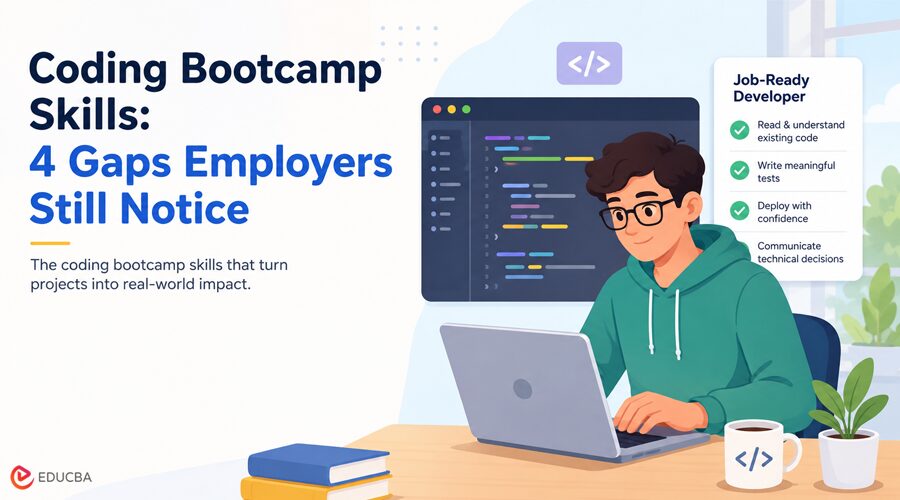
Coding bootcamps are good at teaching people to build something from a blank screen. Employers increasingly want proof that a junior developer can enter an existing codebase, understand what is broken, and fix it without creating a second problem.
A custom survey of 200 hiring managers across full-stack and front-end roles grouped the complaints into four practical areas: debugging unfamiliar code, writing meaningful tests, shipping beyond a local machine, and explaining technical decisions.
Those gaps do not mean bootcamp graduates cannot code. They show that building a portfolio project and working inside a production team are different jobs. Strengthening coding bootcamp skills in these areas can make graduates far more effective in real-world software development.
The market has made that distinction harder to ignore. LinkedIn’s 2026 U.S. Software Engineer Talent Landscape found that entry-level software-engineering hiring did not rebound at the end of 2025. HackerRank’s latest Developer Skills Report reached a similar conclusion: junior hiring remains weak even as overall tech hiring improves.
When fewer teams are willing to absorb a long ramp-up period, “junior” starts to mean job-ready sooner. Today, employers increasingly evaluate coding bootcamp skills by how well graduates perform in production-like environments rather than by the number of projects they have built.
Coding Bootcamp Skills
Here are some coding bootcamp skills every aspiring developer should master to become job-ready and succeed in real-world software engineering roles.
1. Debugging Code They Did Not Write
Bootcamp projects usually reward creation. Students choose the structure, know what every file is supposed to do, and can restart when the architecture becomes messy.
The first ticket at work may be a bug inside a six-year-old application with incomplete documentation, inconsistent naming, and behavior spread across several services.
This is why debugging has moved closer to the center of technical assessment. CodeSignal’s guidance for interview design says debugging exercises reveal whether candidates can investigate an existing application, identify the cause, and explain their reasoning. It also notes that understanding existing code is often more important than writing new code.
Graduates need practice with imperfect repositories, not only polished starter files. A useful exercise should include irrelevant logs, a misleading symptom, and more than one plausible cause. The candidate should reproduce the bug, narrow it down, and explain why the fix works.
Companies that need experienced support during junior staff training may use DesignRush’s web development agency listings to compare external teams. The internal goal should still be to give new developers safe ownership of real bugs, rather than leaving them on tutorial work for months.
2. Writing Tests That Catch Real Failures
Many bootcamp graduates can write a component or API route. Fewer can decide what should be tested, which test level fits the risk, and what a passing test proves.
A weak test repeats the implementation. A useful test protects behavior.
Junior developers should know the difference between unit, integration, and end-to-end testing. More importantly, they should understand when each one earns its maintenance cost.
For a checkout feature, that might mean a unit test for a pricing rule, an integration test for payment failure, and one end-to-end test covering the purchase path. It does not mean testing every line just to make a coverage dashboard look impressive.
Code review belongs here, too. CodeSignal says review simulations are gaining ground because they show whether a candidate can spot subtle bugs, question inefficient logic, and communicate feedback without rewriting the entire pull request.
The skill is not “knows Jest” or “has used Cypress.” It is recognizing what could fail in production and building the smallest reliable check around it.
Strong testing practices are among the coding bootcamp skills that hiring managers increasingly expect from entry-level developers.
3. Shipping Beyond Localhost
A portfolio link proves that an application ran once. Employers need to know whether the developer understands how software reaches users and what happens after release.
LinkedIn’s February 2026 workforce analysis found that demand shifted toward Python, cloud expertise, and AI-adjacent tools between 2021 and 2025, while the earlier skills surplus centered more heavily on HTML, CSS, and JavaScript.
That does not make front-end fundamentals less valuable. It means front-end roles now sit closer to infrastructure.
A junior developer should be able to use Git without treating every conflict like an emergency. They should understand environment variables, build commands, basic CI checks, logs, rollback options, and the difference between development and production behavior.
Designing a global cloud platform is not expected. Instead, they should be able to explain why secrets do not belong in a repository, diagnose why a build failed, and know where to look when a deployment fails.
A small capstone can teach this. Require students to open pull requests, pass automated checks, deploy from a protected branch, monitor one error, and document the rollback.
4. Explaining Decisions Without Hiding Behind AI
AI assistants have made it easier to produce code that looks finished. They have also made technical judgment more valuable.
The latest completed Stack Overflow Developer Survey is the 2025 edition because the 2026 survey only opened on June 23, 2026. Its AI findings show that 46% of developers distrust the accuracy of AI tools, compared with 33% who trust them. Only 3% said they highly trust the output.
HackerRank’s report found that 97% of developers use at least one AI assistant. The question is no longer whether a junior developer used AI. It is whether they can verify the result.
Hiring managers want candidates who can explain why they chose a data structure, what trade-offs they accepted, which edge cases remain, and how they verified the generated code. “The tool suggested it” is not a technical explanation.
This also affects teamwork. Developers need to ask clarifying questions, write useful pull-request descriptions, respond to review comments, and state uncertainty before it becomes an incident.
A strong assessment lets candidates use familiar tools, then asks them to defend the final code. CodeSignal recommends debugging, code review, and system design discussions because they expose the thought process rather than just the final output.
As AI becomes part of everyday development, communication and technical reasoning have become indispensable skills for coding bootcamps.
The Fix: Build Coding Bootcamp Skills Through a Production Sprint
Bootcamps do not need to add six more libraries to the syllabus. They need a final phase that resembles a small engineering team.
Students should inherit an unfamiliar repository, fix a documented bug, add tests, submit a pull request, deploy the change, and explain the decision in a short review. The instructor should introduce one failed build or incomplete requirement along the way.
Employers can improve the other side of the process. HackerRank found that 66% of developers prefer practical coding challenges, yet algorithm-heavy tests remain common. If the job involves reviewing React code and tracing API failures, the assessment should test those tasks.
These coding bootcamp skills are teachable. They are also more revealing than the number of frameworks listed on a resume.
Bootcamp graduates do not need to arrive as senior engineers. They do need to show that they can enter someone else’s system, make a controlled change, and leave the codebase easier to trust. Developing practical coding bootcamp skills that reflect real engineering workflows is the fastest path to becoming job-ready in today’s competitive software hiring market.
Recommended Articles
We hope this guide on coding bootcamp skills helps you build the practical abilities employers value. Explore these recommended articles for more insights on software development, coding careers, and developer interviews.

