


Updated June 23, 2026
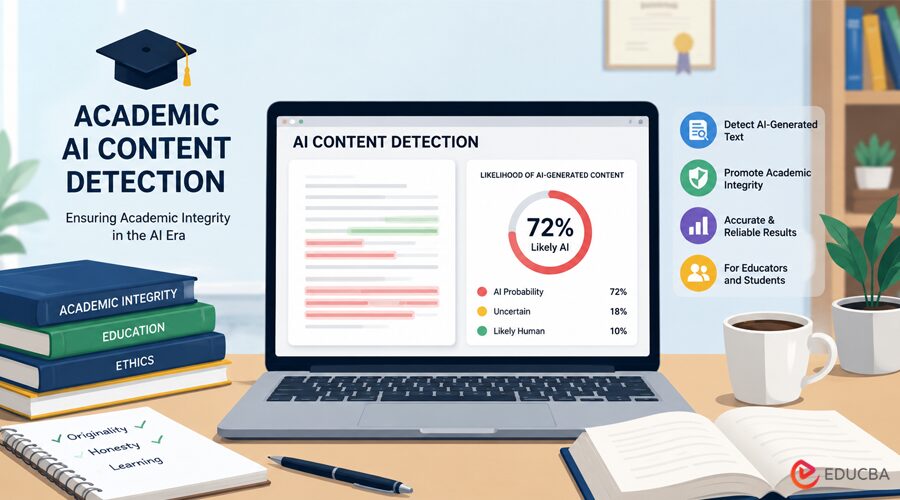
The rapid adoption of AI writing tools has introduced a new challenge for educational institutions and students alike: distinguishing between human-written content and text generated by large language models. As platforms such as ChatGPT, Claude, and Gemini become increasingly common, this issue now affects nearly every academic discipline, from elementary school assignments to doctoral research. As a result, academic AI content detection has become an important part of maintaining integrity in modern education. Understanding how detection technology works can help educators evaluate submissions more effectively and enable students to verify their work before submission.
How Does Academic AI Content Detection Work?
AI detection systems rely on measurable differences between human-written and machine-generated text. Human authors typically create content with greater variation in sentence structure, more diverse vocabulary, and less predictable word choices than AI models. To identify these patterns, detection tools analyze factors such as:
- Perplexity: Measures how surprising or unpredictable a piece of text appears to a language model.
- Burstiness: Evaluates variations in sentence length and structure throughout a passage.
- Linguistic Consistency: Assesses repetitive phrasing and predictable language patterns commonly associated with AI-generated content.
By quantifying these characteristics, detection systems estimate the likelihood that AI assisted in producing the text.
Why Detection Matters in Education?
For students navigating academic work in 2026, the reality is that many educational institutions now screen assignments using AI detection software. This process is not always intended to penalize students. In many cases, schools use detection systems to identify situations where additional writing support may be beneficial. Nevertheless, screening has become routine in academic workflows.
Students can gain insight into how their work may be assessed, while educators can make better-informed choices when selecting evaluation tools. Those researching the best AI detector solutions often compare platforms based on factors such as accuracy, false-positive rates, reporting transparency, and ease of integration into existing educational systems.
Choosing the Right Detection Tool
The ideal detection solution depends largely on the intended use case.
Individual Educators
For instructors reviewing occasional student submissions, a free or affordable web-based detector may be sufficient. Key considerations include:
- Ease of use
- Monthly usage limits
- Report clarity
- Cost-effectiveness
Schools and Universities
Large-scale deployments require additional capabilities, including:
- API integration with learning management systems
- Batch processing of submissions
- Administrative dashboards
- Audit trails and documentation
- Scalable pricing models
The needs of a high school English teacher are very different from those of a university registrar managing thousands of submissions annually.
The Importance of Benchmark Calibration
When evaluating detection software, institutions should look beyond advertised accuracy rates. A detector that performs well in internal testing but yields results that differ significantly from those of commonly used institutional systems can create confusion and inconsistency.
Reliable providers often publish benchmark comparisons showing how their scores align with those of established academic detection platforms. Transparent calibration helps educators interpret results more effectively and apply them within appropriate academic contexts.
Understanding the Risk of False Positives
False positives remain a significant concern in AI detection. When an original student submission is incorrectly identified as AI-generated, the consequences can extend beyond a simple technical error. Such situations can undermine trust and strain the relationship between students and educators. For this reason, detection results should be viewed as one piece of evidence rather than definitive proof. Educators should also consider:
- Previous writing samples
- In-class assignments
- Student writing history
- Direct conversations about the work
Unexpected detection results should encourage investigation and discussion rather than immediate disciplinary action.
The Evolving Detection Landscape
The field of AI detection continues to change rapidly. Tools that were considered highly effective a year ago may struggle against current-generation AI models. At the same time, newer solutions frequently introduce improved methodologies and stronger performance against emerging language technologies. Educational institutions should periodically reassess their detection strategies and conduct internal evaluations using samples that reflect the types of writing their students actually produce.
Tips for Students Reviewing Their Work
Students who wish to assess their own writing before submission can use detection tools as a quality-control measure rather than a final authority. The following practices often help produce authentic, clearly human-authored content:
- Include original analysis and critical thinking.
- Use specific examples drawn from personal experience or research.
- Develop a distinctive writing voice.
- Avoid overly generic or formulaic language.
- Revise sections that appear repetitive or predictable.
Even completely human-written work can sometimes trigger ambiguous detection scores if it lacks variation or originality. Reviewing and refining such content before submission can improve both writing quality and confidence.
Final Thoughts
As AI becomes increasingly integrated into education, the role of academic AI content detection will continue to expand. Effective detection tools can support academic integrity, but they should be used thoughtfully and in combination with professional judgment. For educators, selecting the right platform requires balancing accuracy, scalability, and fairness. For students, understanding how these systems work can help ensure that their original work is accurately represented and evaluated in an evolving academic environment.
Recommended Articles
We hope this guide to academic AI content detection helps you better understand AI detection tools and academic integrity. Check out these recommended articles for more insights on educational technology and responsible AI use.


