


Cybersecurity has long been treated as a technology problem – something to be handled by IT teams, security engineers, and the CISO. HR professionals, meanwhile, have traditionally focused on culture, compliance, talent, and employee experience. On the surface, these worlds look separate. In practice, they have never been more intertwined.
The reality is that most cyberattacks don’t start with sophisticated zero-day exploits. This is precisely why the CISO-CHRO alliance has become increasingly important in modern organizations. They start with people. An employee opened a phishing email. A contractor who still has active credentials 3 months after being offboarded. A team member using a personal device that hasn’t received a security update in weeks. Human behavior is the attack surface, and managing human behavior is HR’s domain.
The organizations that understand this are quietly building one of the most powerful partnerships in the modern enterprise: the CISO-CHRO alliance. And if your HR team does not already have a seat at the cybersecurity table, it is time to pull up a chair.
Why the CISO-CHRO Alliance Makes Cybersecurity an HR Issue?
The data speaks for itself. The IBM Cost of a Data Breach Report estimates that the average cost of a data breach worldwide has surpassed $4.45 million per incident, with many breaches linked to human mistakes or unresolved vulnerabilities within workforce systems.
Consider what HR owns:
- Employee personal data: Names, addresses, salaries, bank details, health records, and performance information sit in HR systems that are prime targets for attackers.
- Identity and access: HR drives onboarding and offboarding workflows, which directly determine who has access to which systems at any given time.
- Culture and behavior: Security awareness, reporting culture, and employees’ willingness to follow protocols are shaped by how HR communicates and trains.
- Remote and hybrid work policy: Decisions about where employees work, what devices they use, and which networks they connect to all have direct security implications.
When a breach compromises employee data, the consequences extend beyond the CISO. HR leaders find themselves managing employee distrust, regulatory fallout under GDPR, and reputational damage that affects recruitment and retention. The risk is shared. The responsibility should be too. These interconnected responsibilities demonstrate why a strong CISO-CHRO alliance is essential for protecting organizational data, reducing human-related risks, and strengthening overall cybersecurity resilience.
Closing the Operational Gaps That Leave Organizations Exposed
Here is where many organizations are currently failing: the CISO and CHRO are making decisions in parallel rather than in concert. Organizations often write security policies without HR input, resulting in poor communication, limited understanding, and weak compliance. Similarly, HR teams frequently make decisions—such as allowing BYOD, approving a new HR software platform, or granting network access to a remote contractor—without conducting adequate security reviews. A well-structured CISO-CHRO alliance eliminates these silos by enabling both teams to develop workforce decisions and security policies collaboratively.
The consequences show up in the gap between policy and practice. Employees use unsanctioned tools. Organizations delay offboarding processes, and teams fail to deploy security patches on personal or hybrid-use devices because no one takes responsibility for ensuring their deployment.
That last point deserves attention. Unpatched software remains one of the most consistently exploited vulnerabilities across enterprise environments. Research suggests that the majority of successful cyberattacks exploit vulnerabilities for which patches already exist – meaning the fix was available, but it was never deployed. In distributed, hybrid workforces where IT teams have limited visibility over every device in use, this becomes a critical problem. Enterprise patch management software has become an essential line of defense. Still, its effectiveness depends on HR and IT working together to ensure every device in the workforce ecosystem is in scope.
What Does a Successful CISO-CHRO Alliance Look Like in Practice?
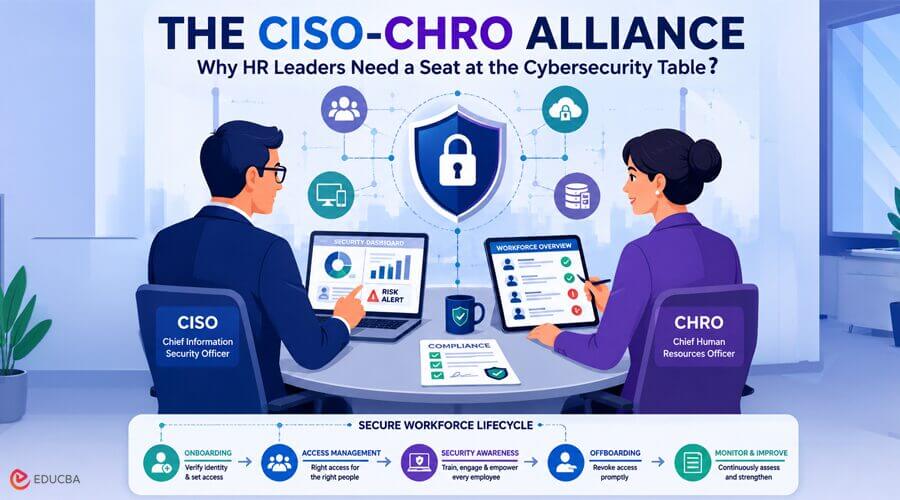
Building a successful CISO-CHRO alliance does not require either leader to become an expert in the other’s domain. It requires shared governance, aligned processes, and a common understanding of how workforce decisions create or reduce security risk.
Here are the four areas where the partnership delivers the most immediate value:
1. Onboarding and Offboarding
Every new hire represents a new access point. Every departure represents a potential liability if access is not revoked promptly. HR and security teams should operate from a shared, automated workflow that triggers identity provisioning and deprovisioning in real time. When these processes are manual and siloed, mistakes are inevitable.
2. Security Awareness and Culture
Security training cannot be a once-a-year checkbox exercise delivered through a forgettable e-learning module. CHROs can effectively embed security behaviors into the broader employee experience through onboarding communications, team culture initiatives, and clear escalation pathways that encourage employees to report suspicious activity without fear.
3. Policy Design and Enforcement
HR brings something the CISO often lacks: an understanding of how employees actually behave and what realistic constraints are. Policies drafted in isolation by security teams frequently fail in practice because they don’t account for workflow realities. HR input makes security policies more effective, not less rigorous.
4. Vendor and Technology Governance
HR teams regularly procure software – applicant tracking systems, payroll platforms, performance management tools, learning management systems. Each of these introduces a new attack surface. A joint review process ensures that security requirements are built into procurement decisions from the start, rather than retrofitted after a contract is signed.
How Are Regulatory Requirements Driving Cross-Functional Collaboration?
GDPR created a direct line of accountability for organizations that fail to protect personal data. Under GDPR, employee data carries the same legal weight as customer data – and HR departments hold vast quantities of it. The obligation to implement appropriate technical and organizational measures to protect that data is not the exclusive territory of the IT department.
NIS2, which came into force across the EU at the end of 2024, goes further still, placing explicit requirements on organizations to manage human-centric risks, including employees’ role in security governance. For many organizations, achieving compliance will require structural changes to how HR and security functions operate together.
A CHRO who treats this as a technology problem and delegates it to others assumes significant personal and organizational risk. The CHRO who treats it as a shared leadership challenge has the opportunity to become a strategic partner in one of the most important areas of enterprise resilience. As regulatory expectations continue to evolve, the CISO-CHRO alliance is becoming a critical component of compliance, governance, and enterprise risk management.
Building a Strong CISO-CHRO Alliance: Where to Start
If you’re an HR leader who has not yet had a substantive conversation with your CISO about shared risk, the time to start is now. A few practical first steps:
- Request a briefing on the organization’s current threat landscape and specifically where human factors – including unpatched systems in remote or hybrid environments – appear in the risk register.
- Review your offboarding process with an access management lens. How quickly are accounts deactivated? Who owns the handoff between HR and IT?
- Audit your HR tech stack for data protection compliance. When were these platforms last assessed? Do your vendors have documented patch and update policies?
- Propose a joint working group between HR, legal, and the security function to align on policy, training, and incident response.
Organizations that build a strong CISO-CHRO alliance can better manage human-centric cyber risks, improve compliance, and foster a more security-conscious workplace culture.
Cybersecurity is no longer a conversation that HR can afford to observe from the sidelines. The workforce is the perimeter. That makes HR leadership not just a stakeholder in organizational security, but also a key driver of a successful CISO-CHRO alliance and long-term cyber resilience.
Final Thoughts
As cyber threats increasingly exploit human vulnerabilities, organizations must view cybersecurity as more than just a technology function. A strong CISO-CHRO alliance helps organizations align people, processes, and technology to reduce risk and strengthen resilience.
By working together on workforce policies, security awareness, access management, and compliance, HR and cybersecurity leaders can create a more secure and adaptable organization. In today’s evolving threat landscape, collaboration between these functions is not just beneficial, it is essential.
Recommended Articles
We hope this guide on the CISO-CHRO alliance helps you understand the growing importance of collaboration between HR and cybersecurity leaders. Explore these recommended articles for additional insights into cybersecurity governance, risk management, and workforce security strategies.


