
What is a Bilateral Contract?
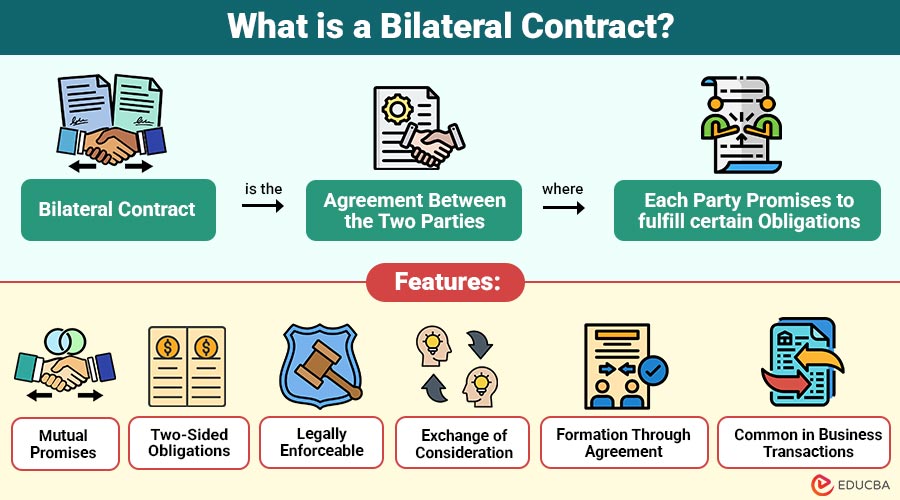
A bilateral contract is the agreement between the two parties where each party promises to fulfill certain obligations. A contract is formed when the promises are exchanged, rather than when the obligations are completed.
For example, if a company agrees to pay a supplier ₹50,000 for delivering raw materials next month, and the supplier promises to provide those materials on the agreed date, both parties have exchanged promises. This creates a bilateral contract.
Most commercial agreements are bilateral because they involve reciprocal commitments between parties. These contracts help establish clear expectations and provide legal protection if either party fails to perform their obligations.
Table of Contents:
Key Takeaways:
- Bilateral contracts create binding obligations through exchanged promises between both parties.
- Mutual consideration supports enforceability, providing legal protection against breaches of contract.
- Commonly used in employment, sales, service, real estate, and leasing agreements.
- Clear responsibilities improve business certainty, though disputes and breaches remain possible.
How Does a Bilateral Contract Work?
A bilateral contract operates through the exchange of promises between two parties.
The process generally follows these steps:
1. Offer
One party presents specific contractual terms outlining obligations, expectations, conditions, and responsibilities for the agreement.
2. Acceptance
The other party reviews and formally agrees to the proposed terms without any required modifications.
3. Exchange of Promises
Both parties mutually promise to perform specified actions or obligations within agreed timelines.
4. Consideration
Each party provides something of value, such as money, goods, services, rights, or benefits.
5. Performance
Both parties perform their promised duties in accordance with the contract’s terms and conditions.
6. Completion
The contract concludes successfully when all obligations are fulfilled and commitments are fully satisfied.
Features of a Bilateral Contract
The following are the features that define a bilateral contract and distinguish it from other types of contractual agreements:
1. Mutual Promises
Both parties make binding commitments, with each promise serving as consideration for the other.
2. Two-Sided Obligations
Each party assumes specific duties, responsibilities, and obligations under the agreement.
3. Legally Enforceable
Courts can enforce contract terms and provide remedies when either party breaches obligations.
4. Exchange of Consideration
Something of value, like as cash, products, services, rights, or advantages, is exchanged by both parties.
5. Formation Through Agreement
The contract becomes valid when both parties accept the terms and exchange binding promises.
6. Common in Business Transactions
Widely used in commercial dealings, employment arrangements, sales agreements, and service contracts.
Types of Bilateral Contracts
Bilateral contracts exist in various forms across business and personal transactions. The following are some of the most common types of bilateral contracts:
1. Sales Contracts
Sales contracts establish obligations in which sellers provide goods and buyers make agreed-upon payments.
2. Employment Contracts
Employment contracts legally define responsibilities, compensation, benefits, and expectations between employers and employees.
3. Service Contracts
Service contracts require one party to perform services while the other provides agreed-upon compensation.
4. Real Estate Contracts
Real estate contracts govern property transfers, clearly specifying buyer obligations and seller responsibilities.
5. Construction Contracts
Construction contracts outline project scope, timelines, responsibilities, and payment terms between contracting parties.
6. Lease Agreements
Lease agreements grant property usage rights while requiring tenants to meet rental obligations.
Examples of Bilateral Contracts
The following examples illustrate how bilateral contracts operate through an exchange of mutual promises between two parties:
1. Employment Agreement
A company offers a job with an annual salary of ₹8,00,000. The employee agrees to work full-time and perform assigned duties. Both parties exchange promises, creating a bilateral contract.
2. Product Supply Agreement
The provider pledges to supply 1,000 units of a product each month, and the buyer agrees to pay the agreed-upon amount upon delivery.
3. Real Estate Purchase
The buyer consents to pay the purchase price in line with the provisions of the contract, and the homeowner agrees to sell the property for ₹50 lakh.
4. Consulting Contract
A consultant promises to provide professional services, and the client promises to compensate the consultant upon completion of milestones.
5. Equipment Rental Agreement
A rental company agrees to provide equipment for a specific period, while the customer agrees to pay rental fees.
Difference Between a Bilateral Contract and Unilateral Contract
The following table highlights the major differences between bilateral and unilateral contract:
| Basis | Bilateral Contract | Unilateral Contract |
| Definition | Exchange of mutual promises | Promise exchanged for an act |
| Number of Parties Obligated | Both parties | Usually, one party initially |
| Formation | Created when promises are exchanged | Created when the requested act is completed |
| Consideration | Promise for promise | Promise for performance |
| Obligation | Mutual obligations | One-sided obligation until performance |
| Common Examples | Employment contracts, sales agreements | Reward offers, contests |
| Legal Relationship | Immediately after acceptance | Arises upon completion of the act |
| Business Usage | Very common | Less common |
Advantages of Bilateral Contracts
Bilateral contracts offer several advantages that make them among the most commonly used forms of agreement in business and personal transactions.
1. Clear Responsibilities
Clearly defined obligations help both parties understand expectations, significantly reducing disputes, confusion, and potential misunderstandings.
2. Legal Protection
Both parties gain enforceable legal rights and remedies if either party breaches a contractual obligation.
3. Business Certainty
Mutual promises provide assurance that agreed-upon responsibilities will be performed, thereby supporting predictable business operations.
4. Flexibility
Contracts can be tailored to effectively accommodate unique requirements, objectives, terms, and transaction-specific conditions.
5. Risk Allocation
Responsibilities and potential risks can be distributed appropriately, helping parties manage obligations more efficiently.
6. Strong Commercial Relationships
Well-defined expectations successfully encourage trust, cooperation, transparency, and long-term partnerships between contracting parties.
Disadvantages of Bilateral Contracts
While bilateral contracts provide legal certainty and mutual advantages, they also present certain disadvantages that parties should carefully consider before entering into agreement.
1. Risk of Breach
One party may fail to fulfill its obligations, leading to disputes, financial losses, and contractual complications.
2. Legal Costs
Resolving contract disputes often requires legal assistance, resulting in substantial expenses and lengthy proceedings.
3. Complex Negotiations
Large agreements may involve detailed discussions, revisions, and negotiations before reaching mutual acceptance.
4. Administrative Burden
Monitoring compliance, maintaining records, and enforcing obligations can regularly consume significant organizational resources.
5. Potential Delays
Contract performance may depend on another party’s actions, creating scheduling issues and project delays.
6. Ambiguous Terms
Unclear contract language can cause misunderstandings, disagreements, and an increased risk of litigation.
Final Thoughts
A bilateral contract is a common agreement where two parties exchange promises and assume mutual obligations. It provides legal enforceability, clarity, and protection in transactions such as employment, sales, services, and real estate. Understanding its features, advantages, limitations, and requirements helps parties reduce risks and manage agreements effectively.
Frequently Asked Questions (FAQs)
Q1. Is an employment contract a bilateral contract?
Answer: Yes. An employer promises compensation, and an employee promises to perform assigned duties.
Q2. When does a bilateral contract become enforceable?
Answer: It generally becomes enforceable once the offer is accepted and both parties exchange valid promises supported by consideration.
Q3. Can a bilateral contract be oral, or must it be written?
Answer: A bilateral contract can be either oral or written, depending on the nature of the agreement and applicable legal requirements. However, written contracts provide stronger evidence and greater clarity.
Q4. What is consideration in a bilateral contract?
Answer: Consideration is something of value exchanged between the parties, such as money, goods, services, rights, or promises, which makes the contract legally enforceable
Recommended Articles
We hope that this EDUCBA information on “Bilateral Contract” was beneficial to you. You can view EDUCBA’s recommended articles for more information.


