


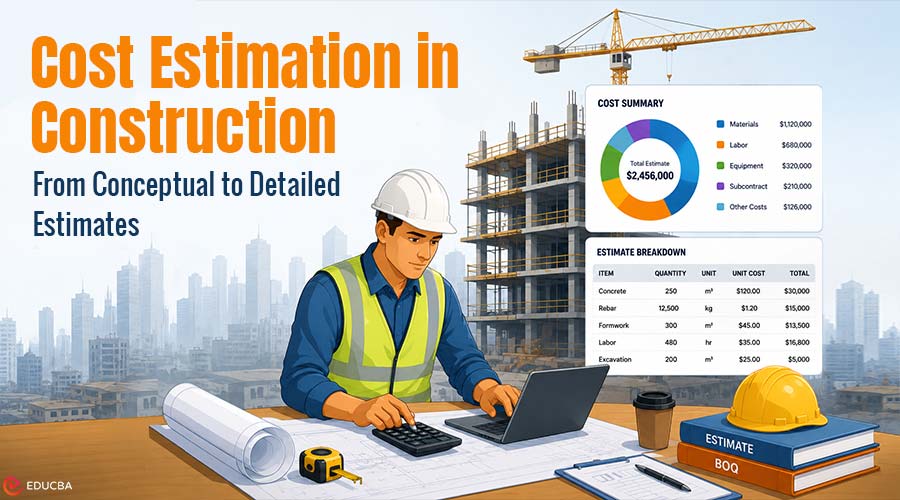
Every construction project, whether it is a single-family home or a multi-story commercial building, begins with a number. Before any contract is signed, before any material is ordered, someone has to answer the question: how much will this cost? That process, cost estimation, is one of the most consequential financial exercises in the entire construction lifecycle. Yet, it is often treated as a single step rather than the structured discipline it actually is. There are, by some counts, as many as 45 documented methods of cost estimation in construction, though most projects rely on a much smaller core set.
What matters more than memorizing all of them is understanding two things: which method applies at which stage of a project, and how accuracy itself changes as a project moves from a rough idea to a fully designed building ready for bidding. This guide explains what cost estimation actually is, the accuracy levels that define how reliable an estimate can be at different project stages, the main methods used to produce estimates, what an estimate should include, and how technology is changing the process. ACON Engineering is a construction cost-estimation and preconstruction consulting firm that produces estimates using all these methods and at various levels of accuracy for residential and commercial projects.
What is Cost Estimation in Construction and Why Does It Matter?
At its simplest, cost estimation in construction is the process of forecasting a project’s costs based on the information available when you prepare the estimate. That definition sounds straightforward, but the phrase “information available at the time” does a lot of work, as it is the key to understanding why estimates exist in multiple forms with varying levels of accuracy.
Cost estimation is not a single calculation performed once. It is a recurring exercise performed at multiple points across a project’s life, from the earliest feasibility conversations through final bid preparation. Each time it happens, the estimate serves a different purpose: an early estimate might determine whether a project is financially viable at all, while a later estimate forms the basis of a contractor’s bid and, eventually, a signed contract.
The financial stakes attached to this process are significant. An estimate sets expectations for budget, scope, and timeline that ripple through every subsequent decision. Project teams evaluate design choices against the estimate, and lenders arrange financing based on it. And when actual costs diverge from the estimate, which they inevitably do to some degree, the size of that divergence is a direct measure of how well the estimation process worked.
What Are the Five Levels of Construction Cost Estimate Accuracy?
One of the most widely used frameworks in cost estimation in construction is the five-level accuracy model that professional estimating standards define.
1. Order of Magnitude Estimate (±20%–30%)
This is the earliest form of cost estimation in construction. It is based on limited information such as building type, size, and historical data. It answers one question: Is this project financially feasible?
2. Schematic Design Estimate
At this stage, early design concepts are available. Cost estimation becomes slightly more refined as basic systems and layouts are introduced.
3. Design Development Estimate
More detailed drawings improve accuracy. Cost estimation in construction now includes more specific assumptions about materials and systems.
4. Construction Document Estimate
This stage includes detailed specifications and quantities, which makes cost estimation significantly more reliable.
5. Detailed Estimate (±3%–5%)
This is the most accurate form of construction cost estimation. It is based on complete construction documents and full quantity takeoffs. At this level, estimates are no longer assumptions—they are measurements.
What Are the Main Methods Used to Estimate Construction Costs?
Different methods are appropriate for different project stages and different levels of available information.
1. Unit Cost Estimating
Unit cost estimating calculates costs based on a standard unit of measurement, such as cost per square foot, per cubic yard, or per unit of material. For example, if you are estimating a house, you may begin with a cost-per-square-foot figure and multiply it by the total building area. This method is common in early-stage estimating because it is fast and easy to apply.
2. Assembly Estimating
Assembly estimating groups relate work items into major components or assemblies rather than pricing every item individually. For example, instead of estimating each part of a wall separately, the estimator may price the wall assembly as a single unit. This method is useful when enough detail is available to define major systems but not every individual item.
3. Parametric Estimating
Parametric estimating uses statistical models and cost drivers to predict project cost. You often use it when historical data is available and you can identify reliable variables. This method is especially useful when project size, capacity, or performance metrics strongly influence cost.
4. Analogous Estimating
Analogous estimating uses costs from similar completed projects as the basis for a new estimate. This method asks a practical question: what did a comparable project cost, and how is this project different? You often use this method in early-stage cost estimation in construction when only limited information is available.
5. Detailed Estimating
Detailed estimating breaks the project into individual materials, labor tasks, and equipment requirements. Contractors measure and price every major item separately. This method forms the foundation of final bid preparation and provides the most reliable form of cost estimation in construction when complete documents are available.
6. Bottom-Up Estimating
Bottom-up estimating evaluates individual project components first and then combines them into a total cost. This method works especially well for projects with both fixed and variable costs because it allows you to identify each cost element clearly instead of averaging everything together.
What Costs Should a Construction Estimate Actually Include?
A complete construction cost estimate is not just a single number representing “the project.” This method breaks down different cost categories, and each category behaves differently as project scope changes. Material costs vary directly with the quantity of work: more square footage means more flooring, more framing, and more drywall. Labor costs similarly scale with the amount of work performed, although market conditions influence labor rates independently of project scope. You may pay equipment costs as fixed expenses (such as renting a crane for the duration of a project regardless of daily use) or as variable expenses (such as fuel and operating costs that increase with usage).
This distinction between cost types that scale with project activity and those that do not is a foundational concept in cost accounting. For a deeper look at how fixed and variable costs behave differently and why that distinction matters for budgeting and forecasting, the underlying principles apply directly to how you structure a construction estimate: site mobilization, permitting, and certain equipment rentals act like fixed costs within a given project, while material quantities and labor hours scale with the size and complexity of the work. Beyond materials, labor, and equipment, a complete estimate also includes overhead (the costs of running the business beyond any single project), profit margin, and contingency—a reserve that accounts for unknowns in every project and that you size according to the level of uncertainty at the time you prepare the estimate.
How Does a Detailed Estimate Differ From a Conceptual Estimate?
The gap between a conceptual estimate (±20% to 30% accuracy) and a detailed estimate (3% to 5% accuracy) is not a gap in effort or skill. It is an information gap, and specifically, in one type of information: quantities. You can produce a conceptual estimate from very little information: a building type, an approximate size, and historical cost data for similar projects. It answers “roughly what should this cost” without knowing precisely what you will build. You cannot produce a detailed estimate the same way, because its accuracy depends on knowing exactly how much of everything the project requires: linear feet of framing, square feet of flooring, cubic yards of concrete, count of fixtures, and so on, all derived from a complete set of construction documents.
This is where a quantity takeoff becomes the foundation of the entire detailed estimate. Construction Takeoff Services from ACON Engineering produce exactly this kind of comprehensive, document-based measurement: identifying, measuring, and listing the materials, labor, and equipment requirements directly from project drawings. Without this step, a “detailed” estimate is not truly detailed; it becomes a conceptual estimate with more decimal places. It improves estimate accuracy from about 20–30% to 3–5% by measuring major quantities instead of relying on assumptions.
How is Technology Changing Construction Cost Estimation?
The tools used to produce construction estimates have evolved significantly, and the direction of that evolution is consistent: more automation in the data-gathering stage, freeing up estimator time for judgment and review rather than manual measurement. Cloud-based estimating platforms now allow teams to generate competitive bids in a fraction of the time manual processes required, through connected 2D and 3D takeoff tools that generate quantities directly from digital drawings, centralized document management, and automated workflows that reduce the repetitive manual work that used to dominate an estimator’s time.
Comprehensive cost databases built into modern platforms give estimators access to current pricing data without having to manually research every material category. The broader trend is the application of big data and AI to provide predictive insights, helping estimating teams identify patterns and potential issues earlier in the process. None of this changes the underlying logic of cost estimation; the accuracy levels and methods described above remain conceptually the same, but it changes how quickly and consistently you can achieve a given level of accuracy, especially for the quantity-heavy work that detailed estimating requires.
How Do You Get an Accurate Construction Cost Estimate for Your Project?
Everything in this guide points toward a practical conclusion: the right estimate for your project depends on where that project currently sits, and getting genuine accuracy, the 3-5% range associated with detailed estimating, requires both the right method and the underlying quantity data to support it. Construction estimating services from ACON Engineering cover the full range, from early feasibility-stage estimates for projects still in the conceptual stage to detailed, quantity-based estimates suitable for final bid preparation. Rather than applying a single generic approach regardless of project stage, ACON Engineering matches the estimating method to the information actually available, producing an order-of-magnitude estimate when a project is still conceptual and a fully detailed, takeoff-based estimate once construction documents are complete.
For homeowners, contractors, and developers, this matters because the cost of getting an estimate wrong is not symmetric. An overly optimistic early estimate can lead to a project that proves financially unviable once the real numbers arrive. An estimate that claims detailed-level accuracy without the underlying quantity data to support that claim can be just as misleading in the opposite direction, projecting a confidence level the numbers do not actually have. Matching the estimate to the project stage and being honest about the accuracy that stage can support makes an estimate genuinely useful for decision-making rather than just a number on a page.
Final Thoughts
Cost estimation in construction is a structured discipline with defined accuracy levels, ranging from order-of-magnitude estimates at ±20-30% during early feasibility through detailed estimates at 3-5% once construction documents are complete, and several core methods, including unit cost, assembly, parametric, analogous, and detailed estimating, each suited to different stages and types of projects. The difference between an initial rough estimate and a detailed final estimate largely comes down to the level of quantity information available, which is why a thorough quantity takeoff forms the basis of any highly accurate cost estimate.
Understanding which type of estimate your project needs and what level of accuracy is realistic based on the information you currently have separates an estimate that genuinely informs decisions from one that creates false confidence. Whether your project is at the conceptual stage or ready for detailed bid preparation, ACON Engineering’s construction estimating and takeoff services provide the methodology and underlying data needed to produce an estimate that aligns with your project’s current status.
Recommended Articles
We hope this comprehensive guide on cost estimation in construction helps you better understand methods, accuracy levels, and the estimating process. Check out these recommended articles for more insights and strategies to strengthen your construction planning and project budgeting decisions.

