
What is Enterprise Risk Management (ERM)?
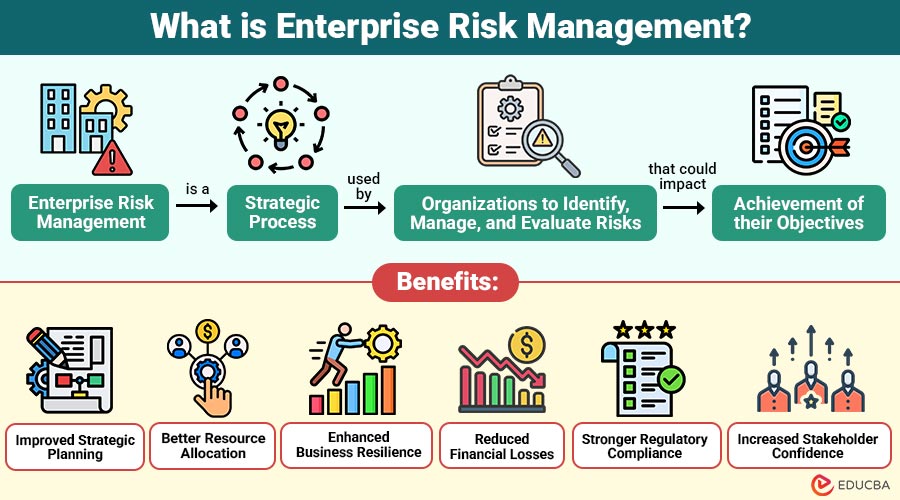
Enterprise Risk Management is a strategic process used by organizations to identify, manage, and evaluate risks that could impact achievement of their objectives.
Unlike traditional risk management, which often focuses on individual risks within specific departments, ERM takes holistic view of risk across the entire organization. It considers both threats and opportunities, helping management make better decisions while balancing risk and reward.
Table of Contents:
Key Takeaways:
- Enterprise risk management provides comprehensive approach to strategically identifying, assessing, and managing organizational risks.
- ERM improves decision-making by integrating risk considerations into business planning and operations processes.
- Effective ERM frameworks enhance resilience, regulatory compliance, stakeholder confidence, and long-term organizational success.
- Organizations use ERM to balance risks and opportunities while achieving strategic business objectives.
Key Objectives of Enterprise Risk Management
The primary objectives of enterprise risk management include the following:
1. Protect Organizational Value
ERM safeguards assets, resources, operations, and reputation by proactively identifying, assessing, and mitigating potential business risks.
2. Improve Decision-Making
ERM provides risk insights that help management make informed decisions aligned with organizational objectives and growth.
3. Enhance Business Performance
ERM enables efficient resource allocation, reduces disruptions, and supports sustainable growth through effective risk management.
4. Ensure Regulatory Compliance
ERM helps organizations meet legal requirements, industry regulations, and compliance standards while minimizing the risk of violations.
5. Increase Stakeholder Confidence
Strong ERM practices build trust among investors, customers, employees, and regulators through improved transparency and governance.
Components of Enterprise Risk Management
An effective ERM framework consists of several interconnected components.
1. Risk Identification
Organizations identify potential operational, financial, strategic, compliance, and technological risks that may impact objectives.
2. Risk Assessment
Organizations evaluate risk likelihood, impact, severity, and potential losses to prioritize mitigation efforts effectively.
3. Risk Response
Management selects appropriate strategies, including avoidance, reduction, transfer, or acceptance, based on risk tolerance.
4. Risk Monitoring
Organizations continuously track emerging risks, control effectiveness, regulatory changes, and evolving business conditions.
5. Communication and Reporting
Transparent risk communication ensures stakeholders receive timely information, supporting accountability and informed organizational decisions.
Types of Risks Managed Through ERM
Enterprise Risk Management addresses a wide variety of risks.
1. Strategic Risks
Strategic risks arise from competition, market changes, or decisions that hinder the achievement of long-term business objectives.
2. Financial Risks
Financial risks affect profitability, cash flow, and stability through market fluctuations, credit issues, or liquidity.
3. Operational Risks
Operational risks result from process failures, system breakdowns, human errors, or supply chain disruptions.
4. Compliance Risks
Compliance risks arise when organizations fail to consistently meet legal, regulatory, or industry-specific requirements.
5. Reputational Risks
Reputational risks damage brand image and stakeholder trust due to negative publicity or unethical actions.
6. Cybersecurity Risks
Cybersecurity risks include digital threats such as breaches, malware, ransomware, and vulnerabilities that affect business operations.
Enterprise Risk Management Frameworks
Several recognized frameworks help organizations implement ERM effectively.
1. COSO ERM Framework
The COSO ERM Framework is a structured risk management model that helps organizations identify, assess, manage, and monitor risks and align risk practices with strategy, governance, performance, and business objectives.
2. ISO 31000
An internationally renowned standard for risk management, ISO 31000 offers concepts and recommendations for detecting, assessing, and managing risks using a methodical, integrated, and constantly evolving methodology.
Benefits of Enterprise Risk Management
Implementing ERM offers numerous advantages.
1. Improved Strategic Planning
ERM helps organizations evaluate risks before decisions, supporting more effective strategic planning and execution.
2. Better Resource Allocation
Organizations allocate resources efficiently by prioritizing significant risks and focusing mitigation efforts accordingly.
3. Enhanced Business Resilience
ERM strengthens organizational resilience by improving preparedness for disruptions, crises, and unexpected business challenges.
4. Reduced Financial Losses
Early risk identification and mitigation reduce financial losses arising from operational failures or uncertainties.
5. Stronger Regulatory Compliance
ERM proactively identifies compliance risks, helping organizations meet regulations and avoid legal penalties.
6. Increased Stakeholder Confidence
Strong risk management practices build confidence among investors, customers, employees, and regulatory authorities.
Challenges of Enterprise Risk Management
Despite its benefits, ERM implementation may present several challenges.
1. Organizational Resistance
Employees and departments may resist adopting new risk management practices, which can make ERM implementation and integration challenging.
2. Lack of Risk Awareness
Without proper training and education, employees may overlook critical risks that could impact organizational objectives.
3. Data Limitations
Incomplete, outdated, or inaccurate data can reduce assessment accuracy and hinder effective enterprise risk management.
4. Resource Constraints
Limited budgets, personnel, and technology resources may restrict an organization’s ability to implement ERM successfully.
5. Rapidly Changing Risk Environment
Emerging cyber threats, regulations, and geopolitical uncertainties require organizations to continuously adapt risk strategies.
Real-World Example
Consider a multinational manufacturing company.
The company faces multiple risks, including:
- Supply chain disruptions
- Cybersecurity threats
- Currency fluctuations
- Regulatory compliance requirements
Using an ERM framework, the company:
- Identifies key risks across departments.
- Assesses their likelihood and impact.
- Develops contingency plans.
- Purchases insurance for specific exposures.
- Implements cybersecurity controls.
- Monitors risks through regular reporting.
As a result, the company reduces potential losses and improves operational stability.
Final Thoughts
Enterprise Risk Management (ERM) helps organizations identify, assess, and manage risks across all business activities. By integrating risk management into strategy and operations, ERM improves decision-making, strengthens resilience, and protects assets. An effective ERM framework enables businesses to address uncertainty, seize opportunities, and achieve sustainable long-term success.
Frequently Asked Questions (FAQs)
Q1. Is ERM only for large companies?
Answer: No, businesses of all sizes can benefit from ERM.
Q2. How often should ERM be reviewed?
Answer: It should be reviewed regularly, usually at least once a year.
Q3. Can ERM help identify opportunities?
Answer: Yes, ERM helps organizations recognize both risks and growth opportunities.
Q4. Does technology support ERM?
Answer: Yes, technology improves risk monitoring, analysis, and reporting.
Recommended Articles
We hope that this EDUCBA information on “Enterprise Risk Management” was beneficial to you. You can view EDUCBA’s recommended articles for more information.


