


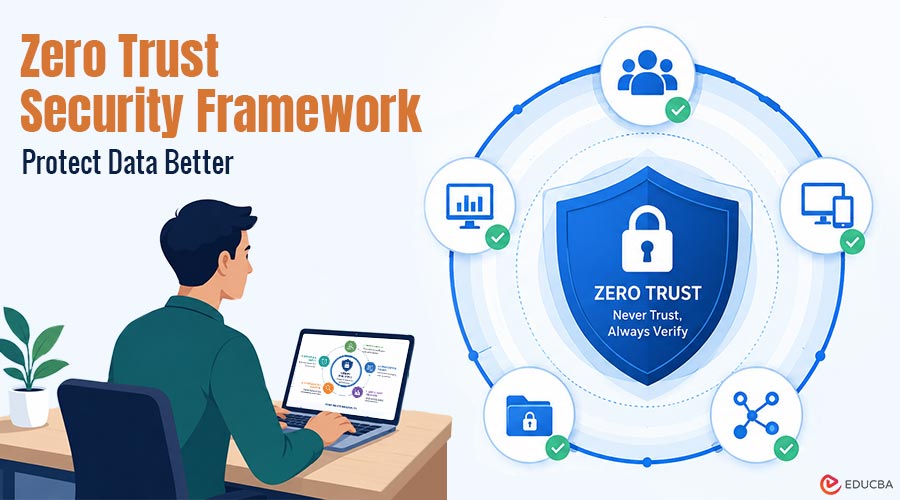
The digital landscape has evolved rapidly, making the zero trust security framework increasingly essential for modern organizations. What was once a relatively open digital frontier has become a minefield of sophisticated, automated cyber threats. For decades, organizations relied on the traditional “castle-and-moat” approach to cybersecurity: build a strong perimeter, keep attackers out, and trust everyone inside. This model worked reasonably well when networks were static, employees worked from office terminals, and data was stored on local servers.
However, the rapid acceleration of cloud adoption, the ubiquity of remote work, and the explosion of Internet of Things (IoT) devices have rendered the traditional perimeter obsolete. Attackers no longer need to breach the walls; they walk through the front door using stolen credentials and move laterally across networks with ease. In this new reality, the assumption that anything inside the network is safe is not just a vulnerability—it is a liability that organizations can no longer afford. As a result, the zero trust security framework has become a leading security approach, based on a straightforward yet powerful principle: never trust, always verify.
The Collapse of the Perimeter and the Rise of Essential Defenses
The fundamental flaw in the old security model lies in its binary trust model. Once a user or device is authenticated at the gateway, they are granted broad access to resources, assuming their identity was the only barrier needed. This approach crumbled the moment an attacker compromised a single endpoint. With the rise of ransomware-as-a-service and advanced persistent threats (APTs), adversaries have become experts at living off the land, using legitimate tools to evade detection while exfiltrating data or encrypting systems.
The perimeter has dissolved because the network itself is no longer a physical location; it is a dynamic ecosystem spanning public clouds, private data centers, and personal devices. When an employee accesses corporate email from a coffee shop in Paris, or a contractor connects from a home network in Ohio, the concept of a “trusted internal zone” becomes meaningless. Relying on firewalls alone is insufficient. To bridge this gap, organizations and individuals must deploy Virtual Private Networks (VPNs) to encrypt traffic across unsecured public Wi-Fi, ensuring that data remains unreadable to, let us call them, eavesdroppers.
Simultaneously, the reliance on weak, reused passwords has become a primary vector for attacks, necessitating the immediate adoption of robust password managers. A password manager can generate and store unique, complex credentials for every service, eliminating the risk of credential stuffing attacks, in which a breach at one site compromises accounts across the internet.
Embracing a Zero Trust Security Framework Through Layered Authentication
Enter Zero Trust, a security framework that operates on a single, uncompromising principle: never trust, always verify. Unlike its predecessor, Zero Trust assumes that the network is already compromised and that threats exist both outside and inside the perimeter. It requires strict identity verification for every user and device accessing resources. This architecture breaks down the network into micro-segments, ensuring that even if an attacker gains a foothold, their movement is severely restricted.
Access follows the principle of least privilege, giving users only the permissions needed to complete their tasks. Crucially, this framework relies heavily on Two-Factor Authentication (2FA) and Multi-Factor Authentication (MFA) as the bedrock of identity verification. Even if a password is stolen, attackers cannot get access without the second verification step. By integrating 2FA into every login process, organizations create a dynamic barrier that renders stolen credentials useless.
Furthermore, Zero Trust relies on continuous monitoring and analytics. Every access request is evaluated in real-time based on user identity, device health, location, and behavioral patterns. If a user suddenly tries to download a massive database from a location they have never visited, the system flags the anomaly and blocks the access instantly. This adaptive approach transforms security from a static gatekeeper into a responsive shield that evolves with emerging threats.
The Strategic Imperative for Business Leaders
For business leaders and executives, implementing a zero trust security framework is no longer solely an IT concern—it is a strategic priority that can significantly influence both financial performance and brand reputation. The cost of a data breach has skyrocketed, with average losses now exceeding $1 million, including regulatory fines, legal fees, remediation costs, and intangible damage to customer trust. In an era where cyberattacks are a leading cause of business failure, the ability to withstand a breach is a competitive advantage.
Implementing Zero Trust requires a cultural shift as much as a technological one. It demands that organizations move away from siloed security teams and adopt a holistic risk management approach. Leaders must invest in automation and orchestration tools to manage the complexity of continuous verification without bogging down productivity. Moreover, Zero Trust aligns perfectly with modern business agility, enabling secure remote work and seamless cloud integration without sacrificing safety.
By prioritizing this framework and equipping teams with essential tools such as enterprise-grade VPNs, centralized password management solutions, and mandatory 2FA, companies signal to investors, partners, and customers that they take data protection seriously. This transforms security from a cost center into a value driver, proving that resilience is a marketable asset. The question is no longer whether organizations can afford these technologies, but whether they can afford to go without them.
Taking Action: Securing Your Digital Future Today
Transitioning to a zero trust security framework is a journey rather than a one-time project, but taking the first step is critical. Organizations must begin by mapping their critical assets, identifying who needs access to what, and understanding how data flows across their environment. From there, they can implement IAM solutions, enforce multi-factor authentication (2FA), and segment networks to restrict lateral movement.
It is essential to partner with experienced cybersecurity professionals who can guide this transformation, ensuring that security measures enhance rather than hinder business operations. The time available to stay ahead of cyber threats is shrinking, and the consequences of inaction are becoming increasingly costly. Do not wait for a breach to force your hand. But this overwhelming sphere does not leave everything lost.
Final Thoughts
While the cybersecurity landscape may seem increasingly complex, organizations and individuals are not without options. Through continuous learning, industry collaboration, cybersecurity training, and the adoption of modern security practices, it is possible to stay ahead of evolving threats. The zero trust security framework provides a practical foundation for protecting sensitive data, limiting risk, and strengthening digital resilience. Ultimately, your data represents your digital identity and one of your most valuable assets. Protecting it requires the right plan, the right tools, and ongoing checks in a constantly changing threat landscape.
Recommended Articles
We hope this guide to the zero trust security framework helps you strengthen your cybersecurity strategy. Check out these recommended articles for more insights on protecting your digital assets and reducing cyber risks.


