


What is an Equity Kicker?
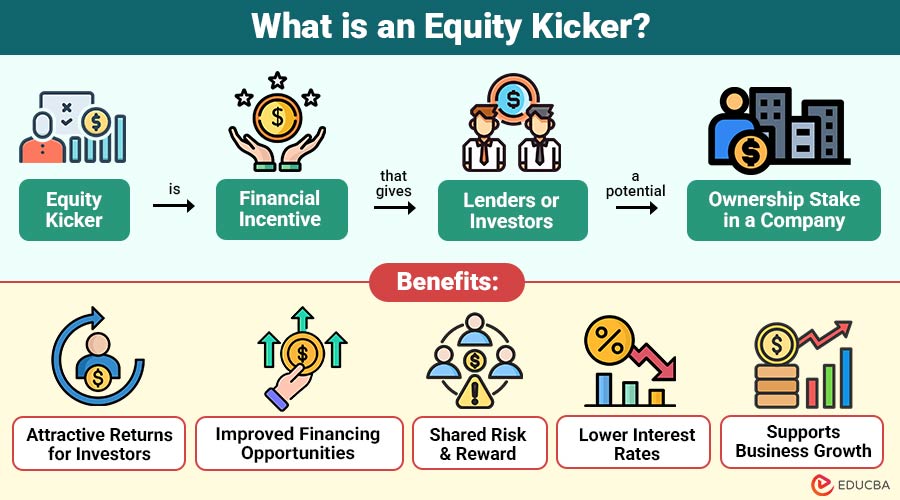
An equity kicker is financial incentive that gives lenders or investors a potential ownership stake in a company. It is typically offered alongside a loan or debt financing arrangement to make the investment more attractive. This additional benefit allows investors to participate in the company’s future growth and potential increase in value, while businesses can secure funding on more favorable terms.
Example:
Imagine a startup needs ₹1 crore to expand its business.
A lender agrees to provide the loan at a lower-than-usual interest rate. In return, the lender receives the right to purchase 5% ownership of the company at a predetermined future price. If the company’s value grows significantly, the lender can earn substantial profits from that ownership stake. This ownership right acts as the equity kicker.
Table of Contents:
- Meaning
- Working
- Why do Companies Use Equity Kickers?
- Benefits
- Limitations
- Common Types
- Real-World Example
- When is an Equity Kicker Most Useful?
Key Takeaways:
- Equity kickers combine debt financing with ownership incentives, significantly enhancing investor returns.
- Companies use equity kickers to secure funding while reducing borrowing costs.
- Investors benefit from interest income and potential equity appreciation as businesses grow.
- It supports business expansion but may dilute existing ownership stakes.
How Does an Equity Kicker Work?
An equity kicker combines elements of both debt and equity financing.
The process generally follows these steps:
- A company seeks funding.
- An investor or lender provides capital.
- In addition to the loan agreement, the investor receives an equity-related benefit.
- The company uses the funds to grow operations.
- If the company’s value increases, the investor gains additional returns through the equity component.
The lender benefits from both:
- Interest payments from the loan.
- Potential capital gains from the equity stake.
For investors, this structure strikes a balance between risk and profit.
Why do Companies Use Equity Kickers?
Many businesses use equity kickers to attract investors when traditional financing options are limited.
1. Lower Borrowing Costs
Companies can negotiate lower interest rates by offering equity incentives, reducing financing expenses, and lowering overall borrowing costs.
2. Easier Access to Capital
Startups and growing businesses often secure funding more easily when investors receive potential future ownership benefits.
3. Reduced Immediate Financial Pressure
Lower interest obligations help businesses preserve cash flow, supporting operations, expansion, and strategic investments.
4. Increased Investor Interest
Investors become more interested in funding opportunities when offered the potential to participate in future company growth.
Benefits of an Equity Kicker
Below are the key benefits of an equity kicker arrangement.
1. Attractive Returns for Investors
Investors have the opportunity to earn profits beyond regular interest income. If the company grows rapidly, the equity portion can generate significant gains.
2. Improved Financing Opportunities
Through equity kicker agreements, businesses that would not be eligible for standard financing might obtain additional capital, facilitating fundraising.
3. Shared Risk and Reward
Both the company and the investor benefit from the business’s success. This alignment of interests encourages long-term cooperation and value creation.
4. Lower Interest Rates
Because investors receive potential equity upside, they may be willing to accept lower interest rates compared to conventional high-risk loans.
5. Supports Business Growth
The additional funding obtained through an equity kicker can help companies expand operations, develop new products, hire talent, enter new markets, or pursue strategic acquisitions.
Limitations of an Equity Kicker
While equity kickers offer many advantages, they also come with certain limitations.
1. Ownership Dilution
When investors acquire shares, existing owners may lose a portion of their ownership percentage.
2. Reduced Future Profits for Founders
As new shareholders enter the business, future profits must be shared among more owners.
3. Complex Agreements
Equity kicker arrangements often involve legal and financial complexities. Proper documentation and valuation are required.
4. Potential Loss of Control
If investors receive substantial equity stakes, founders may have less control over business decisions.
5. Valuation Challenges
Determining a company’s future value can be difficult, especially for startups.
Common Types of Equity Kickers
Below are the commonly used forms of equity kicker arrangements in financing.
1. Warrants
A warrant gives investors, right to purchase company shares at a specified price within a certain period. If the company’s value rises, the investor can buy shares at the lower agreed price and benefit from the difference.
2. Stock Options
Investors can purchase shares at a fixed price at a later date with the help of stock options. These are frequently utilized in venture capital and startup funding.
3. Convertible Debt
Convertible debt starts as a loan but can later be converted into company shares. This structure is widely used by startups seeking early-stage funding.
4. Profit Participation Rights
Some agreements allow investors to receive a percentage of future profits instead of direct ownership. This provides an equity-like benefit without immediately issuing shares.
Real-World Example
Below is a simple example showing how an equity kicker works in practice.
Suppose a manufacturing company needs ₹10 crore for expansion.
A lender agrees to provide financing with the following:
- 8% annual interest rate.
- Warrants granting the right to purchase 7% of the company’s equity.
Over the next five years, the company expands successfully and doubles its market value.
The lender earns:
- Regular interest income.
- Significant profit from exercising the warrants and benefiting from the company’s increased valuation.
Without the equity kicker, the lender would only receive interest payments.
When is an Equity Kicker Most Useful?
Equity kickers are particularly beneficial in situations such as the following:
1. Startup Financing
Helps startups attract funding by offering investors potential ownership alongside capital investments.
2. Private Equity Investments
Enhances investment appeal by providing additional returns through future equity participation opportunities.
3. Real Estate Development Projects
Encourages financing by allowing investors to benefit from property value appreciation.
4. Leveraged Buyouts
Supports acquisition financing by offering lenders potential upside beyond regular debt repayments.
5. High-Growth Business Expansions
Assists rapidly growing companies in securing capital for expansion and scaling efforts.
6. Companies with Limited Access to Traditional Financing
Provides alternative funding opportunities when conventional loans are difficult to obtain.
Final Thoughts
An equity kicker is a financing arrangement that combines debt with potential equity ownership. It allows investors to share in a company’s future growth through warrants, stock options, or convertible securities while helping businesses secure funding at lower costs. Despite the risk of ownership dilution, it effectively aligns investor and company interests.
Frequently Asked Questions (FAQs)
Q1. Does an equity kicker dilute ownership?
Answer: Yes. If investors exercise warrants, stock options, or conversion rights, existing shareholders may experience dilution because additional ownership interests are issued.
Q2. Are equity kickers commonly used by startups?
Answer: Yes. Startups frequently use equity kickers because they often have limited access to traditional financing and can attract investors by offering future ownership opportunities.
Q3. Can an investor lose money with an equity kicker?
Answer: Yes. If the company underperforms or its value does not increase as expected, the equity component may be worth little or nothing, reducing the investor’s overall return.
Recommended Articles
We hope that this EDUCBA information on “Equity Kicker” was beneficial to you. You can view EDUCBA’s recommended articles for more information.


