


Updated June 3, 2026
Something is shifting in how businesses build their teams. Founders are hiring leaner. Overheads are shrinking. Operational output is not going down. In fact, for many businesses, it is on the rise.
The reason is clear in the data. Virtual assistants for business are no longer a workaround or a budget compromise. They have become a core part of how modern companies operate, scale, and compete. In 2026, the numbers behind this trend are bigger and more convincing than ever before.
Here is what the data actually says.
The Market Numbers Behind Virtual Assistants for Business
The market for business virtual assistants is no longer a niche corner of the economy. It is a fast-growing global industry with significant momentum.
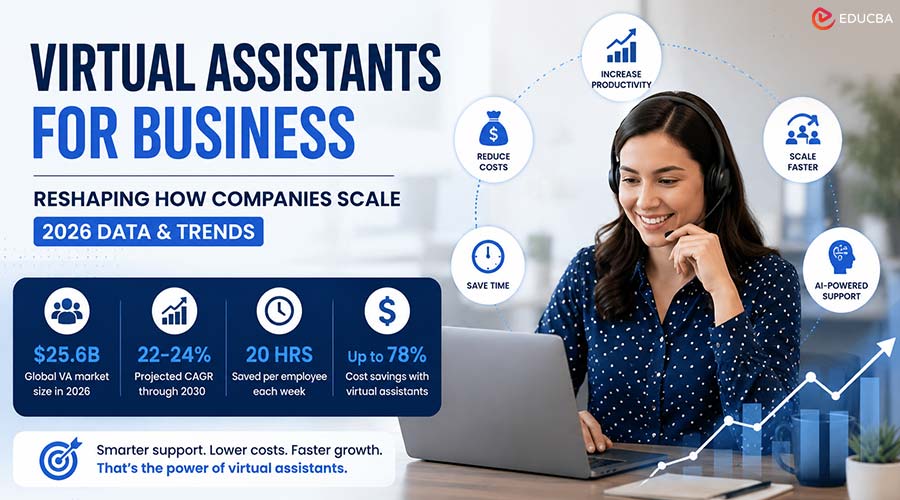
The global virtual assistant services market was valued at approximately $19.6 billion in 2025; projections for 2026 range from $23 to $24 billion, depending on the source. Looking further ahead, the market is expected to reach somewhere between $42 and $55 billion by 2035. This translates to a yearly growth rate of roughly 22 to 24 percent, far surpassing the average growth seen across the broader professional services sector.
Global demand for remote talent increased 29 percent year over year, driven by businesses shifting to hybrid and fully remote operations. There are now approximately 40 million VAs working worldwide, and that number continues to climb steadily.
The industry has grown roughly 475 percent since 2020. This is more than a passing trend. It represents a structural change in how businesses source and manage talent through virtual assistants.
What Does the Productivity Data Actually Show?
The case for investing in virtual assistants for business is not just about cost savings. The productivity data makes an equally strong argument.
Businesses that adopt VA support report an average 35 percent increase in workflow efficiency. Companies using VAs for customer service specifically have seen call center volume drop by up to 40 percent. Employees reclaim an average of 20 hours each week when routine and administrative responsibilities are assigned to the right support resources.
The ROI numbers are also clear. Businesses that hire well and onboard effectively typically see ROI within the first three to four weeks. For mid-sized firms, the average ROI on VA investment has been 320 percent in tracked studies. Entrepreneurs and founders who delegate 10 or more hours of work per week consistently report redirecting that time toward revenue-generating activities.
Remote workers, including VAs, also report 65% higher job satisfaction and productivity than their office-based counterparts, according to Airtasker research. Higher satisfaction often translates into stronger and more consistent performance.
Virtual Assistants for Business Across Key Industries
The adoption of virtual assistants in business varies across industries. Some sectors have moved faster and are seeing the clearest returns.
Real Estate
Real estate agents and investors have been among the earliest and most enthusiastic adopters of virtual assistants for business. VAs in this sector handle MLS updates, lead follow-up, transaction coordination, CRM management, and client communication. Real estate businesses report ROI multiples of 3.4 to 5.1 times on VA investment, among the highest of any industry tracked.
Healthcare
Healthcare-focused virtual assistants for businesses handled around 25 percent of patient triage queries in the United States in 2023, saving an estimated 2.5 million doctor-hours. These professionals manage appointment scheduling, patient records, billing support, and administrative coordination. Healthcare providers that adopted VA support reduced patient wait times by up to 50 percent and cut administrative processing delays by 20 to 30 percent.
E-Commerce
E-commerce is one of the fastest-growing sectors for the adoption of virtual assistants. VAs manage customer service inboxes, process orders, update product listings, handle returns and refunds, and run social media channels. Businesses in this space report a 15 percent increase in conversion rates when VAs handle personalized customer touchpoints. E-commerce VA support is projected to generate more than $1 trillion in additional global sales by 2027.
Startups and SaaS
Early-stage startups that use virtual assistants scale 2 to 3 times faster than those without them, while reducing founders’ workload by 15 to 20 hours per week. Instead of hiring full-time staff for every operational function, startups use VAs to cover administration, marketing, customer onboarding, and research without committing to permanent payroll. This model has become operationally standard for lean startups in 2026.
How Is AI Transforming Virtual Assistants for Business?
This is where the data becomes especially interesting. AI is not replacing virtual assistants for business. It is making them significantly more productive.
More than 40 percent of VAs now integrate AI-powered tools such as ChatGPT, Zapier, Make, and Claude into their daily workflows. VAs who use these tools deliver two to three times the output of those who do not. As a result, they command rates 20 to 40 percent higher.
The industry is increasingly described as an AI-augmented model. The VA handles judgment, context, client relationships, and quality control. AI manages volume, drafting, data processing, and speed. Together, they form a hybrid team that often outperforms either one alone.
By the end of 2026, an estimated 40 percent of VAs are expected to offer niche specializations that include AI-assisted workflows as a core capability. The gap between AI-proficient and non-AI-proficient VAs is expected to widen to a four- to five-times productivity difference by 2028.
Businesses that hire VAs without evaluating their proficiency with AI tools in 2026 may be overlooking significant productivity gains.
The Cost-Saving Benefits of Virtual Assistants for Business
The financial case for hiring virtual assistants for business continues to hold up under scrutiny.
Businesses save up to 78 percent on operational expenses by replacing in-house staff with VAs for comparable roles. These savings result from eliminating costs for benefits, payroll taxes, office space, equipment, and recruitment overhead.
For a single administrative role with a US salary of $47,000, the fully loaded annual cost, including benefits and overhead, typically ranges from $66,000 to $90,000. A full-time offshore VA covering the same functions costs between $12,000 and $31,000 per year. A nearshore VA from Latin America generally costs $25,000 to $50,000 annually, still significantly below the in-house benchmark.
Small and medium-sized businesses that adopt virtual assistants for business report 15 percent higher revenue growth than non-adopters over the same period. The savings are not purely operational. They also free up capital for reinvestment in growth.
What Virtual Assistants for Business Mean for Business Owners Right Now?
Several clear trends are shaping the next phase of business adoption of virtual assistants.
Specialization is deepening. By 2026, around 40 percent of VAs will offer highly specialized niche services tied to a single industry or platform. Hyper-specialized roles such as e-commerce operations manager, real estate transaction coordinator, and GoHighLevel automation specialist are becoming more common and more sought after.
Full-time dedicated engagements are becoming the dominant model. Project-based and shared VA arrangements are declining as businesses recognize the compounding value of long-term relationships. Full-time arrangements are expected to grow from 48 percent to more than 60 percent of all VA engagements by 2028.
Geographic talent hubs are also shifting. Latin America, with strong bilingual talent and US-aligned time zones, has become the fastest-growing region for nearshore VA hiring. The Philippines remains the dominant offshore hub. Both markets continue to rapidly expand their talent supply.
What Does This Mean for Business Owners Right Now?
The data points to one clear conclusion. Businesses that build operational systems around virtual assistants for business are growing faster, spending less, and freeing up leadership bandwidth for higher-value strategic decisions.
37% of small businesses already outsource at least one function, and 52% plan to do so by the end of 2026. The shift is not approaching. It is already underway.
Businesses that wait are not necessarily saving money. Instead, they may be spending their most valuable resource, time, on work that a trained VA could handle for a fraction of the cost.
Final Thoughts
The data makes the case clearly. Virtual assistants for business are no longer a support function operating on the edge of an organization. They are becoming a core part of how competitive, fast-moving businesses operate in 2026.
Market growth is accelerating. Productivity gains are measurable. AI integration is compounding value even further. The cost advantage over traditional hiring has never been wider.
The question is no longer whether virtual assistants for business deliver value. The data has already answered that. The real question is how quickly your business is prepared to capitalize on the opportunity.
Recommended Articles
We hope this guide on virtual assistants for business helps you understand how companies are improving productivity, reducing costs, and scaling more efficiently in 2026. Explore these recommended articles for additional insights and strategies to optimize operations, leverage remote talent, and accelerate business growth.


