


Updated July 27, 2026
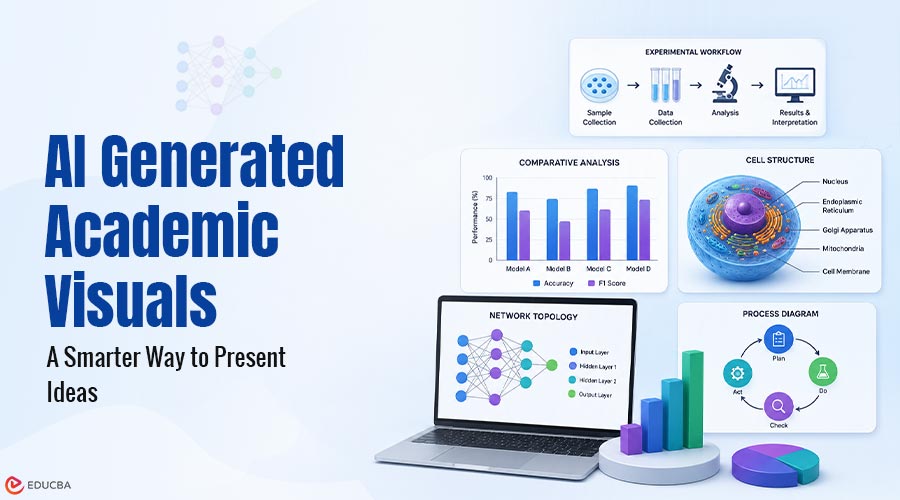
Academic work is becoming more visual than ever, and AI generated academic visuals are playing an important role in this transformation. Students, teachers, and researchers are no longer expected to communicate only through long paragraphs and traditional reports. They also need diagrams, research figures, workflow illustrations, concept maps, and presentation visuals to explain complex ideas clearly. This shift is easy to understand. A good visual can often explain a difficult concept faster than a long block of text. In education, this matters a lot.
Students learn better when information is organized visually. Teachers can explain lessons more effectively when they use diagrams. Researchers can make their papers, posters, and presentations easier to understand when their figures are clear and well-structured. However, creating academic visuals is not always easy. Many students and researchers understand their subject deeply, but they may not have professional design skills. They may know what they want to explain, but struggle to turn that idea into a clean and accurate visual. This is where AI tools are starting to make a meaningful difference.
Why Academic Visuals Matter?
Academic visuals are not just decorative elements. In many fields, they are part of the explanation. A biology student may need a diagram to show a cellular process. An engineering student may need a flowchart to explain a system. A computer science researcher may need an architecture diagram to describe a model. A business student may need a visual framework to present a strategy. In all these cases, visuals help readers understand structure, sequence, and relationships. Text can explain what happened.
A visual can show how different parts connect. This is why academic visuals are important in classrooms, research papers, conference posters, online courses, and thesis presentations. A strong visual can make a paper easier to read. It can make a presentation more memorable. It can help teachers maintain student engagement while also helping students organize their thoughts before they begin writing.
The Challenge of Creating Academic Figures
Even though visuals are useful, creating them can be time-consuming. Many students begin with general design tools or presentation software. These tools can work, but they often require manual effort. Users need to create shapes, align objects, choose colors, add labels, adjust spacing, and make sure everything looks balanced. For a simple diagram, this may be manageable. For a scientific figure or a detailed academic workflow, the process can take hours.
The challenge becomes bigger when the visual needs to be revised. In academic work, revision is common. A teacher may ask a student to simplify a figure. A supervisor may suggest adding more labels. A reviewer may ask for a clearer structure. A collaborator may want the visual in a different format. Because of this, academic visuals need to be both clear and editable. This is one reason AI-powered academic visualization tools are becoming more useful.
How AI Can Support Academic Visualization?
AI tools can help users move from an idea to a first draft much faster. Rather than starting with a blank page, users can simply describe the concept they want to explain. They may provide a research summary, a paragraph from a paper, or a simple prompt. The AI tool can then help generate a visual structure. For example, a student could describe a research method and receive a workflow diagram in return. A teacher could describe a classroom concept and receive an educational illustration. A researcher could summarize a section of a paper and create a draft figure for further editing.
Tools such as Paper Banana show how AI can support this process by helping users turn academic content into clearer visual outputs. The key benefit is not only speed. AI can also help users think visually. Many people know their subject well, but they are not sure how to arrange information on a page. AI can help suggest visual hierarchy, relationships, sections, and flow. This makes the first step much easier. Once the draft is created, the user can review, correct, and improve it.
Benefits of AI Generated Academic Visuals
Here are the detailed benefits of using AI-powered academic visuals for students, teachers, and researchers.
1. For Students
Students can benefit from AI visualization tools in several ways. First, these tools can save time. Instead of spending hours designing from scratch, students can quickly draft a document and focus on understanding the content. Second, visuals can improve learning. When students create diagrams, they often need to think carefully about structure and relationships. This can help them understand the topic more deeply. Third, better visuals can improve assignments and presentations. A clear diagram can make an essay, project report, or classroom presentation more professional and easier to follow.
This is especially useful for students in science, technology, engineering, medicine, business, and social science. These fields often require students to explain systems, models, processes, and research findings. AI does not remove the need for learning. Students still need to understand the topic and check the accuracy of the output. But AI can reduce the design barrier and make academic communication easier.
2. For Teachers
A teacher may use AI to create a concept diagram, a comparison table, a process illustration, or a simple visual explanation of a difficult topic. The teacher can then edit the output to match the classroom context.
Teaching adds a requirement that research figures do not have: the same concept often needs several versions. An introductory class needs a simplified pathway, while a senior seminar requires a more detailed explanation. A worksheet may need blank labels, while the answer key requires them filled in. Tools such as SciDraw AI are designed to edit an existing figure rather than regenerate it from scratch, allowing teachers to adjust labels and visual complexity for each format without rebuilding the diagram or relying on a single, fixed stock image.
For younger students, visuals may need to remain simple and easy to follow. For university students, they should include more technical detail. And for online learners, visuals often need to be clear enough to understand without live instruction or explanation. This flexibility can make AI-generated visuals useful in both traditional and digital learning environments.
3. For Researchers
Researchers also need strong visual communication. A research paper often depends on figures to explain methods, results, and conceptual models. A conference poster needs to communicate the main idea quickly. A presentation needs visuals that help the audience follow the argument. When research visuals are confusing, the work can be harder to understand. When they are clear, the research becomes more accessible.
AI tools can help researchers create draft figures faster, especially in the early stages of writing or presentation preparation. This can be valuable to graduate students, early-career researchers, and small research teams that lack access to professional design support. It can also help researchers explore different ways to explain the same idea. They can draft, revise, compare layouts, and choose the structure that best communicates the research.
Why Human Review Still Matters?
AI generated academic visuals should always be reviewed carefully. Academic communication requires accuracy. Labels must be correct. Relationships must make sense. The visual structure must match the real concept, method, or result. AI can make mistakes. It may oversimplify, misunderstand a term, or create a visual that looks good but does not fully align with the academic content. This is why human review is essential. The best workflow is to use AI as an assistant. AI can create the first draft, while the student, teacher, or researcher checks the logic and improves the final version. This combination can be very powerful. AI provides speed and structure. Human judgment provides accuracy and academic quality.
The Future of Academic Communication
Academic communication will likely continue becoming more visual in the future. As online learning expands, digital research collaboration increases, and students consume more visual content, clear academic visuals will become even more important. AI tools can help more people create professional-quality visuals without advanced design skills. This can improve both education and research communication.
For students, AI generated academic visuals can support stronger learning and more effective assignments. Teachers can reduce preparation time and improve educational resources. Researchers can make complex ideas easier to present and share with global audiences. The goal is simple: make knowledge easier to understand. When used responsibly, AI tools can help academic users communicate ideas more clearly, quickly, and confidently.
Recommended Articles
We hope this guide on AI generated academic visuals helps you create clearer research figures, educational diagrams, and academic presentations. Check out these recommended articles for more insights and strategies to improve visual communication in education.


