


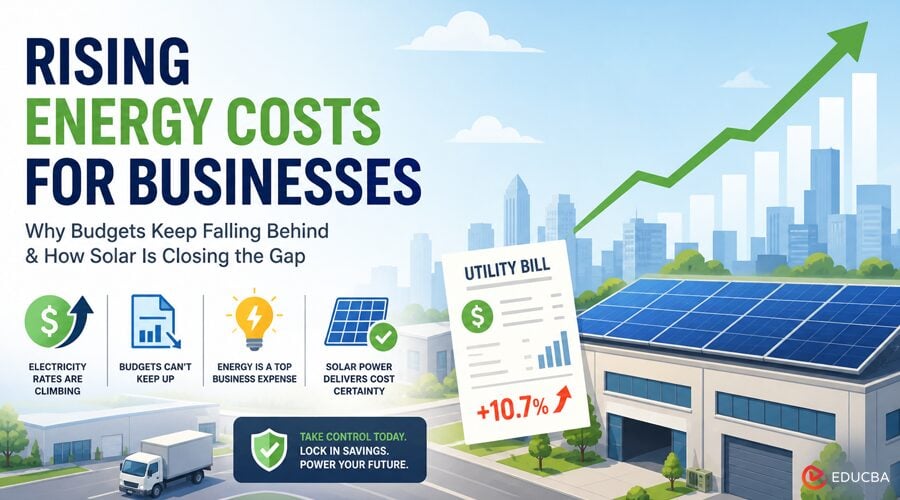
Rising energy costs for businesses in the United States have climbed 21 percent in the past five years alone, and the trajectory in 2026 shows no meaningful sign of reversal. According to the U.S. Energy Information Administration, commercial electricity rates rose 10.7 percent year over year as of February 2026, making the commercial sector one of the fastest-growing areas of electricity cost increases after transportation.
For most businesses, energy now ranks among the top three operating expenses. The problem is not simply that bills are higher. It is that the pace of increase has outrun the planning cycles most companies use to manage costs, leaving finance teams perpetually reacting to a number that was not in last year’s budget.
What Is Driving Rising Energy Costs for Businesses in 2026?
The causes behind rising commercial energy costs are structural, not temporary. The U.S. electrical grid is aging, and the cost of maintaining and modernizing it is passed directly through to ratepayers. Investor-owned utility companies have increased their spending on transmission and distribution by 300 percent since 2005. At the same time, electricity demand is surging from a new source that did not exist at scale a decade ago: data centers and artificial intelligence infrastructure. Record data center construction in 2025 pushed commercial and industrial electricity consumption beyond what existing grid infrastructure could handle, driving capacity prices in some regions to nearly ten times their previous levels.
Natural gas prices compound the problem. Because natural gas still powers a significant share of U.S. electricity generation, electricity prices closely track gas market volatility. Analysts project the Henry Hub natural gas spot price to average $4.80 per million BTU in 2026, up from $2.20 in 2024. That two-year doubling of fuel input costs has been passed through directly to electricity bills, particularly in regions that rely heavily on gas-fired generation.
The geographic spread of the problem has also widened. While the Northeast and West Coast have historically had the highest commercial electricity rates, 43 states and the District of Columbia saw higher electricity revenue per kilowatt-hour in February 2026 than the prior year. Rising energy costs for businesses are no longer a regional issue affecting only high-cost markets.
Why Rising Energy Costs for Businesses Are Outpacing Budgets?
The pace of increase is what separates the current energy environment from previous periods of elevated costs. Annual electricity price increases of 3 to 4 percent, which characterized most of the 2010s, are manageable within a standard operating budget. The 5.4 percent increase in 2026 follows a nearly 5 percent increase in 2025 and a 6.2 percent increase in 2023. These are compounding, not additives. A business that spent $10,000 per month on electricity in 2022 is now spending substantially more, and that gap widens with each billing cycle.
The structural budget problem is that most companies plan energy expenses on an annual cycle, locking in projections based on prior-year actuals plus a modest inflation assumption. Analysts project the Henry Hub natural gas spot price to average $4.80 per million BTU in 2026, up from $2.20 in 2024.
According to the Center for American Progress and the Natural Resources Defense Council, at least 242 electric and natural gas utilities have already implemented, been approved for, or are proposing increases between 2025 and 2027, affecting more than 111.5 million electricity customers. The pipeline of rate increases already in motion means the pressure on business energy costs is unlikely to ease in the near term.
The Fixed-Cost Trap Most Finance Teams Miss
One of the least understood dimensions of rising energy costs for businesses is the shift in how utility bills are structured. Historically, a business’s electricity bill scaled predictably with consumption: use more, pay more. In an increasing number of markets, rising fixed-cost components, particularly capacity charges, are disrupting that relationship.
These charges tie directly to a facility’s peak demand rather than its average consumption, and they rise sharply as grid operators pass through the costs of building generation capacity to meet peak loads.
The practical consequence is that a business that successfully reduces its average electricity consumption through efficiency upgrades may see a smaller-than-expected reduction in its actual bill, because the capacity charge component has grown. This dynamic discourages investment in efficiency by making returns harder to quantify, and it concentrates cost exposure in fixed charges that businesses have the least ability to influence through behavioral changes.
Demand response programs, time-of-use tariffs, and peak-shaving strategies offer partial remedies. However, most small and mid-size businesses cannot manage these operational changes without dedicated energy management resources. The result is a widening gap between large enterprises with energy procurement teams and smaller businesses, which absorb rate increases without a structured response.
What Commercial Solar Installation Providers Are Hearing From Business Owners?
The sustained rise in commercial electricity rates has led to a measurable shift in how business owners approach energy decisions. Solar installation providers serving commercial clients report that conversations that once centered on sustainability credentials have shifted almost entirely to payback period and cost certainty. Businesses that deferred solar evaluation two or three years ago are now revisiting those decisions, as rising energy costs have significantly strengthened the financial case for solar investments.
“What we are seeing in 2026 is that business owners are not asking whether solar makes sense anymore,” said Taha Masood, owner of Cosmo Solaris, a solar energy installation company. “They are asking why they waited. Every year they did not act, their utility bill went up, and the payback period on a solar system got shorter. The urgency is real now in a way it was not three years ago.” The shift Taha Masood describes is consistent with national market data: commercial solar installation activity has accelerated sharply as the spread between locked-in solar costs and rising utility rates has widened.
A reduction in upfront costs has also strengthened the financial case. Solar panel prices have fallen more than 90 percent over the past 15 years, and commercial installation costs in 2026 range from $2.50 to $3.50 per watt for most ground-mounted and rooftop systems. When combined with accelerated depreciation under MACRS and available state incentive programs, the effective first-year cost for many commercial installations is significantly lower than the sticker price suggests.
The Commercial Solar Installation ROI Case in 2026
The financial argument for commercial solar has strengthened in direct proportion to the pace of utility rate increases. Analysis by Paradise Energy found that the average payback period for a commercial rooftop solar installation is 9.01 years, with an average return on investment of 16.45 percent over the system’s life. In markets with above-average electricity rates, businesses document payback periods of 4 to 6 years, and ROI increases accordingly. A commercial system that costs $500,000 and saves $70,000 per year in electricity costs, with $150,000 in applicable tax incentives, reaches payback in approximately five years and continues generating cost savings for 20 or more years beyond that point.
The Compounding Advantage of Acting Early
Because electricity rates compound annually, the value of locked-in solar generation increases with each subsequent rate hike. A system installed in 2026 that saves a business $30,000 in its first year of operation will generate savings of $37,000 to $45,000 in its tenth year, assuming electricity rates continue rising at their recent pace of 4 to 6 percent annually. The business that waits another three years to evaluate solar does not simply delay the savings; it pays escalating utility bills during that period. Then it installs into a market where its competitors have already locked in three additional years of cost certainty.
Power purchase agreements offer an alternative path for businesses that cannot deploy capital for direct ownership. Under a PPA, a solar developer installs and owns the system on a commercial property while the business purchases the electricity produced at a fixed, below-market rate. The business pays nothing upfront and immediately begins receiving electricity at a rate below its utility tariff, with contractual price escalators typically set well below the utility rate trajectory.
Managing Rising Energy Costs for Businesses Without Waiting for the Market
The near-term forecast for commercial electricity rates offers no relief. The EIA projects wholesale electricity prices to reach $51 per megawatt-hour in 2026, an additional 8.5 percent increase over 2025 levels, which were already 23 percent above 2024 levels. Businesses that are building their energy cost management strategy on the expectation that rates will stabilize or fall are basing it on a premise that current data does not support.
The practical responses available to most businesses looking to reduce commercial energy bills fall into three categories. Energy procurement strategies, including fixed-rate contracts and hedging in deregulated markets, convert volatile variable costs into predictable fixed expenses. Efficiency upgrades reduce consumption at the margin and directly offset the per-kilowatt-hour increase without addressing the underlying rate trajectory. On-site generation through solar panel installation for business addresses the root issue by replacing a variable, escalating cost with a finite, depreciating capital investment that eventually produces free electricity once the system is paid off.
None of these strategies requires waiting for the market to cooperate. The businesses navigating rising energy costs most effectively in 2026 are not the ones with the best utility contracts or the most aggressive efficiency programs, though both help. They are the ones who treated energy as a strategic cost center three or four years ago and built responses into their financial planning, only for each successive rate increase to make those responses more expensive.
Recommended Articles
We hope this guide on rising energy costs for businesses helps you understand the key drivers behind increasing electricity rates and their impact on operating budgets. Explore the recommended articles below to learn more about cost-saving strategies, commercial solar solutions, and long-term energy management approaches.


