


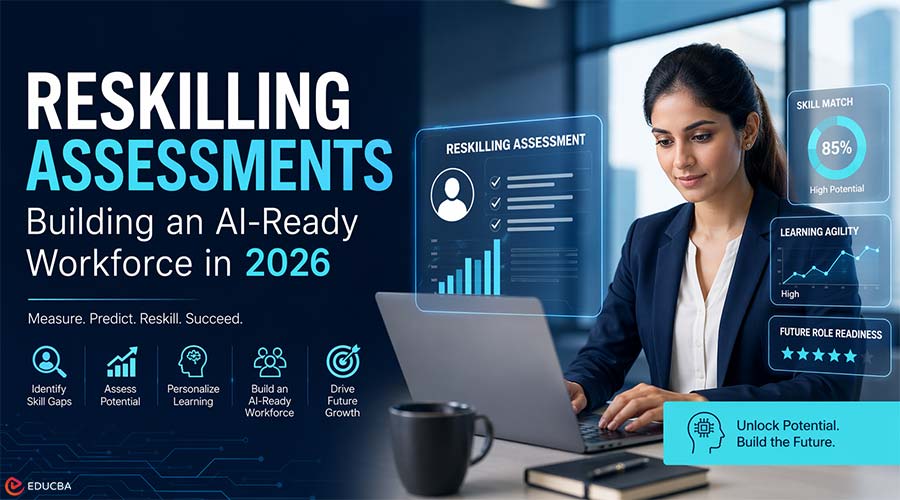
For a very long time, companies have been following a straightforward, simple approach to building a workplace of talented individuals. It starts with hiring the person, providing them with training, and giving them a promotion every 2 years. Due to constant changes in corporate culture and in job requirements, this hiring model is collapsing.
At the center of this shift is the Artificial Intelligence Course, no longer reserved for technical teams but increasingly seen as a foundational learning path for employees across functions. Alongside this transformation, reskilling assessments are becoming essential tools for organizations that want to build an AI-ready workforce.
Organizations are not just changing the format of work; they are redesigning the work itself. This shift is not simply about jobs but about the definition of capabilities. Organizations have reached a point where brands and multinational corporations are no longer asking questions such as “Where did you go to college?” Instead, they are asking, “Can this person perform this task?” and, if not, “Do they have the ability to learn it?”
Skills have become the most important factor, especially as the market continues to see new job opportunities emerging due to the rise of artificial intelligence. By the middle of this decade, businesses will need to reskill nearly 60% of their workforce, as automation eliminates tens of millions of existing jobs while creating even more new roles.
In this environment, the most valuable organizational tool is no longer a learning management system or a training catalog. It is the reskilling assessment. 2026 marks the shift from training programs to skill intelligence, from teaching employees to measuring adaptability.
The End of the Job Description Era
Companies have long hired for a job role, but now they are hiring for capabilities. A modern organization no longer asks, “Can you do this job?” Instead, it asks, “Can you learn what comes next, and how quickly can you learn it?”
At the same time, companies face a strange paradox: they lay off employees while still struggling to find skilled talent. This creates a situation where organizations experience workforce reductions and skill shortages simultaneously. At this point, more than 80% of companies are struggling to find employees with the required skills, as automation has removed routine work.
Companies face this mismatch because jobs are disappearing faster than workers can transfer their skills. Traditional hiring systems cannot solve this. Training programs alone cannot solve this either. What organizations need is visibility and a dynamic map of workforce capability. This is where talent assessment tools like TestnHire become mission-critical, providing the data-driven insights needed to bridge the gap between current talent and future needs.
That is exactly what reskilling assessments provide.
What Reskilling Assessments Actually Are?
A reskilling assessment is not a traditional test. It is a diagnostic framework that evaluates:
- Transferable cognitive abilities
- Learning agility
- Adjacent skill readiness
- Behavioral adaptability
- Future-role compatibility
This is not a test that reveals an employee’s current knowledge or technical base. Instead, reskilling assessments predict future capability, measuring what employees can become tomorrow.
The first step is to identify skills gaps. Companies are increasingly embedding reskilling assessments within learning programs because understanding capability gaps is the first step toward development.
In simple terms:
Training teaches employees new skills, while reskilling assessments predict future performance.
Moreover, in the modern workplace, prediction holds more importance than static knowledge.
Why 2026 Changes Everything for Reskilling Assessments?
Three forces converge in 2026, making reskilling assessments central to business strategy.
1. AI Is Restructuring Tasks, Not Just Jobs
Automation no longer replaces entire professions; it replaces parts of them.
The same role now contains:
- Automatable tasks
- Augmented tasks
- Human-only tasks
Organizations must decide what employees should stop doing, continue doing, and start learning. Without assessment data, that decision becomes guesswork.
2. Skills Expire Faster Than Degrees
The average useful life of a skill is shrinking rapidly. Workers cannot rely on one qualification for a full career anymore. Continuous learning is becoming an operational capability rather than a career choice.
This is why most employers now prioritize reskilling strategies across the workforce.
3. Career Paths Are Becoming Fluid
Career ladders are turning into career lattices. Employees move across functions rather than climb vertically. A marketer becomes a data analyst. A customer support agent becomes a product specialist. A finance professional becomes an AI operations manager.
The limiting factor is no longer experience; it is transferable capacity. Reskilling assessments reveal that capacity.
From Training Programs to Skill Intelligence
The old learning model looked like this:
- Identify training need
- Provide course
- Hope for improvement
The 2026 model looks like this:
- Map workforce capabilities
- Predict role evolution
- Measure readiness
- Assign personalized pathways
- Continuously reassess
The major difference between training and reskilling assessments is that training helps us respond to a situation, whereas assessment helps us anticipate it.
The Four Layers of Modern Reskilling Assessments
1. Capability Mapping
It is a kind of survey to understand what all people working in a company can do; it is not dependent on their titles but on their actual skills. It might be that a man working as a sales executive has a knack for data interpretation, stakeholder communication, or negotiation psychology. The company can map its employees by skill and utilize them accordingly, facilitating a transition.
2. Adjacency Analysis
This also provides an employee with a smooth transition, obviously, if they are looking to make a career move. It is a known problem that working professionals find it extremely difficult to transition to a different job role or work. Assessments solve this by identifying the shortest learning bridge between roles.
3. Learning Velocity Measurement
Two employees with identical knowledge can have drastically different learning potential.
Modern assessments evaluate:
- Problem-solving speed
- Pattern recognition
- Concept absorption
- Adaptability under change.
This predicts who can reskill the most valuable trait in the AI economy most quickly.
4. Human Skill Index
As technology advances, human skills become increasingly important. Demand is rising for abilities such as collaboration, resilience, and ethical judgment, alongside technical skills. Reskilling assessments, therefore, measure behavioral intelligence as seriously as technical competence.
The Business Case for Reskilling Assessments
Reskilling is no longer a cost center; it is a competitive advantage. Organizations that invest in workforce development see stronger retention, productivity, and innovation.
However, here is the real reason assessments matter: Hiring externally solves today’s problem. Reskilling solves tomorrow’s problems.
Companies that rely solely on recruitment chase scarce skills. Companies that use reskilling assessments create skills before the market demands them.
They stop competing in the talent market and start creating their own.
The Ethical Dimension of Reskilling Assessments
There is also a fairness argument. Without assessments, reskilling decisions often depend on a manager’s perception or past performance. This favors visible roles and disadvantages hidden potential. Data-driven skill measurement changes that.
It identifies:
- quite high-potential employees
- unconventional career movers
- late bloomers
- nontraditional backgrounds.
In other words, reskilling assessments democratize opportunity. They replace bias with capability.
The Risk of Ignoring Reskilling Assessments
Organizations that delay adopting reskilling intelligence face three predictable outcomes:
- Constant hiring shortages
- Expensive layoffs and rehiring cycles
- Workforce resistance to change.
Meanwhile, competitors quietly redeploy talent internally.
The gap compounds over time, not in technology, but in adaptability.
Final Thoughts
Companies have been trying to portray themselves or even work towards being seen as an organization that believes in learning, but it is not enough anymore. Now, companies have to be adaptive organizations, which requires prediction, which in turn requires measurement, and measurement requires assessment. This is where the Artificial Intelligence Course delivers its greatest value.
Do not confuse reskilling with an HR tool or a gimmick; it is not even a training feature or an experiment; it is the total infrastructure for the future of this workforce. In the AI age, organizations must measure adaptability to manage productivity effectively. Although Testgorilla is a major player in talent assessments, considering Testgorilla alternatives is no longer optional in the age of rapidly growing AI.
While machines drove productivity in the industrial age and expertise defined it in the knowledge age, adaptability now determines productivity in the AI age. Moreover, organizations cannot train adaptability blindly; they must first understand it. That understanding begins with reskilling assessments.
Recommended Articles
We hope this guide on Reskilling Assessments helps you understand how organizations measure learning agility, identify future-ready talent, and prepare employees for an AI-driven workplace. Explore the recommended articles below to learn more about workforce reskilling strategies, talent assessment tools, and building an AI-ready workforce.


