
What is Liquidity?
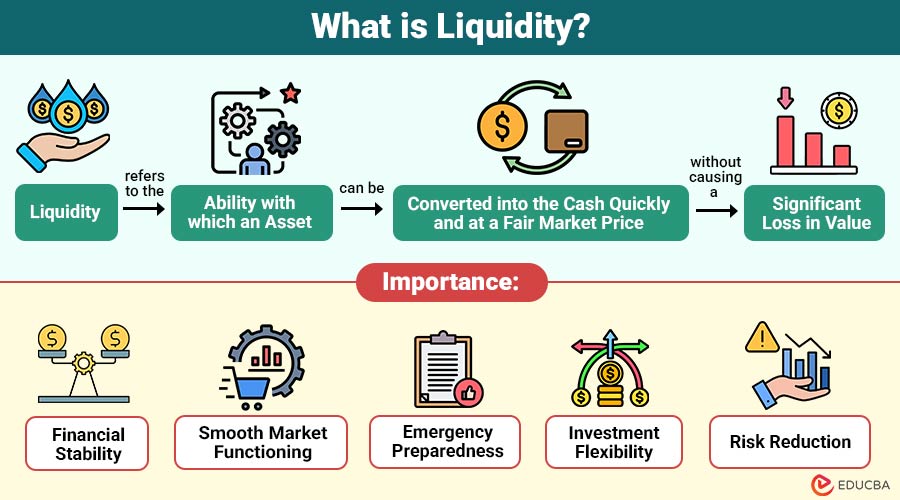
Liquidity refers to the ability with which an asset can be converted into the cash quickly and at a fair market price, without causing a significant loss in value. It also indicates the ability of individuals or businesses to meet their short-term financial obligations.
Table of Contents:
- Meaning
- Importance
- Types
- Liquidity in Financial Markets
- Ratios
- Factors Affecting Liquidity
- Advantages
- Disadvantages
- Crisis
- Real-World Examples
Key Takeaways:
- Liquidity is ability to convert assets into the cash rapidly without a significant loss of value.
- It ensures financial stability, smooth transactions, and readiness for unexpected emergency needs.
- It varies across markets, assets, and financial systems depending on demand conditions and levels.
- Maintaining balanced liquidity helps reduce risk and significantly improve overall long-term financial performance.
Importance of Liquidity
Liquidity plays a important role in maintaining financial health and ensuring smooth economic and business operations.
- Financial Stability: Helps individuals and businesses meet short-term expenses easily without financial stress or disruption in operations.
- Smooth Market Functioning: Enables investors to buy and sell assets quickly, ensuring stable prices and efficient market activity.
- Emergency Preparedness: Provides quick access to cash during emergencies, helping manage unexpected needs such as medical expenses or repairs.
- Investment Flexibility: Allows investors to adjust portfolios quickly, based on market trends and financial goals, efficiently.
- Risk Reduction: Reduces financial risk by ensuring cash is available during uncertain economic conditions or downturns.
Types of Liquidity
It can be categorized into multiple types depending on context:
- Market Liquidity: Ability to quickly buy or sell assets without significantly affecting their market price, ensuring smooth and efficient trading conditions. Example: Shares of large companies can be sold quickly without changing price much.
- Accounting Liquidity: Measures a company’s ability to meet short-term obligations using current assets, evaluated through financial ratios like current and quick ratios. Example: A company uses cash and inventory to pay short-term bills on time.
- Funding Liquidity: Refers to ease of accessing cash or credit to meet financial needs, including loans, credit lines, or internal funds availability. Example: A business takes a short-term loan to cover immediate operational expenses.
Liquidity in Financial Markets
It plays a vital role across different financial markets, ensuring efficient trading, price stability, and smooth transactions.
- Stock Market: In stock markets, liquidity facilitates the rapid buying and selling of shares with narrow bid-ask spreads and stable prices.
- High Stocks: Large companies like Apple or Reliance Industries have highly liquid shares due to strong demand and frequent trading activity.
- Bond Market: Due to their safety, widespread trust, and active trading on international financial markets, government bonds are quite liquid.
- Corporate Bond: Corporate bonds have lower liquidity compared to government bonds, depending on issuer credit rating, risk level, and demand.
- Forex Market: Currencies trade continuously worldwide across different financial centers, making the foreign exchange market highly liquid.
- Global Trading Activity: Forex liquidity remains high due to constant global participation from banks, institutions, businesses, and individual traders.
Liquidity Ratios in Financial Analysis
Ratios are tools used to assess company’s financial health.
- Current Ratio: The current ratio shows the entire liquidity status and assesses a company’s capacity to meet short-term obligations with current assets. A ratio above 1 generally indicates good liquidity.
- Formula: Current Ratio = Current Assets / Current Liabilities
- Quick Ratio (Acid-Test Ratio): The quick ratio measures liquidity excluding inventory, showing a firm’s ability to meet the short-term obligations using the most liquid assets. This shows the company’s ability to meet obligations without relying on inventory sales.
- Formula: Quick Ratio = (Current Assets – Inventory) / Current Liabilities
- Cash Ratio: The cash ratio measures liquidity using only cash and cash equivalents, representing the most conservative view of financial strength. It is the most conservative measure of liquidity.
- Formula: Cash Ratio = Cash / Current Liabilities
Factors Affecting Liquidity
Several factors influence liquidity of an asset or market:
- Market Demand: Higher demand increases ease of trading because more buyers are available for quick transactions.
- Asset Type: Financial securities are easier to trade compared to physical assets like land or buildings.
- Market Conditions: Stable economic conditions encourage trading activity, while recessions reduce participation and make transactions harder.
- Trading Volume: Greater trading volume enables faster transactions and smoother price movements in financial markets.
- Information Availability: Transparent information builds investor confidence and encourages active participation in the market.
Advantages of Liquidity
Provides several advantages to individuals and organizations:
- Easy Access to Cash: Liquid assets quickly convert into cash, helping individuals meet urgent financial needs immediately.
- Reduced Financial Risk: Higher liquidity reduces default risk and protects individuals and businesses during unexpected financial difficulties.
- Better Investment Opportunities: Investors move funds quickly into profitable opportunities, maximizing returns and improving overall portfolio performance.
- Improved Creditworthiness: Companies with strong liquidity attract lenders easily and maintain higher trust among financial institutions.
- Efficient Business Operations: High liquidity allows businesses to smoothly pay salaries, rent, and suppliers without operational delays.
- Market Stability and Confidence: Liquid markets encourage investor confidence and enable smooth trading, supporting overall financial system stability.
Disadvantages of High Liquidity
Although it is generally positive, too much can also have downsides:
- Lower Returns: Highly liquid assets generate lower returns compared to long-term investments, reducing overall wealth growth potential.
- Opportunity Cost: Holding excessive cash limits investment in higher-yield assets, causing missed opportunities for better financial growth.
- Inflation Risk: Cash value decreases over time due to inflation, reducing purchasing power and long-term financial stability.
- Reduced Investment Efficiency: Excess liquidity keeps money idle in low-yield assets, decreasing efficient capital utilization in markets.
- Currency Devaluation Pressure: High liquidity increases the money supply, which can weaken the currency’s value and affect overall economic stability.
- Encourages Poor Financial Discipline: Easy access to cash leads to overspending and reduces focus on disciplined long-term financial planning.
Liquidity Crisis
A liquidity crisis occurs when individuals, businesses, or financial institutions cannot meet short-term financial obligations because they lack cash or liquid assets.
Causes:
- Poor Cash Flow Management: Inefficient cash planning leads to insufficient liquidity, preventing the timely payment of financial obligations and expenses.
- Economic Downturn: Recessions reduce income and credit availability, creating shortages for businesses and individuals across markets.
- Sudden Withdrawal of Funds: Rapid withdrawals from banks or other institutions drain available cash, triggering severe liquidity pressure in the system.
- Credit Freeze in Financial Systems: Lending restrictions reduce access to funds, limiting liquidity and disrupting normal financial market operations.
Effects:
- Business Shutdowns: Companies lacking liquidity fail to pay obligations, forcing the temporary or permanent closure of operations.
- Bank Failures: Financial institutions collapse when they cannot meet withdrawal demands, causing panic and systemic instability.
- Market Instability: Shortages create volatility in financial markets, reducing investor confidence and increasing overall economic uncertainty.
- Reduced Investor Confidence: Shortages discourage investors, leading to reduced market participation and slower overall economic recovery.
Real-World Examples
Here are some real-life examples that show how it works across different financial situations:
- Individual Finance: A person with bank savings enjoys high liquidity and can quickly withdraw money during emergencies at any time.
- Business Scenario: A company with strong cash flow pays employees and suppliers on time, ensuring smooth daily business operations.
- Stock Market: Shares of large companies like Infosys or Tata Motors are highly liquid due to active trading volumes.
- Real Estate: Selling a house requires time, paperwork, and negotiation, making it a low-liquidity asset in markets.
Final Thoughts
Liquidity is a key financial concept that influences personal budgeting and global markets by determining how easily assets can be converted into cash. It supports financial stability, investment decisions, and risk management. While high liquidity provides safety and flexibility, balancing it with profitability is essential for long-term success. Understanding it helps individuals and businesses make informed financial decisions and handle uncertainties effectively.
Recommended Articles
We hope that this EDUCBA information on “Liquidity” was beneficial to you. You can view EDUCBA’s recommended articles for more information.


