


Understanding Borderless Work
If you talk to people about how their work lives look today compared to 2019, you will notice a small smile, a sigh, or sometimes a confused shrug. A lot of us did not end up working with teammates in three different time zones or learning how to pronounce names from six different countries. It just happened. Overnight, in some cases. One minute, we were passing each other in hallways; the next, we were collaborating with people we had never met in person. Somewhere in the middle of all that chaos, a new kind of workplace quietly took shape, a workplace that does not care where you sit, as long as you can show up (digitally, at least). Moreover, that is where the idea of borderless work really started to stick.
This article explores what borderless work actually looks like on the ground, the things global hiring experts keep repeating when no one’s recording, and why more leaders are opening up to the idea that talent might live far outside their home country’s borders.
What Does “Borderless Work” Mean?
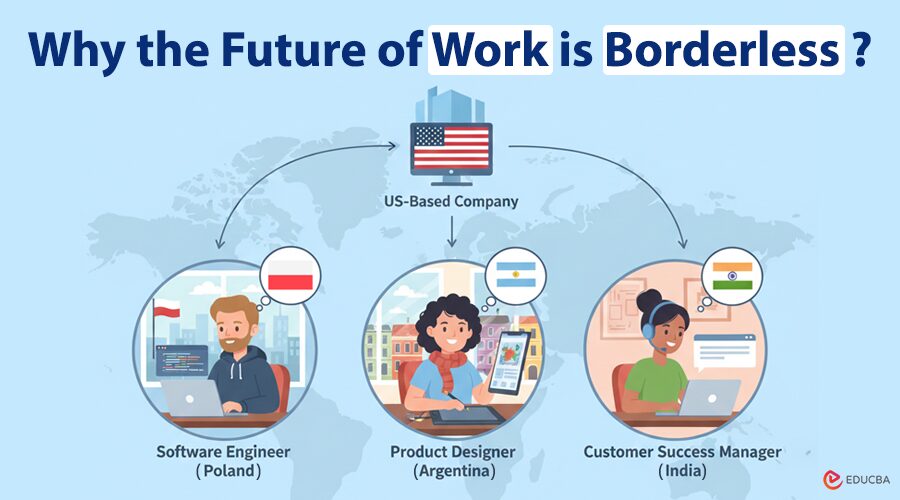
Borderless work is not the same as “remote work.” Remote work means “not in the office.” Borderless work removes geographic limits, allowing people, skills, and opportunities to flow freely across countries. In a borderless work environment, a senior engineer in Warsaw collaborates seamlessly with a UX team in Dublin. An operations lead in Nairobi shares updates early in the morning when connectivity is strongest. A designer joins from Buenos Aires, even though the company has never established a presence in Argentina. Location becomes secondary to contribution.
Borderless work succeeds because technology has become the invisible glue holding teams together. Cloud files, quick calls, and chat threads that run through the night make collaboration feel natural despite physical distance. There is also a practical reality behind the scenes: companies legally hire abroad through Employer of Record (EOR) partners, who handle the messy compliance details that most teams do not want to get wrong. Without those, borderless work would be far harder to pull off.
Why is Borderless Work Accelerating Globally?
There is not one clean reason for the rise of borderless work. Instead, several shifts collided at once.
- Tech finally caught up: For years, collaboration tools “sort of worked.” Then, suddenly, they worked well enough that borderless work no longer felt forced or fragile.
- The talent shortage got louder: Leaders realized the person they desperately needed might not live within commuting distance or even in the same country. Borderless work expanded the talent pool overnight.
- Employees changed their priorities: After everything that happened globally, people want flexibility, not as a perk, but more like a baseline for how life should function.
- Compliance became less terrifying: EOR services made global hiring approachable. Companies did not have to guess at foreign labor laws or open an entity every time they found a great candidate.
In short, borderless work grew because the old obstacles finally loosened.
What Global Hiring Experts Say About Borderless Work?
After speaking with HR directors, legal specialists, and global mobility leaders, a few themes around borderless work come up repeatedly.
“The best candidate is rarely local anymore.”
Talent is scattered. If you only search inside your city or even your country, you are playing with a smaller deck.
“HR practices must evolve.”
Distributed teams need clearer communication, more intentional culture-building, and onboarding that does not assume everyone grew up with the same norms.
“The risk is in the fine print.”
Experts mention this a lot. Not the big decisions, the small, strange rules unique to each country. Those can trip up companies quickly.
Many experts also emphasize that teams want human guidance, not just software portals. Explaining complex rules in plain language makes borderless work less intimidating.
How Companies Build Borderless Workforces in Practice?
Most organizations do not decide to adopt borderless work overnight. It usually begins with a single exceptional hire who happens to live abroad. Someone exceptional appears on the radar. They live abroad. The team wants them anyway. Then, leadership searches for a way to hire them without breaking the law.
That is where EOR partners come in.
A few real-world examples:
- A startup hiring in Germany might use an employer of record to navigate strict regulations and avoid missteps around notice periods, benefits, and working hours.
- A company expanding its UK team might rely on a UK employer of record to stay aligned with local tax and payroll expectations.
- A business adding roles in Amsterdam may work with an employer of record in the Netherlands to understand Dutch holidays, leave entitlements, and social contributions.
What leaders often appreciate most is having someone to interpret the local meaning behind policies. It is not just compliance, it is context.
Benefits of Borderless Work
Companies embracing borderless work often describe the advantages in simple, honest terms.
“We finally found someone who could do the job.”
That relief is real when a role has been open for months.
“Our ideas got better.”
A team that spans cultures ends up with questions and viewpoints that push thinking forward.
“We can scale without overcommitting.”
Hiring abroad without opening entities immediately keeps companies nimble.
“We are not vulnerable to one location anymore.”
A distributed team does not grind to a halt because of one local disruption.
Humans thrive when they feel trusted. Moreover, borderless work, done well, creates space for that trust.
Challenges of Borderless Work
Borderless work is not without friction, and successful teams acknowledge these challenges early.
- Time Zones: You will eventually schedule a meeting at a terrible hour for someone. The fix is clearer documentation and more asynchronous work.
- Cultural Differences: Some teams are direct. Others are not. Some expect formalities; some skip straight to the point. The good news: curiosity solves most of this.
- Compliance: Rules differ everywhere. That is exactly why companies lean on EOR experts.
- Data and Privacy Issues : You cannot mess around with GDPR or local privacy laws when dealing with employee information. Borderless work works best when people are patient, with each other and with the process.
Final Thought
The future of work is not approaching; it is already here. Borderless work is happening in Slack messages sent across continents and Zoom calls where multiple accents fill the room. Organizations that embrace borderless work intentionally rather than reluctantly will build teams that are more resilient, more connected, and better equipped to handle uncertainty. The world is wide. The talent is global. Moreover, borderless work is shaping the next era of how we build, collaborate, and grow.
Recommended Articles
Explore these recommended articles to learn more about global hiring strategies, Employer of Record (EOR) models, and managing distributed teams. Gain practical insights to build compliant, scalable, borderless workforces and lead high-performing teams across borders.

