


Updated September 29, 2026
AI Email Marketing: Overview
Email marketing has long been a valuable means of connecting with customers. It’s intimate, cheap, and works when done well. However, email inboxes have become increasingly full over the last few years, making it harder than ever to get people to open and read emails. That’s where AI, or “artificial intelligence,” comes in. It helps marketers create smarter, more personalized, and perfectly timed emails without having to spend hours figuring out what works. Let us explore how AI email marketing is reshaping the way brands communicate with customers.
How Email Marketing Has Changed?
Marketers used to send the same email to everyone a few years ago. It had the same subject line, message, and timing. It worked for a while, but it no longer does. People increasingly want brands to understand their interests and send them something that genuinely matters to them. That is where AI comes in. It examines how each customer interacts with your business, including when they read emails, which links they click, and what they purchase. Then it utilizes that knowledge to automatically send better emails.
AI can send messages at the same time every day, for example, if someone always reads their emails at night. Or, if someone buys a lot of sports shoes, it might send them offers on new arrivals or other items that complement them. It is like having a personal assistant who knows exactly what your target audience and target market wants.
How AI Email Marketing Is Transforming Customer Engagement?
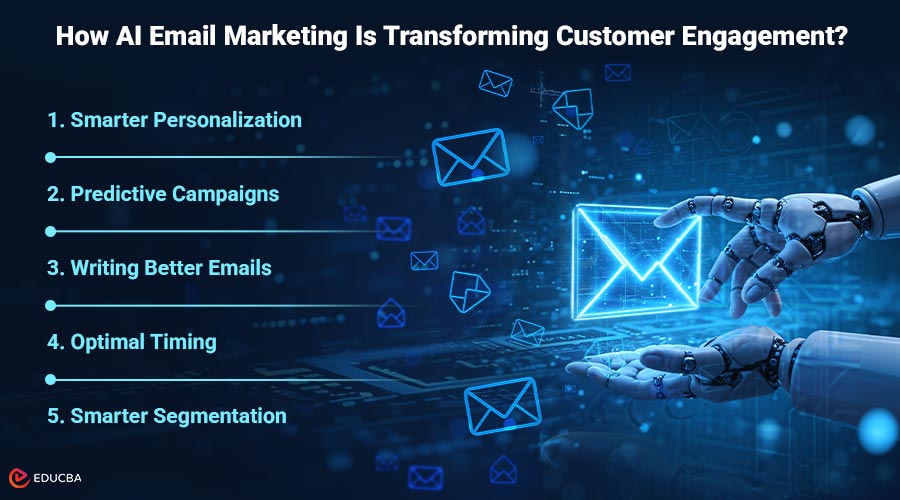
Here are the key ways AI email marketing is transforming customer engagement, from smarter personalization to continuous improvement:
1. Smarter Personalization
We all know that getting an email that starts with “Dear Customer” is not fun. AI lets you do more than just add a name. It helps you make the whole message fit what that person likes. AI can recommend a moisturizer that complements a skincare product a customer has just purchased. It can send a polite reminder with a discount if someone else leaves their cart. The same idea works in B2B sales, where AI cold email outreach tailors each message to a prospect’s role, industry, and company instead of just swapping in a first name. These little touches make your emails seem more genuine and caring, rather than robotic or spammy. People are more likely to open your emails, click through, and even make a purchase when they receive content that directly addresses their needs and interests.
2. Predictive Campaigns
One of the most notable aspects of AI is its ability to predict future outcomes. It can analyze past campaigns and determine what type of material or deals will work best for each person. Let us imagine that some members of your audience are interested in learning about new products, while others appreciate reading informative blog posts. AI can see that pattern and send each group what they enjoy most. It can even estimate who people might stop using it and offer them incentives to return before they leave. This type of prediction enables marketers to move faster and make more informed decisions. They can plan based on the findings instead of waiting to complete them.
3. Writing Better Emails
Writing catchy subject lines has been hard for all of us. What if you had someone help you test a lot of different possibilities and tell you which one will receive more opens? That is what AI tools do. They examine millions of data points, including words, tone, AI-generated email templates, and length, to determine which message works best for your target audience. Some programs can even help you develop brief paragraphs or calls to action (CTAs) that sound natural and engaging. It is not about taking away human ingenuity. It helps you write faster and more effectively, ensuring your emails get noticed immediately.
4. Optimal Timing
Timing is very important in email marketing. If you send an email too early, it can get lost. If you send it too late, your audience might have already moved on. AI tracks when each subscriber typically opens their emails and adjusts the send time for each recipient. AI tracks when each subscriber typically opens their emails and adjusts the sending time for each recipient accordingly. This means one campaign might reach some people at 7 a.m., while others receive it at 9 p.m.
5. Smarter Segmentation
Marketers used to categorize people based on simple characteristics, such as age, gender, or location. AI, however, elevates segmentation to an entirely new level. It can categorize people into groups based on their activities, such as what they read, how often they check their email, or what they purchase the most. This helps you get the appropriate message to the right individual. A regular customer may have early access to new collections, while a new member may receive a welcome guide. It is a more natural method to get to know someone. For B2B marketers, this level of segmentation is especially powerful in B2B cold email outreach because AI can help tailor cold email outreach messages to prospects based on their industry, role, or engagement history, making the initial contact feel more relevant and personalized.
6. Continuous Learning and Improvement
The best thing about AI is that it continues getting smarter. Every time you send an email, it analyzes how people who opened it, clicked on it, and ignored it reacted, and then uses that information to improve the next campaign. Your email approach becomes better, more effective, and more in line with what your audience wants over time, and you don’t have to spend hours in spreadsheets. On a side note, ensure your DMARC settings in your DNS configuration are intact and proper, and that you do not have more than 10 SPF lookups in your SPF settings; otherwise, your email is likely to be undelivered.
AI Does Not Replace Human Touch, It Improves It
Some individuals are afraid that AI may make marketing too robotic. But the truth is that it gets the opposite. AI takes care of data and automation, which provides marketers with more time to be creative, such as crafting compelling stories, creating visually appealing images, and developing messaging that sounds genuine. AI enables you to be more human by automating mundane tasks for you. It makes sure that your emails sound natural, timely, and relevant, not random or forced.
Final Thoughts
AI email marketing does not want to replace people. It aims to make marketers smarter and help firms interact with customers more effectively. It helps you convey the correct message to the right person at the right moment with the least amount of work and the most effect. AI is a game-changer for all businesses, big and small. It raises open rates, gets people more involved, and makes marketing feel real again. In short, AI helps you stop sending emails that people do not read and start sending ones that they do.
Recommended Articles
We hope this comprehensive guide to AI email marketing helps you improve your campaigns and boost engagement. Check out these recommended articles for more insights and strategies to enhance your email marketing success.


