


Updated November 13, 2025
What is Data Taxonomy?
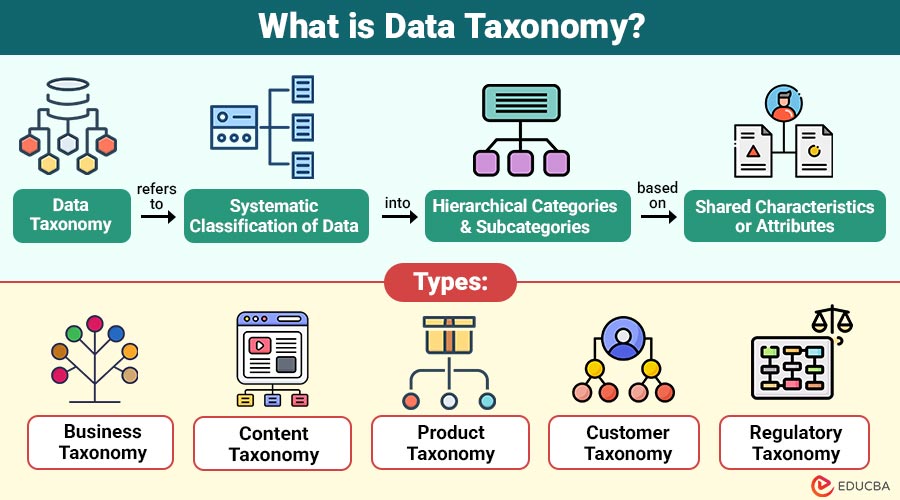
Data taxonomy refers to the systematic classification of data into hierarchical categories and subcategories based on shared characteristics or attributes. It helps organizations define relationships between different data types and ensures consistency in how data is organized and understood.
Example:
Consider a hospital organizing patient data. A data taxonomy might look like this:
Patients
├── Demographics
│ ├── Age
│ └── Gender
├── Medical Records
│ ├── Diagnoses
│ └── Treatments
└── Billing
├── Insurance
└── Payments
This structure ensures patient information is consistently categorized and easily accessible.
Table of Contents:
- Meaning
- Importance
- Framework for Building a Data Taxonomy
- Types
- Benefits
- Challenges
- Real-World Examples
Key Takeaways:
- Data taxonomy creates structured hierarchies that simplify data organization, navigation, and long-term management.
- A well-designed taxonomy enhances data usability and reliability, supporting compliance across diverse business operations.
- It bridges technical and business teams by establishing a unified language for all organizational data assets.
- Regularly updating the taxonomy helps it stay flexible and aligned with changing data, technology, and business needs.
Why is Data Taxonomy Important?
Here are the key reasons why implementing a robust data taxonomy is crucial for modern data-driven organizations:
1. Enhances Data Discoverability
Organized and well-classified data enables users to easily search, locate, retrieve, and analyze relevant information efficiently.
2. Improves Data Quality and Consistency
A well-organized taxonomy uses consistent naming rules, helping avoid repeated, incorrect, or mismatched data across systems.
3. Supports Data Governance
It strengthens compliance with regulations like GDPR and CCPA by maintaining clear data lineage, ownership, and controlled access mechanisms.
4. Boosts Decision-Making
Well-organized data improves analysis accuracy, speeds up reporting, and helps AI or ML provide better insights for smarter decisions.
5. Enables Scalability
As data volumes expand, taxonomies offer a flexible and scalable framework that maintains organization and supports future data integration needs.
Framework for Building a Data Taxonomy
Designing an effective data taxonomy requires strategic planning, stakeholder input, and iterative refinement to ensure its effectiveness.
1. Define Business Objectives
2. Identify Data Sources
List all existing data repositories, such as databases, CRM systems, data warehouses, and file storage systems.
3. Conduct Data Inventory
Catalog existing data types (structured, unstructured, and semi-structured) and map them to business functions.
4. Develop Hierarchical Structure
Group similar data types into categories and subcategories. The hierarchy should reflect business processes or domains.
5. Standardize Naming Conventions
Establish naming and labeling rules to ensure consistency across teams.
Example:
- Customer ID → cust_id
- Transaction Date → txn_date
6. Assign Ownership and Governance
Designate data stewards or custodians responsible for maintaining consistency in the taxonomy.
7. Implement Using Tools
Use data cataloging or taxonomy management tools such as:
- Collibra
- Alation
- Informatica
- Apache Atlas
8. Continuously Review and Update
As data increases, taxonomies should be updated. Set up regular review processes to check and adjust data categories when needed.
Types of Data Taxonomies
Here are the major types of taxonomies that help organizations structure and manage information efficiently:
1. Business Taxonomy
Organizes data efficiently according to specific business functions, departments, and operational processes.
2. Content Taxonomy
Structure unstructured data, such as documents, media, or files, into categorized, searchable groups.
3. Product Taxonomy
Defines hierarchical relationships between products, attributes, and categories for better organization
4. Customer Taxonomy
Segments customers based on demographic details, preferences, and behavioral patterns effectively.
5. Regulatory Taxonomy
Aligns organizational data management with industry-specific legal and compliance standards.
Benefits of Data Taxonomy
Here are the key benefits organizations gain by implementing a well-structured framework:
1. Improved Data Governance
Establishes a structured framework for tracking data lineage, managing access permissions, and ensuring accountability across all organizational data assets.
2. Enhanced Data Discovery and Search
It makes finding data quick and easy by using categories, tags, and keyword searches, giving users better access to information.
3. Greater Collaboration Across Teams
It ensures everyone understands data in the same way, reducing duplication and improving teamwork and decision-making.
4. Better Analytics and Reporting
It helps group and separate data accurately, making analysis more precise and creating useful, insight-based business reports.
5. Compliance and Risk Management
Identifies and classifies sensitive or regulated data, minimizing compliance risks and supporting adherence to legal and regulatory frameworks.
Challenges in Implementing Data Taxonomy
Despite its advantages, building a taxonomy has its complexities:
1. Data Silos
Different departments often maintain isolated data systems or incompatible formats, hindering unified access and seamless data integration efforts.
2. Lack of Standardization
Inconsistent naming conventions and classification methods lead to confusion, which in turn reduces data quality and interoperability across business units.
3. Change Resistance
Employees and teams may resist adopting new taxonomy frameworks, which can slow implementation and impact overall organizational management.
4. Maintenance Overhead
Ongoing taxonomy updates, validation, and governance processes demand continuous effort, time, and dedicated resource allocation.
5. Complexity with Unstructured Data
Categorizing text, images, videos, and social media data poses challenges due to variability and a lack of predefined structure
Real-World Examples
Here are some practical examples of how leading organizations leverage taxonomies for efficiency and scalability:
1. Google Cloud
Google uses taxonomies to organize cloud resources, allowing users to add labels like “Environment: Production” or “Cost Center: Marketing” for easier management.
2. Amazon
Amazon’s e-commerce taxonomy categorizes millions of products using nested categories that improve search accuracy and product recommendations.
3. Financial Institutions
Banks utilize taxonomies to manage transaction data, risk models, and compliance reporting under well-defined hierarchies.
Final Thoughts
Data taxonomy forms the foundation of modern data management, enabling structured organization, improved efficiency, compliance, and smarter decision-making. In today’s AI and big data-driven world, a well-designed taxonomy is essential for maintaining data reliability, discoverability, and value. For both small and large businesses, a solid structure keeps data well-organized, easy to find, and useful for decision-making.
Frequently Asked Questions (FAQs)
Q1. What is the main goal of data taxonomy?
Answer: The main goal is to classify and organize data for easier retrieval, analysis, and governance.
Q2. How is data taxonomy different from metadata?
Answer: Metadata describes data (e.g., author, date), while taxonomy classifies it hierarchically.
Q3. Can AI help in building data taxonomies?
Answer: Yes, AI and machine learning algorithms can automate tagging, classification, and refinement of taxonomy.
Recommended Articles
We hope that this EDUCBA information on “Data Taxonomy” was beneficial to you. You can view EDUCBA’s recommended articles for more information.


