


Updated November 27, 2025

Undetectable AI Essays: Overview
In 2025, AI writing tools have revolutionized content creation across industries. Whether you are a student crafting essays or a marketer developing content, tools like ChatGPT, Claude, and Gemini offer unprecedented efficiency. But with stricter AI detection tools in place, the challenge is clear: how do you create undetectable AI essays that pass every test? The answer lies in two skills—writing effective prompts and humanizing AI text. By mastering both, you can make your essays sound natural, professional, and impossible to flag.
With 89% of students now using AI tools for homework and institutions implementing stricter detection protocols, understanding both aspects has become essential for success. Learning to humanize AI-generated text is no longer optional—it is a necessity.
Why Prompts Are Key to Undetectable AI Essays?
Most users struggle with AI writing because they approach it incorrectly. Instead of providing detailed instructions, they offer vague requests like “write about AI bias” and wonder why the output feels generic or superficial. The truth is simple: AI quality directly correlates with prompt quality. A well-crafted prompt acts as a comprehensive brief, guiding AI to produce sophisticated, professional content that meets your exact requirements. Tools like Undetectable AI can further assist in refining the output to align with human writing patterns, ensuring the content remains natural and context-appropriate.
Example of Prompting for Undetectable AI Essays
Let us examine a real Computer Science ethics essay – one of the most popular topics in US universities today. Instead of a basic request, here is how strategic prompting works:
❌ Poor Prompt Approach: “Write about AI bias in hiring”
Here is the Strategic Multi-Step Approach:
Step 1: Foundation Setting
The initial prompt establishes the complete framework before asking for any content. This prevents AI from making assumptions and ensures alignment with academic standards. Imagine you are a computer science professor helping an undergraduate student write an analytical essay for a CS ethics course. The topic is “AI Bias in Hiring Systems: Technical Solutions vs. Systemic Reform”
Requirements:
- 1200-1500 words, academic tone with critical analysis
- Include technical, ethical, and sociological perspectives
- Address algorithmic bias, fairness metrics, and real-world implementation challenges
- Use current case studies from major tech companies (2023-2025)
- Structure: Introduction with clear thesis, 3-4 analytical sections, conclusion
- Focus areas: machine learning bias sources, detection methods, mitigation strategies, policy implications
Please start with an outline that balances technical depth with ethical considerations.
Why this foundation matters:
- Role Definition: “Computer science professor” sets the expertise level and academic context
- Specific Word Count: Prevents overly brief or excessively long responses
- Multi-disciplinary Approach: Explicitly requests technical, ethical, and sociological angles
- Current Examples: The 2023-2025 timeframe ensures relevant, up-to-date case studies
- Outline First: Starting with the structure before writing ensures logical flow and comprehensive coverage
Step 2: Targeted Depth Enhancement
After receiving the initial draft, we focus on the most complex section that typically needs the most development.
Expand the section on bias detection and mitigation by:
- Adding specific examples from Amazon, Google, and Meta hiring algorithms
- Discussing fairness metrics like demographic parity and equalized odds
- Analyzing the trade-offs between different fairness definitions
- Include counterarguments about the limitations of technical solutions alone
Strategic reasoning for this step:
- Concrete Examples: Generic AI responses lack specificity. Naming actual companies forces detailed, real-world analysis
- Technical Precision: Fairness metrics are complex CS concepts that AI often oversimplifies without explicit guidance
- Critical Thinking: Requesting trade-off analysis pushes beyond surface-level description to genuine analysis
- Balanced Perspective: Counterarguments prevent one-sided argumentation and demonstrate sophisticated thinking
Step 3: Polish and Integration
The final step ensures the essay meets university-level standards and flows cohesively.
Review the essay and:
- Strengthen arguments with specific algorithmic examples and code concepts
- Add transitions that connect technical solutions to broader social implications
- Include appropriate CS terminology (precision, recall, training data, etc.)
- Ensure each section builds toward the thesis about systemic vs. technical approaches
- Add a compelling introduction that hooks readers with a real hiring bias case
Why this final refinement is crucial:
- Technical Vocabulary: University CS courses expect proper terminology usage
- Coherent Flow: Academic writing requires smooth transitions between complex ideas
- Thesis Alignment: Every paragraph should support the central argument
- Engaging Opening: A compelling hook demonstrates advanced writing skills
- Logical Progression: Each section should build upon previous arguments
In short, this systematic approach allows you to produce professional, coherent content that demonstrates a deep understanding and critical thinking.
The AI Detection Challenge
Even if you prompt perfectly, there is a huge problem. Universities, academic publishers, and corporations are deploying AI detection everywhere and using advanced tools to identify AI-generated writing. This means that AI content users face real consequences if they do not know how to humanize AI content.
Common AI Writing Patterns
Readers can detect AI-generated content through several classic writing patterns:
Structural Patterns:
- Overuse of transitional phrases such as “Furthermore”, “Moreover”, “In conclusion”, etc.
- Repeat sentence structure and length
- Mechanical relationship between sentences and paragraphs
- Predictable development of the argument
Language Patterns:
- Overly formalized language
- Overuse of qualifiers: “significant”, “crucial”, “essential”
- Certain word choices and vocabulary patterns
- Overuse of generic examples
- Overuse of starting a paragraph with “it is important to note that…”
GPTHumanizer: Professional Tool to Humanize AI
Given these challenges, students and professionals need a dependable tool that makes AI content feel more human, while keeping its quality, integrity, and authenticity intact. This is where GPTHumanizer is an invaluable tool for anyone looking to humanize AI text.
What Makes GPTHumanizer Different?
1. 100% Free Basic Access
Unlike many competitors that charge from day one, GPTHumanizer offers unlimited free basic humanization with no hidden fees or usage restrictions, which is perfect for students and content creators on tight budgets.
2. Universal Detection Bypass:
The advanced algorithms successfully humanize AI content to bypass all major AI detection systems, including:
- Turnitin (widely used in academic institutions)
- GPTZero (popular in the education sector)
- Copyleaks (professional content verification)
- Winston AI (enterprise-level detection)
- AI (SEO and marketing focus)
3. Multiple Processing Models
- Fast Mode: Quick processing to humanize AI text for time-sensitive projects
- Balanced Mode: Optimal quality-speed ratio for most use cases when you need to humanize AI
- Enhanced Mode: Maximum sophistication and naturalness for critical content
Flexible Pricing Options
| Plan | Price | Word Limits | Words per Request | Key Features |
| Free | $0 | 1,000 words | 300 words | Basic humanization, AI checker |
| Basic | $4.99 | 5,000 words | 800 words | Fast/Balanced/Enhanced models |
| Standard | $9.99 | 30,000 words | 1,200 words | Advanced processing, priority support |
| Pro | $18.99 | 150,000 words | 2,000 words | Ultra-fast processing, premium support |
How to Humanize Text for Undetectable AI Essays?
Let us take a paragraph from the essay we generated using our strategic prompting approach and see how effectively GPTHumanizer can humanize AI text across different detection platforms.
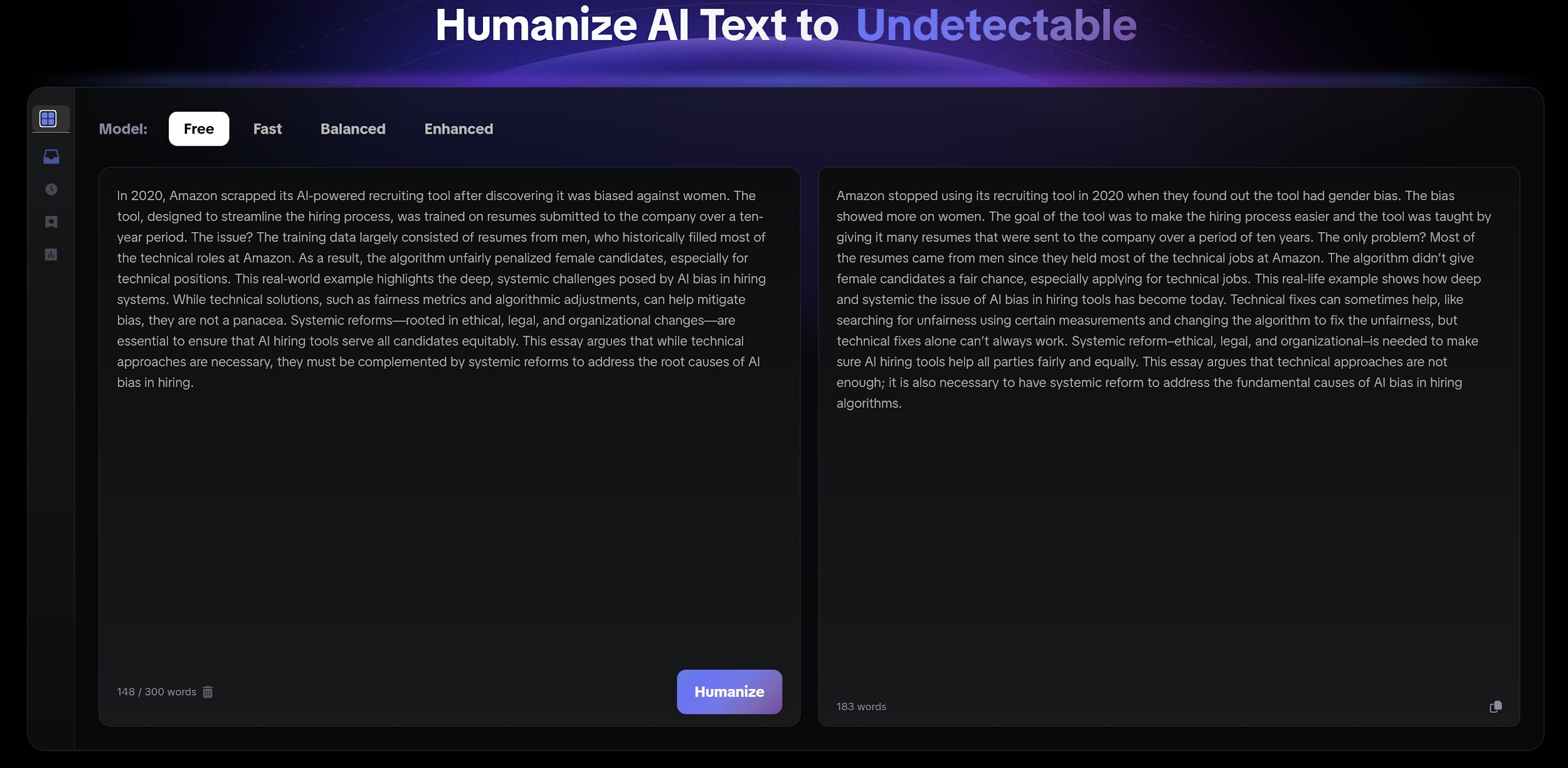
Original AI-Generated Paragraph from Our Essay
After Processing to Humanize AI
Detection Results Comparison
Let us check the AI scored tested by GPTZero:
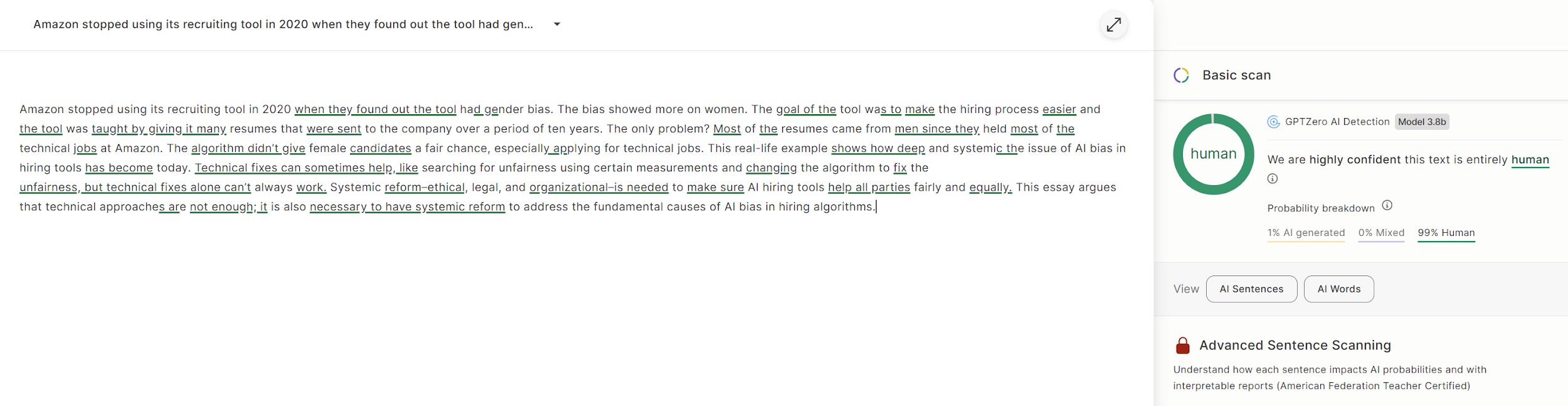
Here is a table comparison to show a more detailed result by all major AI detectors:
| AI Detector | Original AI Content | After Humanize AI Processing |
| GPTZero | 100% AI detected | 1% AI detected ✅ |
| Turnitin | 100% AI detected | 0% AI detected ✅ |
| Originality AI | 88% AI detected | 7% AI detected ✅ |
| Winston AI | 93% AI detected | 0% AI detected ✅ |
| Copyleaks | 82% AI detected | 16% AI detected ✅ |
Final Thoughts
Mastering AI writing in 2025 means going beyond just generating content. It requires expertise in prompt engineering and the ability to humanize AI text effectively. By combining smart prompting techniques with tools like GPTHumanizer, you can create content that is not only efficient but also feels authentically human. Whether you are a student aiming to submit undetectable AI essays, a marketer scaling content production, or a professional ensuring responsible AI use, this workflow helps you achieve high-quality results that pass AI detectors.
The real secret to success lies in learning how to humanize AI content while maintaining originality, clarity, and flow. The future of writing belongs to those who can merge the speed of AI with the authenticity of human expression. With GPTHumanizer, creating undetectable AI essays and natural content becomes simple, reliable, and accessible for everyone.
Frequently Asked Questions (FAQs)
Q1. How long should my AI prompt be for the best essay results?
Answer: Detailed prompts with 100-200 words work best. Include role definition, specific requirements, word count, multiple perspectives, and structure. Longer, detailed prompts consistently outperform short requests.
Q2. Should I write my entire essay in one AI prompt or break it down?
Answer: Break it down into multiple prompts. Start with outline generation, then expand sections individually, and finally refine for flow. This sequential approach produces higher-quality, more sophisticated content.
Q3. How does GPTHumanizer help students avoid AI detection?
Answer: GPTHumanizer transforms robotic AI text into natural writing that bypasses all major detectors like Turnitin and GPTZero, achieving 99%+ human scores while preserving original meaning.
Q4. Is GPTHumanizer free to use for students?
Answer: Yes, GPTHumanizer offers free basic humanization with 300 words per request and 1000 words per month. Premium plans provide enhanced features, higher word limits, and faster processing speeds.
Recommended Articles
We hope this guide to creating undetectable AI essays helps you write with more confidence and authenticity. Check out these recommended articles for more tips and strategies to make your AI-assisted writing truly stand out.


