


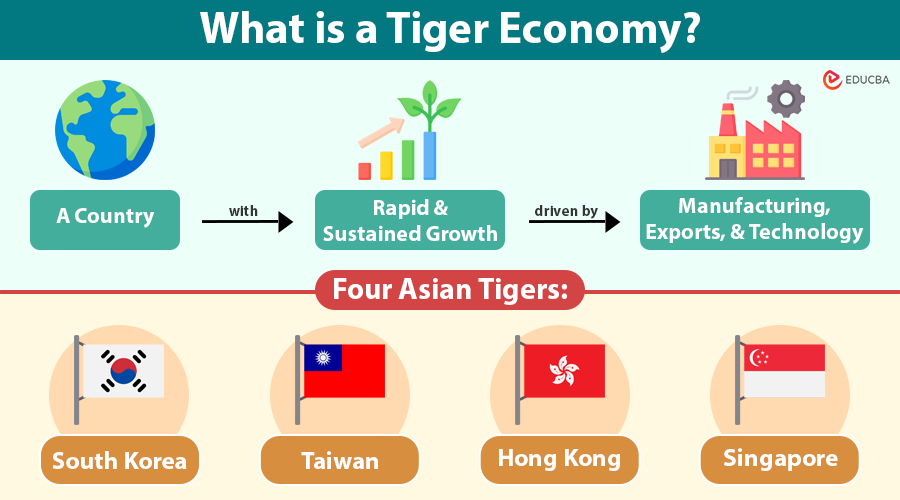
What is a Tiger Economy?
A Tiger Economy refers to a country that demonstrates high and sustained economic growth, particularly through manufacturing, exports, and technological advancement, often over a short period.
The tiger economy serves as a powerful example of how strategic policy reforms, investment in human capital, and a focus on global trade can rapidly transform a nation’s economic standing. For policymakers, investors, and development experts, studying Tiger Economies offers valuable insights into successful development models, effective governance, and scalable industrial strategies.
Table of Contents
- Meaning
- Key Characteristics
- The Original Four Asian Tigers
- Historical Timeline
- Common Features
- Economic Indicators
- Beyond the Original Tigers
- Impact on Global Trade
- Transition from Manufacturing to Innovation
- Benefits
- Challenges
- Tiger Economy vs. The Dragon Economy (China)
- Can Africa Develop Tiger Economies?
- What Critics Say?
- Is India a Future Tiger Economy?
- Popular Culture and Academia
- Key Lessons
Key Characteristics
- Consistent high GDP growth (5–10% annually)
- Industrial and infrastructural modernization
- Export-oriented manufacturing
- Investment in education and human capital
- Stable and reform-driven governance
- Openness to foreign investment and trade.
The term gained popularity in the 1980s and 1990s as the Four Asian Tigers transitioned into high-income countries, despite having few natural resources.
The Original Four Asian Tigers
1. South Korea
- Background: Devastated after the Korean War (1950–53), South Korea was one of the world’s poorest nations.
- Transformation: Through state-led capitalism, heavy investment in infrastructure, and the creation of conglomerates known as chaebols (e.g., Samsung, Hyundai), South Korea emerged as a global leader in technology and automobiles.
2. Taiwan
- Background: Following the Chinese Civil War, Taiwan became the refuge of the Nationalist government and began to develop from an agrarian base.
- Transformation: Leveraging land reforms, U.S. aid, and export-led policies, Taiwan has emerged as a technology manufacturing powerhouse, particularly in the semiconductor sector.
3. Hong Kong
- Background: As a British colony with limited land and resources, Hong Kong developed into a financial and shipping hub.
- Transformation: By adopting laissez-faire policies, low taxes, and a robust legal system, it became a global center for trade and investment.
4. Singapore
- Background: Gained independence in 1965, with few natural resources and ethnic tensions.
- Transformation: Through disciplined governance, a zero-tolerance approach to corruption, and pro-business policies, Singapore has become a top destination for multinational corporations and investors.
Historical Timeline of Tiger Economies
| Period | Key Milestones |
| 1950s | Post-war recovery in South Korea and Taiwan begins |
| 1960s | Singapore gains independence; starts export-oriented growth |
| 1970s | Rapid industrial expansion in South Korea and Taiwan |
| 1980s | Hong Kong emerges as a global financial hub |
| 1990s | Tiger economies become high-income nations |
| 2000s | Vietnam, Indonesia, and Malaysia follow the Tiger model |
Common Features of Tiger Economies
1. Export-Led Industrialization
Tiger Economies focused on producing goods for global markets, rather than relying solely on domestic consumption. Key industries included electronics, textiles, and heavy machinery.
2. Government-Led Planning
Strong state planning helped:
- Protect emerging industries
- Channel credit to strategic sectors
- Encourage R&D and innovation.
3. Human Capital Investment
Emphasis on literacy, vocational training, and higher education equipped the workforce for industrial advancement.
4. Infrastructure Development
Ports, roads, and communication systems were quickly established to facilitate the growth of trade and manufacturing.
5. Macroeconomic Stability
Policies promoting low inflation, sound public finances, and consistent reforms attracted global investors.
Economic Indicators That Define a Tiger Economy
| Indicator | Typical Range in Tiger Economies |
| GDP Growth | 6–10% annually |
| Export-to-GDP Ratio | 50%+ |
| Investment in Education | 4–6% of GDP |
| Foreign Direct Investment | Rapid year-on-year growth |
| Literacy Rate | 90%+ |
| Urbanization Rate | 70%+ |
Beyond the Original Tigers: Emerging Tiger Economies
Several nations have adopted similar models and are now considered “Tiger Cubs”:
Southeast Asia
- Vietnam: Emerging manufacturing hub with tech sector growth.
- Indonesia: Investments in infrastructure and digital economy.
- Malaysia: Electronics and services expansion.
- Thailand: Automobile and electronics production.
- Philippines: BPO industry and growing tech startups.
Outside Asia
- Ireland (“Celtic Tiger”): Rapid growth through tech investment.
- Rwanda & Ethiopia: Infrastructure-led African growth stories.
- Chile: Mineral exports and economic diversification.
Impact of Tiger Economies on Global Trade
- Shifted manufacturing from the West to the East
- Decentralized global supply chains
- Triggered new trade agreements (e.g., ASEAN Free Trade Area)
- Encouraged MNCs to expand operations in Asia.
Transition from Manufacturing to Innovation
Many Tiger Economies are now innovation hubs:
- South Korea: Robotics, 5G, AI
- Taiwan: Semiconductor leadership (e.g., TSMC)
- Singapore: Biotech and fintech growth.
They have moved from low-cost production to knowledge-driven economies.
Benefits of a Tiger Economy Model
- Rapid economic growth: GDP multiplies in a short span, enabling quicker poverty alleviation and improved infrastructure.
- Rising incomes and living standards: Increased industrial output leads to job creation, higher wages, and better quality of life.
- Global integration: Export orientation connects domestic industries with global markets, investors, and supply chains, facilitating seamless trade and economic growth.
- Knowledge and skill enhancement: As economies evolve, focus shifts to high-tech, knowledge-driven sectors, upgrading labor skills.
Challenges Faced by Tiger Economies
- Income inequality: Rapid growth can widen the gap between urban and rural populations, as well as between skilled and unskilled workers.
- Environmental degradation: Unchecked industrialization led to air, water, and land pollution in many Tiger nations.
- Global economic dependency: High export dependence makes these economies vulnerable to global shocks, recessions, or trade wars.
- Demographic shifts: Some Tigers, such as South Korea and Taiwan, now face aging populations, which strain public finances and workforce dynamics.
Tiger Economy vs. The Dragon Economy (China)
| Factor | Tiger Economies | China (Dragon Economy) |
| Size | Small-to-mid size countries | One of the largest economies |
| Growth Model | Export-led, private sector-led | Export-led with strong state control |
| Political System | Mostly democratic | One-party state |
| Labor Cost | Initially low, now rising | Initially very low, now increasing |
| Trend | Innovation, services | Tech and geopolitical influence |
Can Africa Develop Tiger Economies?
Emerging African economies are adopting similar frameworks:
- Ethiopia: Industrial parks and textiles
- Rwanda: Smart cities and digital governance
- Ghana: Focus on exports and education.
Success depends on replicating the Tiger model through:
- Infrastructure
- Governance
- Investment in people.
What Critics Say About the Tiger Economy Model?
- Over-reliance on exports can lead to economic shocks
- Educational pressure may impact youth mental health
- Environmental oversight often lagged behind growth
- Unequal wealth distribution remained a challenge.
Is India a Future Tiger Economy?
Strengths
- Young population
- Tech innovation and startup growth
- Infrastructure development (e.g., Digital India, Bharatmala)
- Global investor interest.
Challenges
- Bureaucracy and policy delays
- Skilling gap
- Regional inequality
- Environmental sustainability.
India has the potential to be a future Tiger Economy with sustained reforms and strategic focus.
Tiger Economy in Popular Culture and Academia
- Featured in books like “The East Asian Miracle” (World Bank)
- Case studies in Ivy League business schools
- Documentaries on South Korea, Singapore, and Taiwan’s development.
Key Lessons from Tiger Economies
- Visionary planning and consistent execution
- Balance between market and state intervention
- Long-term investment in education and R&D
- Institutional strength and low corruption
- Global competitiveness and openness to trade.
Final Thoughts
Tiger Economies demonstrate that rapid transformation is possible with the right combination of policies, governance, and global engagement. From low-income, resource-poor nations to global innovation hubs, their journey offers a powerful lesson in ambition, strategy, and human development.
As the world searches for the next economic success stories, the Tiger Economy model remains a guiding blueprint for sustainable and inclusive growth.
Frequently Asked Questions (FAQs)
Q1. Can a Tiger Economy status be lost?
Answer: Yes. If growth stagnates due to poor governance, global downturns, or failure to innovate, a Tiger Economy can slow down or even regress. Maintaining status requires adaptability, reform, and innovation.
Q2. What sectors are most commonly developed in Tiger Economies?
Answer: While each country may vary, the most common sectors include electronics, automotive, textiles, financial services, telecommunications, and technology-based manufacturing.
Q3. Do Tiger Economies experience social changes along with economic growth?
Answer: Yes. Economic growth typically leads to urbanization, improved education, shifting family structures, and the emergence of a growing middle class. However, it can also trigger challenges like rising inequality and mental health pressures.
Q4. Can digital economies or virtual industries help create modern Tiger Economies?
Answer: Yes. Today, digital transformation, AI, fintech, and e-commerce are key drivers of growth. Countries investing in digital infrastructure and tech skills can leapfrog into Tiger status without following traditional manufacturing-heavy paths.
Recommended Articles
We hope this guide gave you a clear understanding of Tiger Economies and their global impact. Check out these next:


