
Updated March 14, 2023
Introduction to SQLAlchemy DateTime
The SQLAlchemy DateTime is one of the keywords and it’s not a default key for the user input it should return the input as the column function and also it will be calculated by the DB server rather than the application server and to calculate the timestamp with various lead problems on the network latency through via the variable of the different programming languages occasionally on the time zone.
Overview of SQLAlchemy DateTime
The SQLAlchemy extensions provide the type of serialization and deserialization support for the JSON, CSV, YAML, and other python dictionaries. It’s one of the main projects and it is similar to the SQLAlchemy models with the Marshmallow and other frameworks that agnostic libraries to perform the complex conversations like the datatypes such as the objects to and from the native python datatypes through validating the input datas and deserialized with the app-level objects. The Serialize app-level objects are the most primitive data types that can be rendered to the standard formats along with the JSON and the other HTTP API. We also did the feature with the same point of the reflection map types that can be customized and formatted to the different database schemas along with the engine’s dialect to the reflection mapping names. The input is accepted with almost any reasonable format including the ISO 8601 SQL-compatible on the traditional POSTGRES and others of the same formats. In date input is ambiguous and there is more support for specifying the ordering fields with the DateStyle parameters to the MDY data interpretation. We used PostgreSQL for more flexibility while handling the date/time inputs rather than the SQL standard required for exacting parsing rules of the date/time inputs on the recognized text fields which is including months, days of the week, and time zones.
How to change SQLAlchemy DateTime?
The PostgreSQL supports the full set of SQL date and time types with the specified operations on the specified data types counted according to the Gregorian calendar for more information. SQL operations are available on each data type that is described with the separated dates counted according to the Gregorian calendars. Time zones and time-zone conventions are influenced through the political decisions around the world it became standardized and continues to be arbitrary changes with respect to daylight with the saving rules. We used PostgreSQL databases widely used on the IANA with specified time zone databases for historical zone rules. For each and every time in the future, the assumption with latest time zone will continue to be observed indefinite future. Interval output is the type of format that can be used on the type and it will be set with the other areas that included the Postgres databases. And we used sql_standard style that will be produced with similar outputs that conform to the SQL standard specification with literal. The type allows for the timezone is the true argument for saving the native datetime object to the database. And This returns the way to modify the timezone of the database to store all the dates with time objects in the UTC to convert the native resulting datetime objects for awaring to the retrieval in timezone information.
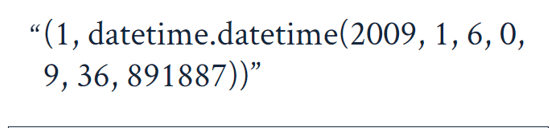
The above screenshot shows the general format of the datetime method with separate parameters here the datetime() method with the first parameter as the year, date, month and sometimes referred to as the date, year and month, month, date and year. Timedelta() is the method that satisfies the UTC format. It represents the database schema and sequences object considered to be a special case of the column default objects to aware of the datas which is retrieval in the timezone information that store separately at the UTC time. The timezone configuration parameter can be set in the postgresql.config file which is on the other standard ways. We past recommend using the UTC timestamps throughout the app and timezones naïve dates and times of the databases.
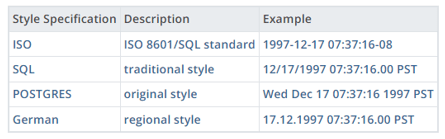
Some of the style specifications of the date and time zone with the additional description. It may vary when compared to the ISO, traditional style, original and regional style.
Example #1
import sqlalchemy as sa
from sqlalchemy.sql import select
import datetime
md = sa.MetaData('sqlite:///Mar9.db')
data_table = sa.Table('test4', md,
    sa.Column('id',   sa.types.Integer, primary_key=True),
    sa.Column('name',   sa.types.String),
    sa.Column('datess', sa.types.DateTime(timezone=True), default=datetime.datetime.utcnow)
)
md.create_all()
eng = md.bind
con = eng.connect()
res = con.execute(data_table.insert().values(id=1))
s = select([data_table])
res = con.execute(s)
rw = res.fetchone()
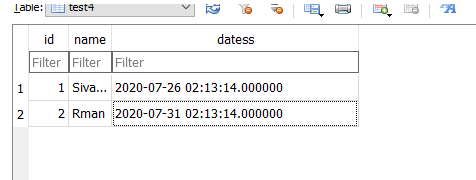
Output:
Example #2
import datetime
from sqlalchemy import Column, Integer, DateTime
from sqlalchemy.ext.declarative import declarative_base
Base = declarative_base()
class Fitrstss(Base):
__tablename__ = 'test4'
id = Column(Integer, primary_key=True)
datess = Column(DateTime, default=datetime.datetime.utcnow)
print(id)
print(datess)
Output:
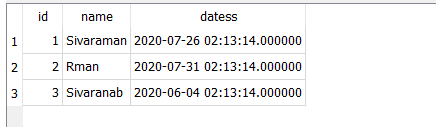
Example #3
from sqlalchemy import types
class thirdclass(types.TypeDecorator):
  thrd=types.String
  def __init__(ab, vars2, *vas, **ref):
    types.TypeDecorator.__init__(ab, *vas, **ref)
    ab.vars2 = vars2
def mthd(ab, vals, eng):
ress = ab.thrd.mthd(value, eng)
if ress not in ab.vars2:
   raise TypeError(
"Please find the output results from the newmeth methd" % (ress, ab.vars2))
  return ress
 def outs(ab, vals, eng):
  'Have a Nice day thanks for your support'
   return ab.thrd.outs(vals, eng)
print("Thanks for the thrd example regarding sqlalchemy types datetimes")
Output:
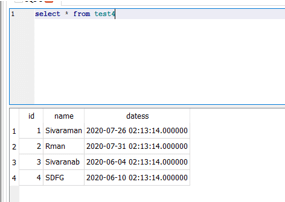
In the above examples, we used to date and time in various ways and logic to perform the user operations in the database. And we imported the sqlalchemy types, datetime, and declarative of the imported base class additionally the def keyword is used to define the methods and print the output results on each and every method. We declared the class and passed the parameters like types.TypeDecorator and to initiate the methods as the return type to the database connection for connecting the databases with additional data like id, name, and dates attributes for storing the inputs in the corresponding columns.
Conclusion
The SQLAlchemy datetime is the most widely used method for defining the functions, operators, and other keywords for connecting the databases from the application UI to the backend. It’s a single transaction to have the consistent notion of the current time, date, and multiple modifications with the same transaction date time stamp.
Recommended Articles
This is a guide to SQLAlchemy DateTime. Here we discuss the Introduction, overviews, How to change SQLAlchemy DateTime, examples with code implementation. You may also have a look at the following articles to learn more –

