
What is OKR?
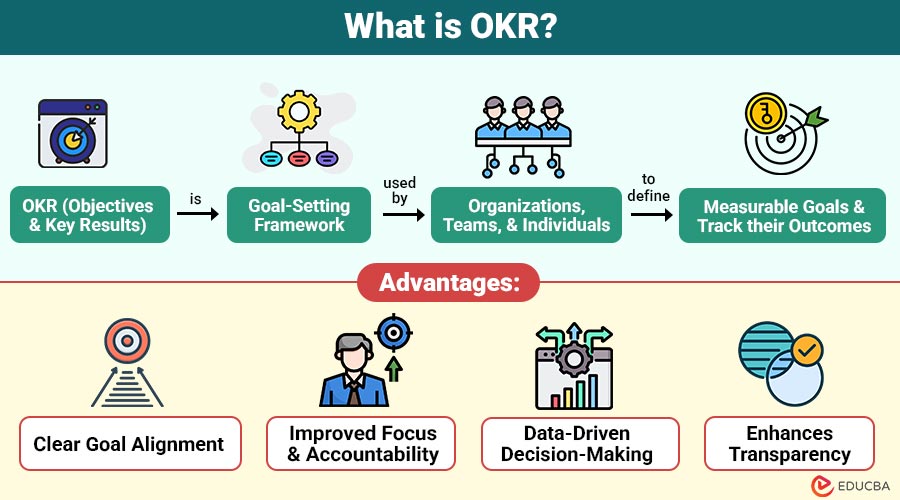
OKR (Objectives and Key Results) is goal-setting framework used by organizations, teams, and individuals to define measurable goals and track their outcomes.
- Objective answers the question: What do we want to achieve?
- Key Results answer question: How will we know we have achieved it?
OKRs focus on outcomes rather than tasks, encouraging teams to work toward measurable results rather than simply completing activities.
Table of Contents:
- Meaning
- Importance
- Components
- Types
- Implementation
- Advantages
- Example
- Common Mistakes to Avoid
- Tools
Key Takeaways:
- OKRs align strategy with measurable outcomes, ensuring teams focus on priorities that drive real business impact.
- Clear objectives provide direction, while well-defined key results provide objective metrics for consistently tracking meaningful progress.
- Limiting OKRs and reviewing them regularly improves transparency, accountability, learning, and continuous organizational improvement across teams.
- Successful implementation emphasizes outcomes over tasks, avoids misuse of performance appraisal, and encourages ambitious goals organization-wide.
Why are OKRs Important?
OKRs are more than just goal-setting tool; they are a performance and alignment system. Their importance lies in the following areas:
1. Strategic Alignment
Eliminates siloed efforts by ensuring that team and individual goals align with organizational objectives.
2. Focus and Prioritization
By limiting objectives to the most important goals, it helps teams focus on high-impact work.
3. Measurable Progress
Key results provide clear metrics, enabling teams to track progress objectively rather than relying on assumptions.
4. Transparency
They are visible across the organization, fostering accountability and collaboration.
5. Continuous Improvement
Regular reviews encourage learning, adaptation, and improvement rather than rigid performance evaluation.
Components of OKR
Below are the core components, which explain how objectives define direction and how key results measure success.
1. Objective
An objective is a clear, inspiring goal that defines what you want to achieve, providing direction and motivation without specifying how the work will be done.
Characteristics:
- Clear and concise
- Action-oriented
- Ambitious but realistic
2. Key Results
Key results are specific, measurable outcomes that track progress toward an objective, showing whether the goal is achieved through clearly defined metrics within a set timeframe.
Characteristics:
- Measurable and time-bound
- Outcome-focused, not task-based
- Typically 3–5 per objective
Types of OKRs
It can be categorized based on scope and intent, helping organizations align goals from strategic leadership to individual contributors.
1. Company OKRs
High-level objectives that set the organization’s strategic direction and align all teams toward common business goals.
2. Team OKRs
Department-focused objectives that translate company goals into actionable outcomes relevant to specific teams or functions.
3. Individual OKRs
Personal objectives aligned with team and company goals help individuals focus on impactful, measurable contributions.
4. Committed OKRs
Mandatory goals that must be achieved, with direct impact on core business operations and performance expectations.
5. Aspirational OKRs
Ambitious stretch goals that encourage innovation, experimentation, and breakthrough thinking beyond current capabilities or resources.
How to Implement OKRs Step-by-Step
Following steps outline a structured approach to defining, aligning, tracking, and improving OKRs across the organization.
Step 1: Define Organizational Objectives
Start by identifying 3–5 strategic priorities for the company.
Step 2: Set Measurable Key Results
Ensure key results are quantifiable and outcome-focused.
Step 3: Align Team and Individual OKRs
Teams create OKRs that directly contribute to company objectives.
Step 4: Communicate and Cascade
Make visible across the organization to promote transparency.
Step 5: Track Progress Regularly
Conduct weekly or biweekly check-ins to review progress.
Step 6: Review and Reflect
At the end of the cycle, evaluate outcomes and capture learnings for the next cycle.
Advantages of OKRs
The following advantages highlight how it improves alignment, focus, decision-making, and transparency across organizations.
1. Clear Goal Alignment
Ensures teams clearly understand priorities and align individual efforts with overall organizational objectives.
2. Improved Focus and Accountability
Helps employees focus on impactful work while holding teams accountable for measurable outcomes.
3. Data-Driven Decision-Making
Uses measurable results to guide decisions, track progress, and evaluate performance objectively.
4. Enhances Transparency
Makes goals and progress visible across teams, improving trust, collaboration, and organizational clarity.
OKR Example
This example demonstrates how a clear objective and measurable key results define success and enable effective progress tracking.
Objective: Enhance employee productivity
Key Results:
- Increase project completion rate from 70% to 90%
- Reduce average task turnaround time by 25%
- Improve employee engagement survey score from 3.5 to 4.5
This example clearly shows what needs to be achieved and how success will be measured.
Common OKR Mistakes to Avoid
Here are some common mistakes teams and organizations often encounter when implementing it:
1. Too Many OKRs
Creating excessive OKRs reduces focus, causes confusion, and prevents teams from prioritizing what truly matters.
2. Vague Key Results
Using unclear or unmeasurable key results makes progress tracking difficult and weakens accountability and outcomes.
3. Performance Appraisal Misuse
Treating OKRs as performance evaluations discourages ambition, experimentation, and honest goal-setting across teams.
4. Ignoring Check-ins
Skipping regular OKR reviews leads to misalignment, missed issues, and poor visibility into progress.
5. Unrealistic Objectives
Setting unclear or unrealistic objectives demotivates teams and makes achieving OKRs difficult or impossible.
Tools for OKR Management
Popular tools include:
1. WorkBoard
Enterprise-focused OKR platform offering alignment, analytics, and integration with business execution workflows.
2. Betterworks
A comprehensive and performance management tool enabling continuous feedback, goal tracking, and alignment.
3. Profit.co
User-friendly software with task management, dashboards, check-ins, and strong coaching support.
4. Ally.io
Microsoft-integrated tool that aligns goals, tracks progress, and supports leadership visibility.
5. Weekdone
Simple OKR and weekly planning tool emphasizing progress updates, feedback, and team transparency.
Final Thoughts
OKRs are a powerful framework that transforms strategy into measurable action. Organizations can enhance alignment, boost performance, and cultivate a results-oriented culture by focusing on specific goals and measurable outcomes. When implemented correctly,enablesable teams to work smarter, stay focused, and consistently achieve meaningful results.
Frequently Asked Questions (FAQs)
Q1. How often should OKRs be reviewed?
Answer: OKRs are typically reviewed weekly and formally evaluated quarterly.
Q2. How many key results should an objective have?
Answer: An objective should include 3–5 key results to ensure clarity and focus.
Q3. Can OKRs be used for individuals?
Answer: Yes, individual OKRs help align personal goals with team and company priorities.
Q4. Are OKRs suitable for all organizations?
Answer: OKRs work best in organizations that value transparency, agility, and continuous improvement.
Recommended Articles
We hope that this EDUCBA information on “OKR” was beneficial to you. You can view EDUCBA’s recommended articles for more information.

