


Updated August 25, 2026
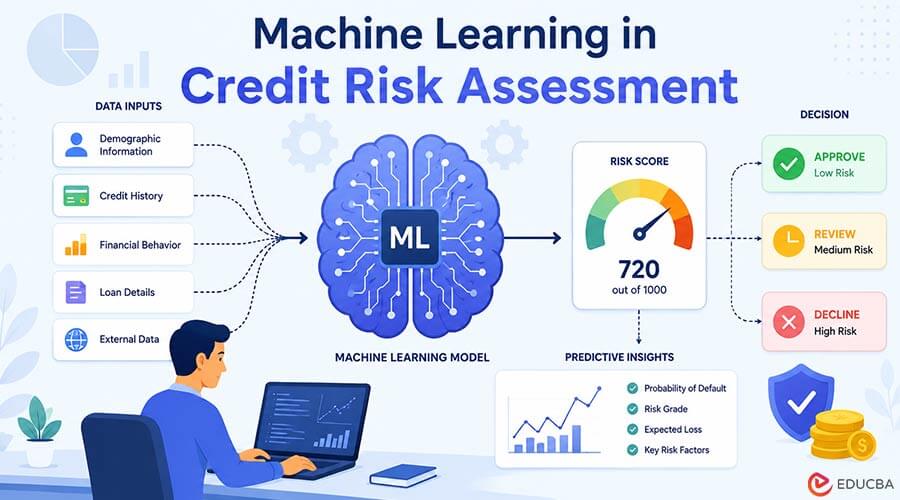
Banks have been predicting who will repay a loan for over a century. Long before algorithms entered the picture, credit committees relied on ledgers, gut instinct, and a handful of ratios. Today, machine learning promises sharper predictions, faster decisions, and fewer blind spots. However, traditional financial models have not disappeared. Instead, lenders increasingly use machine learning in credit risk assessment alongside established statistical models. This hybrid approach allows lenders to combine the predictive power of modern technology with the transparency and regulatory familiarity of traditional credit scoring.
The Old Guard: FICO Scores and Logistic Regression
Traditional credit scoring often relies on logistic regression, a statistical technique that dates back to the 1950s. It takes a handful of variables, payment history, credit utilization, length of credit history and produces a single number. Simple, explainable, and legally defensible.
That simplicity is exactly why regulators love it. In the United States, FICO scores still influence roughly 90% of lending decisions, according to industry estimates. When a bank denies a loan, it needs to explain why in plain language. A logistic regression model can do that. A deep neural network often cannot.
Enter Machine Learning: Pattern Recognition at Scale
Machine learning models, especially gradient boosting and random forests, can chew through thousands of variables at once. They catch subtle interactions a human analyst would never notice say, how spending patterns shift three months before a missed payment. Some lenders report default prediction improvements of 10 to 15% when layering ML on top of traditional scoring. But raw power is not the same as trust. A model that is 15% more accurate but impossible to explain can create real problems, especially when a rejected applicant asks why.
Protecting Your Financial Data While You Browse Loan Offers
Here is something borrowers rarely think about: every time you compare loan rates or check your credit score online, you are feeding personal financial data into websites that may not protect it well. Public Wi-Fi at a coffee shop, unsecured comparison sites, and third-party trackers can all expose sensitive information during the exact moment you are most vulnerable applying for credit.
A premium VPN offerings encrypts that connection, hiding your browsing activity from prying eyes and making it much harder for anyone to intercept the numbers you are typing into a loan application form. For a deeper breakdown, read the guide with step-by-step instructions. This way you can protect your privacy and improve your cybersecurity.
Alternative Data: From Rent Payments to Phone Bills
One of the biggest shifts machine learning has enabled is the use of alternative data. Instead of relying solely on credit bureau files, lenders can now factor in:
- Rent and utility payment history
- Mobile phone bill consistency
- Bank transaction patterns
- Even, in some markets, social media activity
This matters enormously for the “credit invisible” population. An estimated 45 million Americans lack a traditional credit score, yet many pay rent and bills reliably every month. Machine learning gives lenders a way to see that reliability where old models could not.
Where Machine Learning Falls Short?
For all its promise, ML is not a magic fix. Bias baked into historical data can get amplified rather than corrected, if past lending discriminated against certain neighborhoods, a model trained on that data may quietly repeat the pattern. Regulators worldwide are watching this closely.
The “black box” problem also exists. Explaining exactly why a neural network flagged someone as high-risk is genuinely hard, and in many jurisdictions, it is a legal requirement to explain adverse credit decisions. That single limitation keeps traditional models in the driver’s seat for final approval decisions, even when ML does the heavy lifting upstream.
Why Do Banks Keep Both Systems Running Side by Side?
Most large lenders now run a hybrid setup. Machine learning flags patterns and generates risk scores. Traditional statistical models then validate, explain, and finalize the decision. Human experts may also review unusual or high-impact cases.
This combination allows financial institutions to benefit from machine learning’s predictive capabilities while retaining the interpretability and governance associated with traditional models. In other words, the goal is not necessarily to make machine learning the final decision-maker. Instead, it can serve as an additional layer of intelligence within a broader credit risk framework.
The Numbers Behind the Shift
The scale of adoption is worth pausing on. Surveys of financial institutions suggest more than 60% now use some form of machine learning in their credit risk workflows, up from under 20% just five years ago. Processing times have dropped too; some lenders report cutting loan approval times from days to minutes for straightforward applications. Yet default rates have not collapsed to zero, and they never will. Machine learning improves precision at the margins. It does not eliminate uncertainty, and no serious risk manager claims otherwise.
What Borrowers Should Know About Machine Learning in Credit Risk Assessment?
If you are applying for credit today, your data likely passes through both a machine learning model and a traditional scoring system before a human ever sees your file. That is generally good news, more checks, fewer errors, faster turnaround. It also means your digital footprint matters more than ever.
Many borrowers now install a browser extension like the VeePN Chrome extension before comparing rates across multiple lending sites, simply to keep their session data private while they shop around. It is a small habit, but one that fits naturally into how people research credit products today, given how much personal financial detail gets typed into forms during the process.
A Hybrid Future, Not a Takeover
Machine learning is not replacing traditional credit models anytime soon, and honestly, it probably should not. The two approaches solve different problems. Statistical models offer transparency, regulatory compliance, and decades of proven reliability. Machine learning offers scale, pattern detection, and the ability to include borrowers that older systems overlooked entirely.
Machine learning in credit risk assessment is therefore more likely to be collaborative than revolutionary. The smartest lenders are not choosing one over the other. They are building systems where each does what it does best, checking each other’s blind spots along the way. That balance, more than any single algorithm, is reshaping credit risk assessment.
Recommended Articles
We hope this guide to machine learning in credit risk assessment helps you understand how technology is reshaping modern lending. Check out these recommended articles for more insights into financial technology, risk management, and data-driven decision-making.

