


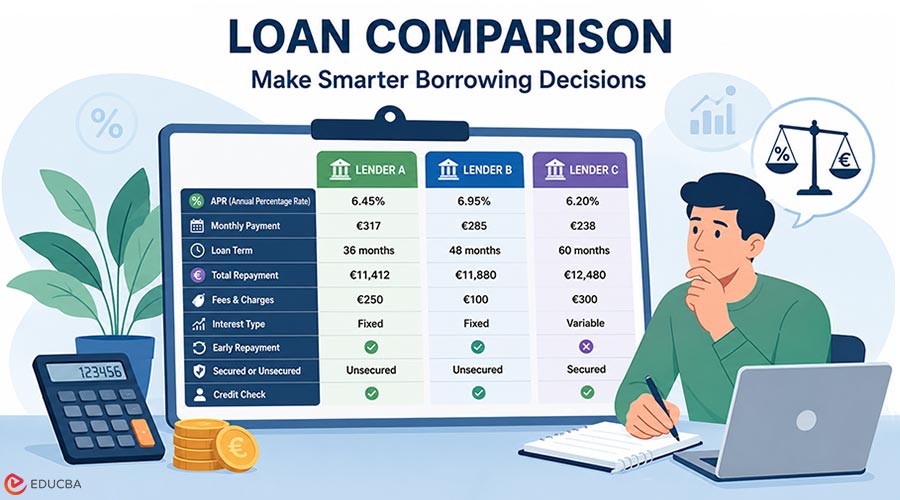
A loan should be evaluated as a financial commitment, not simply as access to money. An effective loan comparison helps borrowers evaluate the true cost of borrowing, understand repayment obligations, and avoid expensive mistakes. Borrowers researching a specific market can begin with country-focused resources such as loangermany. The same principles apply almost everywhere: understand the total cost, test the payment against your budget, and review the conditions.
What is Loan Comparison?
Loan comparison means evaluating borrowing options using consistent financial criteria. Looking only at the advertised interest rate can be misleading because loans with similar rates may have different fees, terms, insurance requirements, or early repayment rules. A useful comparison shows how much the borrower receives, how much must be repaid, and which restrictions apply.
9 Metrics Every Borrower Should Understand
The following metrics highlight the key factors every borrower should evaluate when comparing loans to better understand loan costs, repayment obligations, and overall affordability.
1. Annual Percentage Rate
The nominal interest rate shows the basic cost of borrowing. The annual percentage rate, commonly called APR, provides a broader view of the yearly cost and may include interest and certain mandatory fees. Suppose one lender offers 6.5% interest with a high setup fee, while another offers 7% with no setup fee. The second loan may still be cheaper. Use APR as an initial tool, but also review the fee schedule because some costs may not be included.
2. Total Amount Repayable
The total amount repayable is the full sum of principal, interest, and included charges paid over the life of the loan. It turns percentages into a clear monetary figure.
| Loan | Amount | Monthly Payment | Term | Total Repayment |
| A | €10,000 | €310 | 36 months | €11,160 |
| B | €10,000 | €245 | 48 months | €11,760 |
| C | €10,000 | €205 | 60 months | €12,300 |
Loan C has the lowest monthly payment but the highest total cost. This is why affordability and cost must be examined separately.
3. Monthly Payment and Budget Impact
Loan approval does not automatically prove affordability. A lender may approve an amount that leaves little room for savings, emergencies, or rising expenses. Calculate the payment as part of a complete monthly budget. Include housing, utilities, food, transportation, insurance, existing debt, and irregular costs such as repairs or annual bills. Test whether the payment remains manageable if income falls, costs rise, or an unexpected bill appears. It should not depend on overtime or bonuses.
4. Loan Term
The loan term refers to the length of time a borrower is given to repay the loan. A longer term usually lowers the monthly payment but increases the total interest paid. A shorter term can save money, but an unrealistically high payment creates missed-payment risk. The best term is generally the shortest period that remains comfortably affordable. Match each term to its useful life. Avoid paying for an item long after it becomes outdated.
5. Fixed Versus Variable Interest
A fixed-rate loan keeps the agreed interest rate unchanged for a defined period or the full term. This makes payments easier to plan. A variable rate can change according to a benchmark or mechanism stated in the agreement. The initial payment may be attractive, but subsequent payments may increase. Before choosing a variable loan, identify the benchmark, adjustment frequency, any maximum, and the effect of a rate increase. Fixed rates are easier for households needing predictable expenses.
6. Fees and Additional Products
Loan costs may include application fees, administration fees, account charges, valuation costs, brokerage fees, and missed-payment penalties. A lower rate may also depend on buying insurance, opening an account, or accepting another product. List every required payment before accepting an offer. Separate one-time charges from recurring costs and ask whether each additional product is mandatory. Also, check whether fees are deducted before disbursement. A borrower may sign for €10,000 but receive only €9,700 while repaying the full contractual amount.
7. Early Repayment Conditions
Early repayment can reduce future interest, but the agreement may include compensation charges, notice requirements, or limits on additional payments. Check whether the lender allows full settlement, partial extra payments, or changes to the payment date. Flexibility is useful, but it cannot make an unaffordable loan safe.
8. Secured Versus Unsecured Borrowing
An asset, such as a home or vehicle, backs a secured loan. Security may lead to a lower rate or larger loan, but the asset can be at risk if payments are missed. An unsecured loan does not use a specific asset as collateral. Approval is generally based on income, existing debt, credit history, and repayment capacity. Rates may be higher because the lender has less security. The lowest rate is not always the safest choice. Using a home as security for short-term consumer spending can create a serious mismatch between the purpose of the debt and the consequences of default.
9. Credit Checks and Applications
Loan applications may involve a review of the applicant’s credit history. The effect of an inquiry depends on the country, credit bureau, and type of check. Before making several applications, ask whether the lender offers an eligibility check or pre-assessment. Prepare identification, income records, bank statements, and liability details. Avoid making several major credit applications during an important loan process unless necessary. New borrowing can affect how a lender evaluates repayment capacity.
A Five-Step Loan Comparison Process
- Define the purpose and amount. Borrow only what is required for a specific need.
- Set an affordable payment range. Base it on current income and realistic expenses.
- Collect comparable offers. Use the same amount and term for each quotation.
- Calculate the total cost. Include interest, mandatory fees, and required products.
- Read the agreement. Verify payment dates, rate rules, penalties, and early repayment conditions.
Keep copies of quotations and confirm that the final agreement uses the same assumptions.
Common Loan Comparison Mistakes
A common mistake is choosing the lender offering the highest amount. A larger approval does not mean the borrower needs or can comfortably repay the full amount. Another is focusing on the monthly payment while ignoring the term. Extending a loan can make the payment appear affordable while increasing the overall cost. Small recurring charges are also easy to overlook. A monthly account fee may seem minor, but over several years, it can affect the comparison. Unless the need is a genuine emergency, allow time to compare documents, verify the lender, and question unclear terms.
Frequently Asked Questions (FAQs)
Q1. Is the loan with the lowest interest rate always best?
Answer: No. Fees, repayment length, rate type, insurance, and early repayment conditions can make a loan with a slightly higher rate cheaper or more suitable overall.
Q2. Should I choose the lowest monthly payment?
Answer: Not automatically. A low payment often results from a longer term, which may increase total interest. Choose a payment that is affordable while keeping the repayment period reasonable.
Q3. How many offers should I compare?
Answer: Three comparable offers are often enough to reveal differences in price and flexibility. For mortgages, business finance, or other complex borrowing, a wider review may be useful. Always compare offers based on the same amount and term.
Q4. What should I check before signing?
Answer: Confirm the amount received, monthly payment, number of payments, total repayment, APR, fees, interest type, late-payment consequences, collateral, cancellation rights, and early repayment rules.
Recommended Articles
We hope this comprehensive guide to loan comparison helps you evaluate borrowing options with greater confidence. Check out these recommended articles for more personal finance tips and strategies to make smarter borrowing decisions.


