


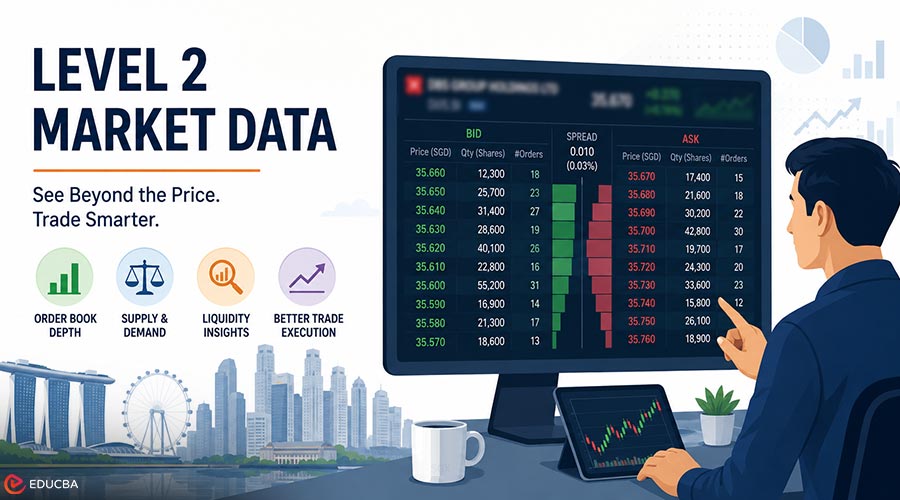
Most Singapore retail investors trade on Level 1 data and do not realize they are missing context that is freely available on other platforms. Level 1 shows the best bid and ask, the current price, and the day’s volume. Level 2 shows the full order book on both sides, the actual demand and supply stacking up around the current price. The difference between the two is the difference between seeing a headline and reading the article underneath it. This article explains what Level 2 market data is, when it matters most in SGX trading, and what to look for in a platform’s order book display.
What is Level 2 Market Data?
Level 1 quotes give you four data points: the best bid (the highest buyer offer), the best ask (the lowest seller offer), the last traded price, and the day’s traded volume. That is enough to place a market order and see what the stock did today. Level 2 quotes give you a full picture of the order book. On the bid side, you see the top 10 buy orders ranked by price and size.
On the ask side, you see the same for sell orders. Each line shows the price, quantity, and (on some platforms) the number of orders contributing to it. For an SGX-listed name like Singtel or DBS, hundreds of orders are visible at once, refreshing in real time as buyers and sellers update. In practical terms, Level 1 tells you the price. Level 2 tells you how much supply and demand sit behind that price.
Why Does Level 2 Market Data Matter?
The following benefits explain why Level 2 market data has become an essential tool for active investors seeking greater transparency.
Reading Liquidity on Mid-Cap and Small-Cap SGX Names
Outside the STI 30, SGX liquidity drops sharply. A name with healthy daily headline volume can still have a thin order book, where a single SGD 50,000 order would move the price by 2%. Level 1 hides that. Level 2 makes it obvious. If the best ask shows 5,000 shares at $1.20 and the next ask is 2,000 shares at $1.24, you know the gap, and you know your market order is likely to fill at a worse price than the screen suggests. For investors holding S-REITs, mid-cap industrials, or any name outside the top 30, this is the single most useful application of Level 2 data. It changes how you size orders, when you use limit orders versus market orders, and whether you split a large position across multiple days.
Reading Demand Around Ex-Dividend Dates
S-REITs and dividend-heavy blue chips like DBS, OCBC, and UOB see clear shifts in demand around ex-dividend dates. The order book often shows bid stacking in the days before the ex-date as dividend-capturing investors build positions, then thinning post-ex-date as those positions get sold. Watching the bid-ask depth around these dates gives a clearer read than headline volume figures. Level 2 also helps spot when bids are pulling because a name is about to trade ex-dividend, which can look like sudden weakness on a Level 1 chart.
Spotting Order Book Imbalances
A heavy bid book with light ask depth typically signals near-term upward price pressure. The reverse signals pressure downward. This is not a precise indicator (large orders can be pulled; iceberg orders hide true size), but the directional read is useful. Active traders use it to time entries. Long-term investors use it to time entries on names they already plan to buy, getting in on weakness rather than chasing strength.
Identifying Spread Costs on Less Liquid Names
Bid-ask spread is the silent cost of trading. For a blue-chip like DBS, the spread is typically a single cent or two on a price north of SGD 30, which is immaterial. On a small-cap SGX name trading at SGD 0.80 with a spread of three cents, that is a 3.75% round-trip cost before you have made anything on the position. Level 2 shows the full spread structure and lets you set a sensible limit order rather than crossing the spread with a market order.
When is Level 2 Data Less Useful?
Level 2 is not always relevant. For investors buying STI ETFs or running a passive index-tracking strategy, Level 1 is enough. The names are deeply liquid, spreads are tight, and the order book offers little additional information beyond the headline price. The same goes for long-term holders who buy and hold for 5+ years; the entry price refinement Level 2 enables compounds to relatively small returns over that horizon. Level 2 matters most for investors trading SGX names actively, holding positions in less liquid mid-caps and small-caps, building positions in larger blocks, or running strategies around earnings, dividends, and corporate actions.
Why is It Often Behind a Paywall (and Why That Is Changing)?
Historically, Level 2 SGX data was a paid add-on. Most local brokers charged a monthly subscription, typically SGD 20-30, for real-time depth-of-market data. For retail investors trading occasionally, the cost rarely justified the benefit, so most stayed on Level 1. That has shifted in the last few years. Newer entrants to the Singapore market have started offering free Level 2 SGX data as a competitive differentiator. Moomoo, for example, is regulated by the Monetary Authority of Singapore (MAS) and includes free, real-time Level 2 SGX market data.
For investors who hold mid-cap SGX names or trade around dividend events, that is a meaningful upgrade over Level 1 platforms. The best broker in Singapore for active SGX investors is increasingly the one that includes Level 2 data as standard rather than charging for it separately. The cost difference compounds over time, especially for investors making more than a handful of trades per month.
What to Look for in a Level 2 Display?
Not all order books are equally useful. Three things separate a useful Level 2 view from a cluttered one. Speed of refresh. Real-time SGX order books update many times per second during market hours. A platform that batches updates or refreshes on a one-second delay is less useful for active timing decisions. Watch the order book for 30 seconds on a liquid name like DBS during market hours, if you see numbers ticking smoothly, the feed is real-time.
Aggregated versus full depth. Some platforms show the top 10 bid and ask levels with full quantity at each price. Others aggregate by price level and hide order count. Aggregated views are easier to read; full-depth views give more detail. Pick the format that matches how you actually use the data. Integration with order entry. The most useful Level 2 displays let you click a price level in the order book to pre-fill a limit order at that level. That speeds up execution and removes the gap between reading the book and acting on what you see.
A Practical Workflow for SGX Investors
Start with Level 1 for names in the STI 30. Most of those positions are liquid enough that depth does not add much. Consider using Level 2 data for SGX stocks outside the top 30, S-REITs near earnings announcements or ex-dividend dates, positions larger than SGD 20,000, and whenever you are placing limit orders to secure a better execution price than the current best ask. Over time, checking the order book before placing orders becomes a natural habit, leading to better trade execution and fewer surprises. Choosing a trading platform Singapore with free real-time Level 2 SGX data is the first step to keeping trading costs low.
Final Thoughts
For Singapore investors, level 2 market data provides a deeper understanding of market activity than standard Level 1 quotes. Revealing real-time supply and demand through the order book helps investors assess liquidity, identify order imbalances, evaluate spread costs, and improve trade execution. While passive investors may not need additional depth, active SGX traders, dividend investors, and those trading less-liquid stocks can benefit significantly from incorporating Level 2 market data into their investment process.
Recommended Articles
We hope this comprehensive guide to level 2 market data helps you better understand order book dynamics, market liquidity, and trading opportunities. Check out these recommended articles for more insights and strategies to enhance your investing and trading decisions.

