


(Image Source: Blooket)
Most corporate training programs are quietly ignored by the employees they are meant to help. Compliance modules get click-through completions. Onboarding videos get muted and left running. Skills courses get abandoned by the second week. The disengagement is not a mystery; it is what happens when adult learners are handed content designed for compliance rather than for interest. Gamification changes the equation. Not because games are magical, but because they solve a specific problem: how to make training that adult professionals actually finish, remember, and apply to their work.
This guide covers what gamified corporate training actually looks like when done well, how to design a program that endures beyond the pilot, which tools have earned real adoption among enterprise learning teams, and the mistakes that quietly kill engagement in every rollout. No hype. No repurposed consumer app pitches. Just the framework working L&D teams are using in 2026.
What is Gamification in Corporate Training, and Why Does it Matter?
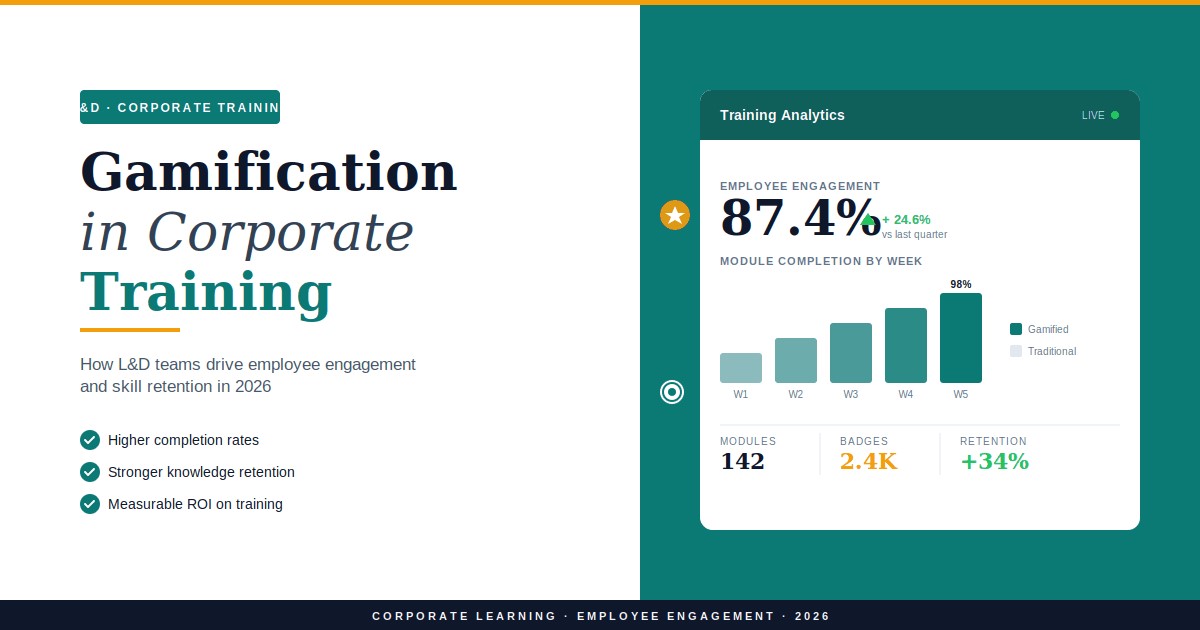
Gamification in corporate training applies game design elements, such as points, badges, leaderboards, progress tracking, and challenge-reward loops, to workplace learning content. It matters because traditional corporate training completion rates are consistently low, retention drops sharply within days of completion, and gamified formats have shown measurable improvements on both metrics across multiple industry studies. Three shifts made gamification a serious L&D strategy rather than a novelty layer.
Attention Economics Changed at Work
Employees now consume most content on phones, in short bursts, between meetings. Static hour-long modules feel like homework in an environment where every other interaction is optimized for engagement. Gamified formats align with how modern professionals actually process new information in short cycles, with immediate feedback.
Remote and Hybrid Work Made Engagement Measurable
In an office, a manager could visually confirm that employees were paying attention in a training session. In distributed teams, the only signal is completion data, quiz scores, and voluntary participation. Gamified platforms produce cleaner engagement signals than traditional courses, allowing L&D teams to see what is actually working.
Cost Pressure Demanded Better Retention
Companies invest significant budgets in training and get frustrated when the content does not stick. Industry research from firms such as Brandon Hall Group and Training Industry has consistently shown that gamified learning yields higher retention rates than lecture-based delivery for skill-based topics. The efficiency argument moved gamification from an experiment to a mainstream approach. The result: gamification in corporate training in 2026 is no longer a novelty pitch from consultants. It is a standard element of learning strategy at organizations serious about employee development.
How do you Design an Effective Gamified Training Program?
The core steps for implementing successful gamification in corporate training are: define the specific learning outcome, choose game mechanics that match the content type, keep sessions short and repeatable, build in meaningful (not vanity) rewards, and measure retention rather than completion. Programs that skip any of these steps produce noisy engagement metrics that do not change actual employee capability. Here is the sequence that consistently produces effective gamification in corporate training programs.
Step 1: Define the Outcome Before Choosing the Format
“We need better security training” is not a design brief. “Employees should identify phishing emails with 90% accuracy after 30 days.” Every downstream design decision, content structure, quiz depth, session length, and reward design flows from a specific behavioral outcome. Programs designed backward from “let us make this more fun” produce entertainment rather than learning.
Step 2: Match Game Mechanics to Content Type
Different content types benefit from different mechanics. Fact-recall content (compliance, product knowledge, terminology) works well with quick quiz-based games and leaderboards. Process training (workflows, systems, procedures) works better with branching scenarios and simulation-style formats. Soft skills training benefits from role-play mechanics and reflective badges. Using the wrong mechanic for the content type creates friction that trainees experience as a gimmick.
Step 3: Design Short, Repeatable Sessions
The best gamified training sessions run 5–15 minutes. Long single sessions lead to fatigue, which shows up as strategic guessing. Short, repeatable sessions produce spaced repetition, the mechanism behind long-term retention. A weekly 10-minute security quiz for eight weeks outperforms a single 90-minute course on nearly every retention metric.
Step 4: Build Meaningful Rewards, Not Just Points
Point totals in isolation do not motivate adult professionals. Points that convert into something visible, such as team standings, certifications displayed on internal profiles, small tangible rewards, and recognition in team meetings, drive real engagement. Points that live only on a leaderboard, nobody looks at, spark initial curiosity, only to be followed by rapid disengagement.
Step 5: Measure Retention, Not Completion
Completion rates lie. An employee who clicked through a module in 4 minutes at double speed is not trained. Measure application at 30 days, 60 days, and 90 days. Programs that look successful on completion but fail to retain participants need redesign, not more marketing to employees.
Step 6: Iterate Publicly
L&D teams that share what they are learning about their gamified programs build organizational trust. Managers, HR partners, and employees themselves offer better ideas than any single L&D team can generate. Treat the program as a product, not a launch. Most enterprise L&D teams that succeed with gamification in corporate training treat it as an ongoing capability rather than a one-time initiative. The teams that fail typically run a single pilot, call it done, and move on.
What are the Best Gamification Tools for Corporate Training in 2026?
The leading enterprise gamification platforms in 2026 include Kahoot! at Work, 360Learning, Docebo, Cornerstone Learning, EdApp (now SC Training), Axonify, and consumer-crossover platforms like Booket and Quizlet for smaller teams. Each solves a different part of the training workflow LMS integration, mobile microlearning, quiz-based reinforcement, or full simulation delivery. Here is how the major categories actually compare in real enterprise use.
| Tool | Category | Best For | Notable Strength |
| Kahoot! at Work | Live quiz platform | Team meetings, kickoffs, live training | Strong brand recognition |
| 360Learning | Collaborative learning | Peer-driven course creation | Social learning features |
| Docebo | Full-featured LMS | Enterprise learning ecosystems | AI-powered content recommendations |
| Cornerstone Learning | Enterprise LMS | Large organization compliance | Deep HR integration |
| EdApp (SC Training) | Mobile microlearning | Frontline and deskless workers | Mobile-first design |
| Axonify | Reinforcement platform | Retail, healthcare, ongoing training | Spaced repetition mechanics |
| Blooket / Quizlet | Consumer-crossover tools | Small teams, informal reinforcement | Low cost, easy setup |
1. Kahoot! at Work — The Live-format Anchor
Kahoot’s enterprise product extended the classroom format that made the brand famous into workplace training. Live quiz sessions during team meetings, all-hands events, and training kickoffs became standard at many enterprise clients. The recognition factor helps employees who used Kahoot in school know how to participate without needing onboarding.
2. 360Learning — The Collaborative Approach
360Learning built its position around peer-generated content and social learning. Employees create and refine training modules together, resulting in greater relevance than top-down content design. Particularly effective in fast-changing knowledge areas where centralized content teams cannot keep pace with the front line.
3. Docebo and Cornerstone — The Enterprise LMS Platforms
For large enterprises with complex compliance requirements, Docebo and Cornerstone Learning remain the platforms that meet security, audit, and integration needs. Both have added significant gamification features over the past few years, such as badges, learning paths, leaderboards, and mobile app engagement layers. They are less flexible than pure gamification tools but handle the enterprise-grade requirements that pure gamification platforms often lack.
4. EdApp / SC Training — The Mobile-first Choice
EdApp (rebranded SC Training) built its position on mobile microlearning for frontline and deskless workers across retail, hospitality, manufacturing, and logistics. Sessions are designed to be completed in 3–5 minutes on a phone during a shift break. The gamification is subtle but consistent: streaks, badges, team competitions.
5. Axonify — The Reinforcement Specialist
Axonify focuses on daily reinforcement rather than course completion. Employees answer 2–3 role-specific questions per day, with adaptive spacing based on which knowledge areas need reinforcement. The retention outcomes tend to be strong because the platform is engineered around spaced repetition rather than event-based training.
Consumer-crossover Tools: Blooket, Quizlet, and Small-Team Platforms
Some smaller teams and training managers get real value from consumer-oriented platforms originally built for classrooms. These tools cost far less than enterprise LMS platforms and require almost no setup. A training manager can build a question set and run a session in under 15 minutes. For example, teams running quick knowledge checks during retrospectives or team meetings often use platforms like Blooket play sessions to make reviewing team playbooks, security basics, or new-hire orientation content feel less like a checkbox exercise.
The trade-off is that these tools lack enterprise features such as SSO, audit trails, and LMS integration, which is fine for small teams but not appropriate for regulated industries or large enterprise deployments. The right tool depends heavily on the scale of deployment. A 20-person team can deliver effective gamified training on consumer crossover platforms. A 20,000-person regulated organization needs enterprise LMS platforms with built-in gamification layers.
What Mistakes Do Companies Make with Gamified Corporate Training?
The most common mistakes in gamification in corporate training are gamifying content that does not benefit from it, treating leaderboards as the main motivator, running one-off pilots and calling them a program, ignoring the disengagement of trailing performers, and confusing training completion with actual skill development. Each error looks reasonable during early implementation, but compounds quickly over time. These patterns repeat across nearly every enterprise gamification rollout I have seen fail.
Mistake 1: Gamifying the Wrong Content
Not all training benefits from gamification. Complex conceptual training, nuanced judgment calls, and open-ended problem solving lose depth when forced into game formats. Compliance quizzes, product knowledge, security awareness, and process training benefit from gamification. Executive coaching, sensitive HR training, and strategic decision-making usually do not.
Mistake 2: Leaderboard Obsession
Public leaderboards motivate the top three performers and quietly demoralize the bottom twenty. In a corporate context, this can create real cultural damage. Solutions include team-based scoring, personal-best tracking rather than public rankings, and anonymous participation options for sensitive training topics.
Mistake 3: Pilot-then-forget Syndrome
A common pattern: an L&D team runs a successful 90-day pilot, celebrates the engagement metrics, then never institutionalizes the program. Six months later, the tool is dormant. Successful gamified training programs need ongoing content refresh, quarterly reviews, and a clear owner. Without operational support, even excellent pilots decay.
Mistake 4: Ignoring Trailing Performers
Gamified training tends to engage further employees who are already engaged. The employees who most need the training are often the ones who disengage fastest from competitive formats. Watch for who is not participating, not just who is at the top of the leaderboard. Some employees respond better to individual progress tracking than to competitive formats.
Mistake 5: Vanity Metrics Over Real Outcomes
Engagement rate, session count, and average time on task feel like proof of success. They are not. The real question is whether employees perform differently after the training. Six-month retention checks, application observations, and changes to business KPIs are the real success signals. Everything else is activity, not outcome.
Mistake 6: Consumer-app Cultural Mismatch
Some highly engaging consumer gamification platforms do not translate well to formal corporate contexts. Animated cartoon characters, aggressive sound effects, and TikTok-style feedback can feel infantilizing to senior professionals. Choose platforms whose visual and interaction design fit the audience’s professional context, not just the game mechanics.
Mistake 7: Skipping Accessibility Considerations
Many gamified training tools rely on timed responses, animated interfaces, or specific interaction patterns that create barriers for employees with disabilities. Any enterprise deployment should verify WCAG compliance and offer timed alternatives for employees who need them.
Organizations that avoid these mistakes are far more likely to build durable gamification in corporate training programs that survive leadership transitions and budget cycles. Those that do not often end up with expensive shelfware and a lingering internal skepticism about gamification.
How Much Does Gamified Corporate Training Cost to Implement?
Enterprise gamification platforms typically cost between $3 and $15 per user per month, while total program costs, including content development, integration, and ongoing management, run significantly higher. Consumer-crossover tools cost far less, often $10–$50 per month total for small teams, but lack enterprise features. The right budget depends on the organization’s size, regulatory requirements, and content development capabilities. Here is the realistic breakdown for implementing gamification in corporate training by deployment scale.
Small team (under 50 employees):
- Consumer-crossover tools (Blooket, Quizlet, Kahoot free tier): $0–$50/month
- Basic mobile microlearning (EdApp free tier, similar): $0–$200/month
- Content development: Usually handled internally
- Total realistic annual cost: $0–$3,000
Mid-sized organization (50–500 employees):
- Mid-market platforms (SC Training, Kahoot! at Work): $200–$2,000/month
- Content development: $5,000–$30,000 initial
- Total realistic annual cost: $10,000–$50,000
Enterprise (500+ employees):
- Enterprise LMS with gamification (Docebo, Cornerstone, Axonify): $30,000–$500,000+ annual
- Content development, integration, ongoing management: $50,000–$300,000+
- Total realistic annual cost: $100,000–$1,000,000+
Most enterprises significantly underestimate the ongoing costs of content refreshes associated with gamification in corporate training. Purchasing the platform is only a small portion of the overall investment. Keeping learning content current, launching quarterly engagement campaigns, analyzing learner performance, and maintaining employee interest are the ongoing operational costs that determine the program’s long-term success.
Final Thoughts
Gamification in corporate training is neither the silver bullet vendors sometimes promise nor the gimmick some L&D veterans dismiss. It is a design approach that works well for specific content types, audiences, and business objectives and poorly when applied without those constraints in mind. The organizations that get real value from gamified training treat it the way disciplined engineering teams treat any operational capability: define the outcome, choose the right mechanism, measure honestly, and iterate based on data. They do not chase engagement for its own sake. They pursue measurable behavior change, and gamification is one of several tools they use to achieve it.
Start with one clear training outcome that matters to the business. Pick a small, well-defined audience. Choose a tool that fits the scale of the deployment. Run a real pilot with proper measurement. If it works, institutionalize it; if it does not, learn from the failure and try a different approach. The next generation of workplace learning is being built right now by teams that stopped treating training as content and started treating it as a product. Gamification, done well, is part of that shift. Done poorly, it becomes another line item in the shelf-ware budget. The difference is discipline, not tooling.
Frequently Asked Questions (FAQs)
Q1. Does Gamification in Corporate Training actually improve employee learning?
Answer: Yes. Gamification in corporate training improves engagement and retention for compliance, product knowledge, and skill-based learning. The best results come from spaced repetition rather than entertainment.
Q2. Which industries benefit the most from Gamification in Corporate Training?
Answer: Retail, healthcare, hospitality, manufacturing, and financial services see the strongest results because they rely on ongoing knowledge reinforcement and frontline employee training.
Q3. Is Gamification in Corporate Training suitable for compliance training?
Answer: Yes. Compliance training is one of the best use cases for gamification in corporate training because it increases engagement while improving knowledge retention and completion rates.
Q4. How long should a gamified training program run?
Answer: Gamified training works best as an ongoing learning strategy with short weekly or daily reinforcement sessions rather than one-time training events.
Q5. Can small businesses use Gamification in Corporate Training?
Answer: Absolutely. Small businesses can use affordable tools like Kahoot!, Quizlet, and Blooket to deliver engaging training without investing in an enterprise LMS.
Q6. How do you measure the ROI of Gamification in Corporate Training?
Answer: Measure improvements in business outcomes such as productivity, compliance, error reduction, sales performance, and knowledge retention at 30-, 60-, and 90-day intervals.
Q7. Does gamification work for senior professionals?
Answer: Yes, when designed appropriately. Senior professionals respond better to simulations, private progress tracking, and meaningful challenges than flashy leaderboards or gimmicky rewards.
Q8. What is the difference between microlearning and gamified training?
Answer: Microlearning delivers short, focused lessons, while gamification adds game mechanics like points, badges, and challenges. They complement each other but are not the same.
Recommended Articles
We hope this guide on gamification in corporate training helps you create engaging learning experiences that improve employee participation, knowledge retention, and workplace performance. Explore these recommended articles for more insights on corporate learning, employee training, learning management systems, microlearning, and workplace engagement strategies.


