


Updated June 30, 2026
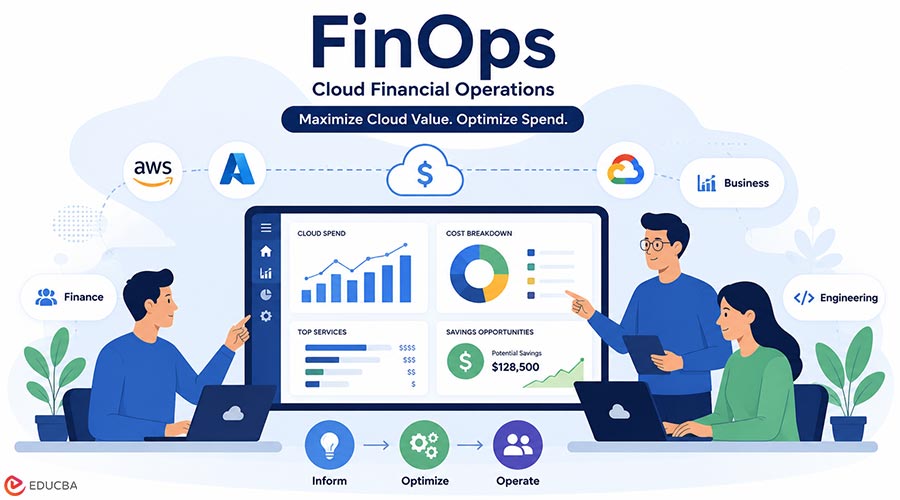
The cloud promises infinite scalability and agility, with Gartner data suggesting spending grew by over 20% last year. But for most organizations, it delivers something far less welcome: runaway costs. FinOps, short for Cloud Financial Operations, is an operational framework designed to break this cycle by bringing financial accountability to the cloud’s variable-spend model. It goes beyond reducing costs by ensuring every dollar invested in cloud infrastructure delivers maximum business value.
What is FinOps?
FinOps is a cultural practice that unifies finance, engineering, and business teams to ensure shared accountability over cloud spend. In traditional on-premises environments, infrastructure procurement went through a rigid budgeting process with predictable capital expenses. The cloud flipped this model on its head by introducing operational expenses driven by decentralized engineering decisions. A single developer can spin up a massive cluster with a few clicks, instantly impacting the company budget.
According to the official FinOps Foundation, this practice is centered around driving business value rather than simply reducing expenses. To navigate this shift, organizations adopt a continuous framework split into three core phases: Inform, Optimize, and Operate. The Inform phase focuses on visibility and allocation, ensuring that teams know exactly what they are spending and why. The Optimize phase empowers teams to identify efficiency opportunities, such as downsizing underutilized resources or leveraging strategic discount models. Finally, the Operate phase embeds these practices into daily operations, aligning continuous improvement with business goals.
The Cloud Cost Crisis Mandating FinOps
The shift to cloud architecture has accelerated innovation, but it has also created a systemic visibility crisis. Recent research from Flextera shows that 85% of organizations struggle with cloud spend because their engineering and finance departments operate in structural silos. Engineers focus on performance, deployment speed, and system uptime, while finance teams look at lagging monthly billing statements without context. This disconnect turns cloud billing into a guessing game, leaving leadership unable to forecast capital deployment accurately.
When organizations lack a unified approach to cloud management, waste accumulates rapidly. Left unchecked, idle resources, unattached storage volumes, and misconfigured instances quietly drain corporate budgets. Managing these moving parts manually quickly becomes a losing battle. To build a sustainable framework, forward-thinking enterprises use machine learning to dynamically align infrastructure purchases with actual workload usage. Modern engineering teams choose to improve cloud ROI with automation to eliminate the manual overhead of managing complex savings instruments. By automating infrastructure commitments, organizations can confidently scale their systems without risking budget overruns.
Core Pillars Of Cloud Cost Optimization
Achieving meaningful optimization requires moving past superficial fixes like arbitrary shutdown schedules. True optimization relies on a granular understanding of how architecture choices impact unit economics. To build a reliable baseline, teams must analyze their infrastructure across multiple operational dimensions. A holistic approach balances immediate waste reduction with long-term architectural health. Before implementing massive structural updates, engineering teams generally focus on three fundamental baseline areas:
- Rightsizing overprovisioned compute instances to match actual workload demand.
- Deleting unattached storage blocks left over from decommissioned environments
- Purchasing reserved instances or savings plans for predictable baseline traffic
Once these baseline steps are completed, the focus shifts to architectural sustainability. This involves evaluating your application design to ensure it scales efficiently during peak and off-peak hours. Data visibility remains a persistent roadblock throughout this optimization journey. Studies indicate that 82% of organizations practice FinOps while actively facing severe data visibility challenges across multi-cloud environments. Without a single source of truth for your cost metrics, optimization efforts remain isolated, and teams cannot accurately measure their progress.
Standardizing Cloud Billing Data With FOCUS
Multi-cloud environments inherently create a data-formatting nightmare because each provider names its billing metrics differently. The FinOps Open Cost and Usage Specification solves this structural mess by providing a universal, open-source schema for all cloud billing data.
Using this shared data system helps teams create clear cost dashboards without spending hundreds of hours changing billing terms from different vendors. When your compute metrics speak the same language across AWS, Azure, and Google Cloud, tracking unit economics across the entire corporate footprint becomes a seamless daily routine rather than an architectural headache.
Operationalizing FinOps For Long-Term Success
Successfully deploying FinOps requires changing how your engineering and finance teams collaborate. It means treating cloud efficiency as a core product feature rather than a cleanup task scheduled at the end of the quarter. When engineers view cost efficiency as a performance metric alongside latency and uptime, corporate culture shifts naturally toward sustainable growth.
Real success comes when responsibility is built into your deployment process. This means setting up real-time issue alerts, adding automatic cost control rules, and giving engineering leads direct access to their team’s cost data. Over time, these daily habits build a robust operational posture in which cloud spend scales directly with business revenue.
Final Thoughts
As cloud adoption grows, organizations need more than traditional budgeting methods to manage infrastructure costs effectively. FinOps provides a collaborative framework that empowers engineering, finance, and business teams to work together toward shared financial goals. By improving visibility, adopting automation, optimizing resource utilization, and standardizing cloud billing practices, FinOps helps organizations maximize cloud value while maintaining financial accountability.
Recommended Articles
We hope this FinOps guide helps you understand how cloud financial management can improve cost visibility and optimize cloud spending. Explore these articles to learn more about cloud infrastructure, cost optimization strategies, and modern IT operations.


