


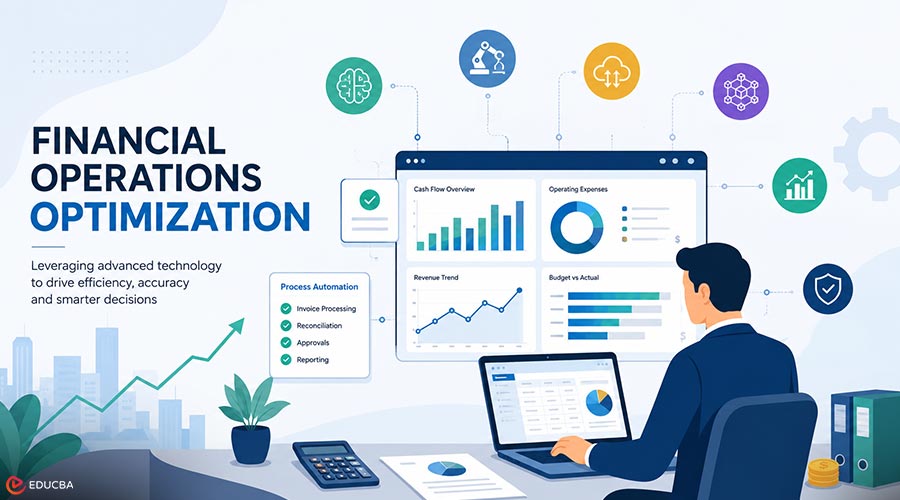
Financial departments have always been the slowest part of any organization to change. Not because the people working there resist change, but because the stakes are too high to experiment casually. A broken marketing pipeline is embarrassing. A broken pipeline in the treasury is a crisis. That tension between “we need to modernize” and “we cannot afford mistakes” is exactly what makes financial operations optimization so complicated and so interesting to look at right now. This article breaks down the real tools, the real problems, and the approaches that are actually working in 2026.
The State of Financial Operations Optimization in 2026
Something shifted over the past two years. Banks and financial firms that were running AI pilots quietly moved them into production. What was experimental in 2023 is now a baseline expectation: real-time reporting, process automation, cloud-native infrastructure. The firms keeping pace tend to work with providers that specialize in the intersection of IT and financial infrastructure. Teams using IT solutions financial services designed for scale see measurable gains in processing speed, compliance accuracy, and operational cost. The difference usually comes down to whether the tech stack was built from the ground up for financial workflows or adapted from another domain.
A few things are happening simultaneously right now:
- Core banking systems are being modernized through microservices and APIs, not replaced overnight, but gradually re-plumbed
- Regulatory pressure is pushing firms toward better audit trails and real-time reporting.
- Talent shortages are making automation less of a luxury and more of a necessity.
- Customer expectations for instant payments, instant decisions, instant everything have moved beyond retail into B2B.
So the environment is more pressure, fewer people, stricter rules, and customers who remember how quickly their Revolut app used to work.
Technologies Reshaping Financial Operations Optimization
Here are the key technologies driving efficiency, automation, and real-time decision-making in modern financial systems.
1. AI and Machine Learning
AI is now central to financial operations optimization, especially in areas like:
- Fraud detection: Models trained on transaction patterns flag anomalies in milliseconds. Mastercard’s Decision Intelligence Pro processes over a billion transactions daily with AI-generated risk scores. The false-positive rate has dropped significantly for firms that have properly integrated these systems.
- Accounts payable and receivable automation: Where mid-size companies are seeing the fastest ROI. Tools like Tesorio (cash flow forecasting), HighRadius (AR automation), and Stampli (AP processing) have moved from niche to standard over the past 18 months. They learn vendor payment patterns, predict late payments, flag duplicates, and handle routine approvals without human involvement. An AP team that used to process 400 invoices a week manually might handle 2,000 with the same headcount.
- Credit decisioning is being rebuilt: Traditional rule-based models are being supplemented by ML systems that evaluate hundreds of variables simultaneously. Upstart pioneered this in consumer lending; commercial lending is catching up. The challenge: regulators in the EU and US increasingly require that credit decisions be explainable in plain language, which creates a specific technical constraint on model design. You can not just deploy a black box and call it done.
2. Real-Time Treasury Management
Treasury used to work on T+1 data. Yesterday’s numbers are used to make today’s decisions. In fast-moving markets, that lag is expensive.
Real-time treasury is becoming standard for any firm above a certain size. The underlying technology combines:
- API connections to banking partners (open banking standards, PSD2 in Europe)
- Streaming data pipelines like Apache Kafka that process transaction events rather than batch files
- Cloud-hosted TMS platforms (Kyriba, FIS Quantum, Serrala), all of which moved to real-time architectures in recent versions
The business impact is cleaner than most tech upgrades: when you know exactly how much cash is where at any moment, you make better borrowing and investing decisions. Companies with $500M+ in annual revenue can recapture meaningful yield simply by reducing excess cash held in low-interest accounts due to delayed visibility. Sounds simple. Most are not doing it yet.
3. Robotic Process Automation (RPA)
RPA got overhyped in 2019–2021 and then quietly became boring infrastructure. That is actually a good outcome. UiPath, Blue Prism, and Automation Anywhere are now used for what they are genuinely good at: repeatable, rule-based tasks that require interacting with legacy systems without APIs.
Reconciliation is the canonical example. Many banks still run core systems built in the 1980s and 1990s. They do not expose APIs. They are not being replaced anytime soon because the migration risk is enormous. RPA bots that log in, pull data, and pipe it into modern reporting tools serve as a practical bridge, not a long-term solution, but not nothing. The firms that got burned by RPA tried to use it everywhere. The firms doing well with it use it specifically for legacy interface automation and treat it as temporary scaffolding while proper integrations get built.
4. Blockchain in Financial Operations
Blockchain is now in production use across several financial domains:
- Trade finance: Contour, the blockchain network for digitizing letters of credit, handles real transactions for HSBC, BNP Paribas, and Standard Chartered. The traditional LC process takes 5–10 days and enormous amounts of paper. The blockchain-based version handles it in 24 hours.
- Cross-border payments: Ripple’s ODL uses XRP as a bridge currency for corridors where correspondent banking is slow or expensive. JPMorgan’s Onyx platform processes internal cross-border transfers using JPM Coin.
- Tokenized assets: This one is moving faster than most expected. BlackRock’s BUIDL fund, Franklin Templeton’s BENJI token, and HSBC’s tokenized gold product are real assets (money market funds, government securities, commodities) issued as blockchain tokens. The practical benefit: faster settlement, easier fractional ownership, and programmable compliance logic embedded in the asset itself.
What is Being Tested Right Now?
The following emerging technologies and experimental systems are currently being explored and tested in financial operations optimization.
1. Quantum Computing and Risk Modeling
IBM and Google, together with financial institution partners including JPMorgan and Goldman Sachs, are running quantum computing experiments focused on portfolio optimization and risk modeling. Still research-stage, current hardware is too error-prone for production financial calculations at scale. But IBM’s Quantum Network has financial partners specifically working on Monte Carlo simulations for derivatives pricing. This computation takes hours on classical hardware and could run in minutes on mature quantum hardware. Firms building quantum-ready cryptography practices now are ahead of where they need to be in five years.
2. Agentic AI in Financial Workflows
This is the newest category and the least settled. Agentic AI refers to systems that go beyond answering prompts and can independently carry out multi-step tasks, such as collecting information, making decisions, executing actions, and providing updates. The difference between a calculator and an analyst.
Early prototypes in financial operations:
- Autonomous close processes: An agent that pulls data from multiple systems, runs reconciliations, flags exceptions, and prepares journal entries.
- Dynamic hedging: Agents monitoring FX exposure continuously and executing hedges within pre-approved parameters, without human sign-off on each transaction
- Regulatory reporting: Agents compiling data, checking it against current rule sets, and drafting submissions
Salesforce showed agentic financial workflow prototypes at Dreamforce 2025. SAP has similar capabilities in preview as part of its Business AI roadmap. None of this is fully autonomous in production at major institutions yet, but the timelines are being pushed forward quickly.
Practical Framework: Where to Start
If you are looking at a financial operations optimization project, a practical framework looks like this.
Step 1: Map Where Time Actually Goes
Before buying any software, spend two weeks tracking where finance team hours actually go. The result is usually surprising. In most organizations, the biggest time sinks are:
- Manual data entry and reconciliation between systems that do not talk to each other
- Chasing approvals through email threads
- Rebuilding reports in Excel because the official system does not produce the format anyone needs
- Dealing with exceptions from upstream data quality problems
The fix for each of these is different. Data entry problems need integration. Approval bottlenecks need workflow software. Reporting problems needs better BI tooling. Knowing which problem you have determines the right solution.
Step 2: Integration Before Automation
Common mistake: automating a broken process. If the underlying data flows are messy, systems that do not sync, manual uploads that introduce errors, and no single source of truth, adding automation on top only makes the mess faster, not better.
Integration work is unglamorous. Building API connections between your ERP, banking partners, TMS, and reporting stack takes time and produces no impressive demos. But it is the foundation on which everything else sits. Firms that invested in clean data infrastructure in 2022–2023 are the ones running AI models effectively now.
Step 3: Automate in the Right Order
Once data flows are clean:
- High volume, rule-based first: Invoice processing, payment runs, reconciliation, report generation. Clear ROI, low risk.
- Exception management second: Rules to flag anomalies and route them to the right person. Reduces cognitive load without removing human judgment where it is needed.
- Predictive last: Cash flow forecasting, credit scoring, FX exposure modeling. These require clean historical data for training, which is why they come last.
Step 4: Governance First, AI Second
Deploying AI in financial operations without a governance framework is building on sand. Governance means:
- Model documentation: What data trained it, what decisions it influences, when it was last validated
- Override procedures: How humans intervene when model output is wrong
- Audit trails: Logs showing what the system decided and why, at the transaction level
- Regular validation: Scheduled reviews of model performance against actual outcomes
This is not optional compliance theater. It is what distinguishes deployments that work from ones that fail silently until something expensive goes wrong.
Common Mistakes
Some patterns appear repeatedly across failed financial technology projects:
- Buying a platform instead of solving a problem: Enterprise software salespeople are good. The result is often a $2M TMS that largely replicates what Excel did, because the workflow issues were not addressed first.
- Underestimating change management: Finance teams have processes that work. Changing them requires involving the team in the design process, which takes longer but leads to greater adoption.
- Treating IT as a vendor: The most effective projects involve finance and IT working together from the start, not finance specifying requirements and IT implementing them six months later.
- Ignoring technical debt in core systems: Modernizing around a legacy core without addressing the core itself creates an increasingly complex web of workarounds. Eventually, the maintenance cost exceeds the migration everyone was avoiding.
The Talent Shift
Technology changes what finance teams do, not whether they are needed. The skills profile shifts. Less demand for manual data entry, routine report preparation, and rule-based transaction processing. More demand for data analysis and interpretation, technology evaluation, process design, understanding AI model outputs and their limits, and cross-functional communication between finance and technology teams.
The gap between a CFO who understands what their technology stack is actually doing and one who does not is widening, and it shows in decision quality. Firms investing in upskilling finance staff in Power BI, SQL basics, and API fundamentals are building a more durable capability than firms that treat technology as something IT handles separately.
Final Thoughts
Financial operations optimization in 2026 is not one decision. It becomes a series of decisions over years, each building on the last. The organizations moving fastest share a few things: they diagnosed actual problems before buying solutions, they invested in data infrastructure before automation, and they treated governance as a design constraint rather than an afterthought.
The technology works. Agentic AI, real-time treasury platforms, intelligent AP/AR systems, blockchain-based settlement, these are in production, and the results are measurable. The question is not whether to invest. It is whether the organizational foundations exist to let the technology actually deliver.
Recommended Articles
We hope this guide to financial operations optimization helps you improve efficiency and decision-making. Check out these recommended articles for more insights and strategies.


