


Updated August 17, 2026
What are Data Collection Methods?
Data collection methods are different ways that researchers use to collect information from various sources for research purposes.
The types of data collection methods are:
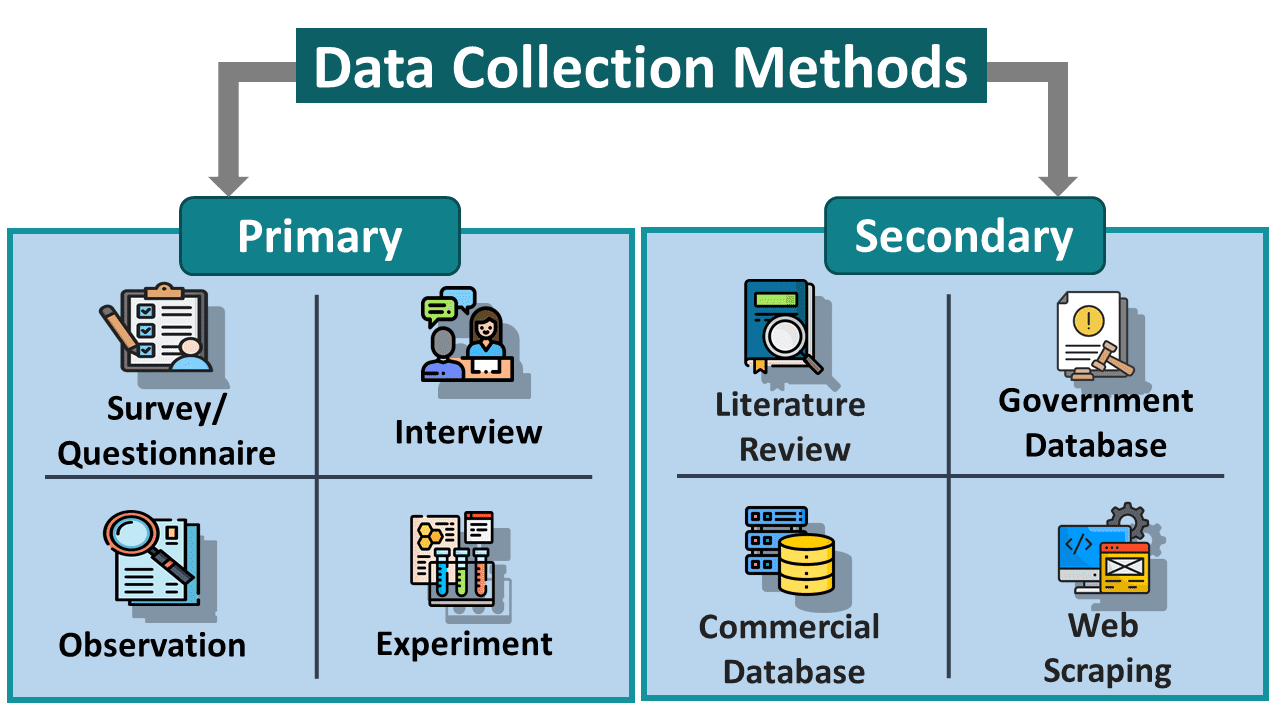
Table of Contents
- What are Data Collection Methods?
- Types
- Choosing Between Collection Methods
- Process
- Challenges
- Methods for Different Research Types
- AI in Data Collection
Types of Data Collection Methods
A. Primary Data Collection Methods
Primary data refers to original information that researchers collect directly from the source. These methods involve the researcher or data collector interacting directly with individuals, entities, or the environment to obtain fresh and unique data.
Primary data collection methods include:
1. Surveys and Questionnaires
Surveys and questionnaires help us collect structured data (neatly arranged information) from individuals or groups. Researchers design sets of questions to gather specific information from respondents. They can conduct this using paper forms or online surveys.
Real Example:
Researchers conducted the Manufacturing Business Outlook Survey in the United States to understand business conditions in the manufacturing sector. Companies answered questionnaires about production, employment, new orders, and future business expectations. The survey found that many manufacturers experienced growth in business activity and remained optimistic about future economic conditions.
(Source: Federal Reserve Bank of Philadelphia)
Advantages & Disadvantages
| Advantages | Disadvantages |
| It is the most cost-effective data collection method. | It may include response bias or misinterpretation of questions. |
| Efficient for collecting data from a diverse and large group of respondents. | The information will only include data related to the questions asked in the survey. |
2. Interviews
Interviews involve direct communication between the researcher and the participant(s). They can be structured (with predefined questions) or unstructured (allowing for open-ended responses). Interviews are particularly useful when the researcher needs to collect in-depth insights, such as in qualitative research or case studies.
Real Example:
Researchers conducted semi-structured interviews with 24 medical science professors in Iran to understand the reproducibility crisis in medical education research. The interviews revealed major concerns related to research bias, poor study design, and lack of transparency, which affected the reliability of published research findings.
(Source: Nature)
Advantages & Disadvantages
| Advantages | Disadvantages |
| Allows researchers to ask follow-up questions and clarify doubts regarding participants’ responses. | It is time-consuming, especially with a large number of participants. |
| Provides rich, detailed information. | The interviewer’s biases or communication skills can influence the data. |
| Flexibility to adapt questions based on the interviewee’s responses. | Difficulty in maintaining consistency across different interviews. |
3. Observations
Observations involve directly monitoring and recording events, behaviors, or phenomena. Researchers can either participate in the activities they observe (participant observation) or simply watch without participating (non-participant observation).
Real Example:
In 2026, researchers and industry experts observed data from more than 1,300 Earth observation satellites operated by over 100 companies worldwide. These observations helped monitor climate conditions, agriculture, urban development, and disaster management using real-time satellite data.
(Source: CSIS)
Advantages & Disadvantages
| Advantages | Disadvantages |
| Provides firsthand, real-time data. | Time-consuming and resource-intensive. |
| Minimizes response bias since participants may not be aware they are under observation. | Risk of observer bias or misinterpretation of observed events. |
| Suitable for studying non-verbal behavior and environmental factors. | Limited to what is observable may not capture underlying motivations. |
4. Experiments
Experiments are investigations where researchers manipulate one or more variables (independent variables) to observe their impact on another variable (dependent variable). They are common in scientific research to establish causal (cause and effect) relationships.
Real Example:
In 2025, researchers conducted experiments during the CRIMAC research cruise to test advanced acoustic and camera technologies for monitoring fish populations in the ocean. The experiment helped scientists evaluate how accurately these technologies could identify and measure marine species in real-time.
(Source: Institute of Marine Research)
Advantages & Disadvantages
| Advantages | Disadvantages |
| Allows for the establishment of cause-and-effect relationships. | It may lack validity if the findings do not apply to real-world contexts. |
| It can be easily replicated and generalized. | Ethical concerns when manipulating variables, especially with human subjects. |
5. Focus Groups
Focus groups involve small, moderated group discussions where participants share their opinions, experiences, and perceptions on a specific topic. This method is particularly useful for exploring complex issues, product development, and understanding consumer behavior.
Real Example:
In 2025, researchers conducted focus group discussions and collected feedback from 88 students and teachers to understand their views on using augmented reality (AR) in classrooms. The study found that although participants identified some challenges, most believed AR improved learning experiences and student engagement.
(Source: Nature)
Advantages & Disadvantages
| Advantages | Disadvantages |
| It helps generate rich qualitative data. | Requires a skilled moderator to manage discussions effectively. |
| Facilitates group dynamics and interaction. | Limited to the participants’ willingness to express their views. |
| Allows for the exploration of diverse perspectives. | It may not be representative of the broader population. |
6. Case Studies
Case studies involve an in-depth examination of a single entity, such as an individual, organization, or community. Experts use this to understand specific phenomena or situations thoroughly. It is simply a collective method where researchers gather data using multiple methods, including interviews, observations, and documents.
Real Example:
In 2025, researchers analyzed multiple low-carbon building projects to study the economic impact of reducing embodied carbon in construction. The case study found that sustainable building practices can lower carbon emissions without significantly increasing overall project costs.
(Source: RMI)
Advantages & Disadvantages
| Advantages | Disadvantages |
| Provides detailed insights into complex issues. | Subject to researcher bias during data interpretation. |
| Suitable for studying rare or unique cases. | Requires a lot of time and resources. |
B. Secondary Data Collection Methods
Secondary data refers to information that is already collected and available for use. This data can come from a wide range of sources, including government agencies, academic institutions, private organizations, and publicly available datasets.
Secondary data collection methods include:
1. Literature Review
A literature review comprehensively examines existing academic and non-academic sources, such as books, research papers, reports, and articles. Researchers gather and synthesize information from these sources to provide context, support, or insights for their own research.
Real Example:
In September 2022, a group of experts did a literature review to examine the impact of extracurricular activities (EAs) in medical education. Among 263 articles published from 2013 to 2022, the researchers chose 64 most suitable ones. The comprehensive analysis found that EAs in medical colleges enhance medical students’ educational value. Thus, these activities help students make career decisions, choose specialties, and even learn medical skills.
(Source: BioMed Central)
Advantages & Disadvantages
| Advantages | Disadvantages |
| Saves time and resources compared to primary data collection. | It may not always provide the specific data required for a research question. |
| Access to a wide range of expertise and perspectives. | Limited to the quality and availability of existing sources. |
2. Government Databases
Government agencies often collect and maintain extensive datasets on various topics, including demographics, health, economics, and education. Thus, researchers can access and utilize these publicly available data sources for their studies.
Real Example:
A study in Indonesia used an available government dataset of a survey conducted by the Ministry of Health of the Republic of Indonesia. They wanted to see who signs up for National Health Insurance (NHI) among the poor. They found that people with more education, living in cities, being older than 17, married, and having more money were more likely to have NHI. For example, if you had some level of education, you were more likely to have NHI than if you had none. Therefore, the government should invest in NHI and education to make healthcare fairer for everyone.
(Source: BioMed Central)
Advantages & Disadvantages
| Advantages | Disadvantages |
| There is an availability of large and comprehensive datasets. | Data may be outdated or not aligned with research needs. |
| Information is of high quality and very reliable. | Limited to the categories defined by government agencies. |
| It has free or low-cost access. | Researchers may require expertise in data retrieval and analysis. |
3. Commercial Databases
Apart from the government, private companies also compile and sell datasets covering various industries and markets. These databases can be valuable for businesses, market research, and competitive analysis.
Real Example:
Published in 2023, a study examined 276 product pouches of commercial baby food products in Australia. It used the text on the package to study the misleading ‘no added sugar’ claims. They found many of these products had high sugar content and lacked essential nutrients like iron. The result shows that we must immediately improve regulations to protect infant health.
(Source: BioMed Central)
Advantages & Disadvantages
| Advantages | Disadvantages |
| Access to up-to-date and industry-specific data. | Costly subscription fees or one-time purchases. |
| Often includes financial and business information which is not available elsewhere. | Data accuracy and reliability may vary between providers. |
4. Web Scraping
Web scraping involves extracting data from websites and online sources. It commonly includes collecting information from social media, e-commerce sites, news articles, and more. And also, when choosing between scraping and API, you should know that APIs generally offer a more reliable and efficient way to access data, whereas web scraping may be necessary for extracting information from sites without available APIs. Web scraping tools and web scraping services can retrieve large volumes of data quickly.
Real Example:
Some scientists developed a web scraping code to make it easier to find trustworthy information on the internet, given the vast amount of data available. They tested the program by using it to gather information from a zircon geology and chemistry database containing over 150,000 analyses. The resulting database accurately matched trends seen in other published zircon data collections, demonstrating the program’s reliability.
(Source: Nature)
Advantages & Disadvantages
| Advantages | Disadvantages |
| Provides real-time data from online sources. | Legality and ethical concerns, as web scraping may violate website terms of service. |
| Useful for tracking online trends and sentiment analysis. | It requires technical skills and tools for effective web scraping. |
Choosing Between Primary and Secondary Data Collection
The choice between primary and secondary data collection methods depends on various factors, including the research objectives, available resources, time constraints, and the nature of the research question. Researchers also often use a combination of both methods to triangulate findings and enhance the validity and reliability of their research.
1. Primary data collection is beneficial when:
- Specific, customized data is needed for a research project.
- Researchers want more control over data quality and relevance.
- The research question requires real-time or context-specific information.
2. Secondary data collection is advantageous when:
- Time and budget constraints limit primary data collection.
- Researchers seek historical or comparative data.
- The study requires a broader perspective or context.
Data Collection Process
The process can vary depending on the nature of the data you need and your specific goals, but here is a general step-by-step guide to help you with data collection:
1. Define Your Objectives
- Clearly state the purpose of your data collection effort.
- Specify what you want to achieve or learn from the data.
2. Identify the Data Sources
- Determine where the data you need is available. It could be within your organization, publicly available, or from third-party sources.
- Identify potential data providers or collaborators.
3. Plan Your Data Collection
- Develop a data collection plan that outlines the methods, tools, and resources you will use.
- Consider the timeframe, budget, and personnel needed for the project.
4. Choose Data Collection Methods
- Select appropriate data collection methods based on your objectives.
- Ensure your methods align with your research goals and the data type you need (qualitative or quantitative).
5. Design Data Collection Instruments
- Create surveys, questionnaires, interview guides, or data collection forms if applicable.
- Ensure your instruments are clear, unbiased, and can capture the necessary information.
6. Obtain Necessary Permissions
- If you collect data from individuals or organizations, obtain informed consent and any required approvals or permits.
- Comply with legal and ethical standards, including data protection regulations.
7. Train Data Collectors
- If you have a team of data collectors, provide training to ensure consistency and accuracy in data collection.
- Emphasize the importance of maintaining data integrity and privacy.
8. Pilot Testing
- Before full-scale data collection, conduct a pilot test to identify and address any issues with your instruments or methods.
- Use feedback from the pilot test to refine your data collection process.
9. Collect the Data
- Execute your data collection plan as per your chosen methods.
- Ensure that you record the data accurately, and keep track of any challenges or deviations from the plan.
10. Data Storage and Management
- Establish a system for securely storing and managing collected data. Consider using Google Sheets alternatives to successfully maintain and manage your collected data.
- Maintain data integrity and security to protect against loss or unauthorized access.
11. Data Validation and Cleaning
- Review the collected data for errors, inconsistencies, and missing values.
- Clean and preprocess the data as needed to prepare it for analysis.
12. Securely Archive Data
- Ensure that collected data is securely archived for future reference and potential audits.
Challenges in Data Collection
Collecting data can be challenging, as it requires you to gather relevant information efficiently while avoiding unnecessary or redundant data. Here are some challenges you might encounter and tips to address them:
1. Defining Data Requirements
- Challenge: Determining what data is essential for your project.
- Solution: Clearly define your project’s objectives and research questions. Consult with domain experts to identify critical data points.
2. Data Overload
- Challenge: Getting overwhelmed with too much data, making it difficult to extract meaningful insights.
- Solution: Use data sampling techniques to work with a manageable subset of data. Focus on key variables that align with your project goals.
3. Data Bias
- Challenge: Bias in the data can lead to skewed (inaccurate and unreliable) results.
- Solution: Be aware of potential biases in your data sources. Implement bias detection and mitigation strategies as needed.
4. Data Accuracy
- Challenge: Operating in the dark or relying on intuition due to inadequate insights can lead to poor decision-making and missed opportunities.
- Solution: Implement data observability tools to comprehensively monitor your data, uncover hidden issues, and ensure your organization is equipped with actionable, accurate
5. Data Quality
- Challenge: Poor data quality can lead to incorrect conclusions.
- Solution: Invest in data cleaning and preprocessing. Also, implement validation checks to ensure data accuracy.
6. Data Privacy and Ethics
- Challenge: Finding the right balance between collecting data and respecting privacy and ethics.
- Solution: Adhere to data privacy regulations (e.g., GDPR, HIPAA) and ethical guidelines. Anonymize or pseudonymous sensitive data.
7. Data Collection Tools and Methods
- Challenge: Choosing the right tools and methods for efficient data collection.
- Solution: Select data collection tools and methods that align with your project’s objectives. You can also automate data collection where possible.
8. Data Storage and Management
- Challenge: Organizing and storing data in a structured and easily retrievable manner.
- Solution: Use appropriate data storage systems and implement data management best practices.
9. Data Integration
- Challenge: Integrating data from various sources into a cohesive dataset.
- Solution: Develop data integration pipelines and ensure data compatibility through standardized formats and naming conventions.
10. Data Access Control
- Challenge: Controlling access to sensitive data while ensuring relevant team members can access it.
- Solution: Implement access controls and permissions to restrict data access to authorized personnel. Moreover, you can use encryption for sensitive data.
11. Data Collection Consistency
- Challenge: Maintaining consistency in data collection processes over time.
- Solution: Create clear data collection protocols and train data collectors. Regularly audit and update data collection processes.
Best Data Collection Methods for Different Research Types
Different research projects require different data collection methods depending on the research objectives, target audience, budget, and type of information needed. Choosing the right method helps researchers gather accurate, reliable, and relevant data for analysis. Below are some of the best data collection methods used across various research fields.
1. Academic Research
Academic research often focuses on developing theories, testing hypotheses, and contributing to existing knowledge. Researchers commonly use both qualitative and quantitative data collection methods depending on the subject and study design.
Best methods for academic research include:
- Surveys and questionnaires for collecting responses from large student or participant groups
- Interviews for detailed qualitative insights
- Literature reviews for analyzing previous studies and published research
- Experiments for scientific and laboratory-based studies
- Case studies for in-depth analysis of specific topics or situations
Example: A university researcher studying students’ online learning experiences may use surveys to collect feedback and interviews to understand individual challenges in detail.
2. Market Research
Market research helps businesses understand customer behavior, market trends, product demand, and competitor performance. Companies use data collection methods to make informed business and marketing decisions.
Best methods for market research include:
- Online surveys for customer feedback and satisfaction analysis
- Focus groups to understand consumer opinions and preferences
- Social media analytics for tracking customer engagement and trends
- Web scraping for competitor pricing and product analysis
- Customer interviews for product improvement insights
Example: An e-commerce company may conduct customer surveys and analyze social media comments to identify which product features customers prefer most.
3. UX (User Experience) Research
UX research helps understand how people use websites, mobile apps, software, and other digital products. Its main purpose is to make products easier to use, improve the user experience, and increase customer satisfaction.
Best methods for UX research include:
- User interviews to understand user expectations and frustrations
- Observational studies to monitor user behavior during product interaction
- Usability testing to identify design or navigation issues
- Heatmaps and analytics tools to track user clicks and engagement
- Feedback forms and in-app surveys for collecting user opinions
Example: A mobile app company may observe users navigating an app to identify confusing features and improve the overall user experience.
4. Healthcare Research
Healthcare research involves studying diseases, treatments, patient behavior, healthcare systems, and medical outcomes. Accurate data collection is essential because healthcare decisions directly impact patient safety and public health.
Best methods for healthcare research include:
- Clinical experiments and trials for testing treatments and medications
- Patient surveys for collecting healthcare experiences and satisfaction data
- Interviews with doctors, nurses, and patients
- Government and hospital databases for medical statistics
- Observational studies for monitoring patient behavior and treatment outcomes
Example: Researchers conducting a diabetes study may use patient interviews, medical records, and clinical trials to evaluate treatment effectiveness.
5. Social Science Research
Social science research studies human behavior, societies, cultures, relationships, and social systems. Researchers often combine qualitative and quantitative methods to understand social patterns and behaviors better.
Best methods for social science research include:
- Interviews for exploring personal experiences and opinions
- Focus groups for group discussions and social interaction analysis
- Surveys for collecting public opinions and demographic information
- Participant observation for studying behavior in real-world settings
- Case studies for examining communities, organizations, or social events in depth
Example: A sociologist may use interviews and focus groups to understand how employees behave and feel at work.
AI in Data Collection
Artificial Intelligence (AI) is transforming how researchers and businesses collect, manage, and analyze data. AI-powered tools can quickly gather large amounts of information, reduce manual work, improve accuracy, and identify patterns that humans may miss. As a result, AI is now widely used in research, healthcare, marketing, finance, education, and customer service.
AI helps automate many parts of the data collection process. For example, chatbots and virtual assistants can conduct surveys and collect customer feedback in real time. Machine learning algorithms can analyze user behavior on websites and mobile apps, while AI-powered systems can automatically organize and clean large datasets.
Some common uses of AI in data collection include:
- AI chatbots for surveys and customer interactions
- Speech-to-text tools for interview transcription
- Sentiment analysis for analyzing social media opinions and reviews
- Predictive analytics for identifying trends and patterns
- Facial recognition and image analysis in security and healthcare
- Automated web scraping for collecting online information
- AI-powered recommendation systems for user behavior tracking.
For example, e-commerce companies use AI to collect and analyze customer browsing history, purchase behavior, and product preferences to provide personalized recommendations. Similarly, healthcare organizations use AI systems to collect patient data and detect possible health risks more efficiently.
Advantages of AI in Data Collection
- Faster data collection: AI can quickly collect and process large volumes of data, saving significant time compared to manual methods.
- Improved accuracy: AI reduces human errors during data entry, organization, and analysis, leading to more reliable results.
- Real-time insights: AI systems can analyze data in real time, helping businesses and researchers make faster decisions.
- Automation of repetitive tasks: AI automates routine tasks such as sorting, categorizing, validating, and cleaning data.
- Better pattern detection: AI can identify hidden trends, relationships, and customer behaviors that may be difficult for humans to detect.
- Scalability: AI tools can efficiently handle growing amounts of structured and unstructured data.
- Cost efficiency: Automation reduces manual labor and operational costs over time.
Disadvantages of AI in Data Collection
- Privacy concerns: Collecting personal or sensitive information through AI systems may create ethical and legal issues.
- High implementation costs: Advanced AI technologies, software, and infrastructure can be expensive to develop and maintain.
- Data bias: If the training data contains bias, AI systems may produce unfair or inaccurate results.
- Technical complexity: AI tools often require specialized knowledge and technical expertise for proper implementation and management.
- Security risks: Sensitive data collected through AI systems may become vulnerable to hacking or data breaches.
- Dependence on data quality: Poor-quality or incomplete data can negatively affect AI performance and accuracy.
- Limited human understanding: AI may struggle to understand emotions, context, or cultural factors in certain situations.
As AI technology continues to evolve, it is expected to play an even greater role in modern data collection, improving efficiency, scalability, and decision-making across industries.
Frequently Asked Questions (FAQs)
Q1. Why is data collection important?
Answer: Data collection is a crucial step in various fields, such as research, business, and decision-making. It is crucial for generating insights, making informed decisions, and conducting research. It provides the infraction and knowledge for analysis and helps understand patterns, trends, and behaviors.
Q2. What are some data collection tools and software available?
Answer: There are various tools and software for data collection, including SurveyMonkey, Google Forms, Qualtrics, REDCap (for research studies), and other specialized softwares.
Q3. What is the role of data validation and data cleaning in the data collection process?
Answer: Data validation ensures that data is accurate and reliable. In contrast, data cleaning involves identifying and correcting errors, outliers, or inconsistencies in the collected data.
Recommended Articles
This is a comprehensive article on the types of data collection methods. It includes the process of collecting data as well as the challenges one might face. For more related articles, refer to the following,


