


A growing global team can look well-organized in reports, while the day-to-day work still depends on people chasing down updates across tools, time zones, and departments.
As teams expand, information often becomes fragmented across multiple systems, making it harder to maintain visibility, coordinate workflows, and keep everyone aligned. What starts as a manageable process can gradually become more complex and time-consuming.
None of these problems is unusual. They are also not always caused by poor effort. Most of the time, the process has outgrown the way the team originally handled the work.
Business process management for global teams provides companies with a practical way to review workflows, reduce repetitive manual tasks, and establish clearer ownership across departments. For global organizations, it is especially useful because the same process may need to work across different countries, employment rules, customer expectations, and training needs.
What does Business Process Management for Global Teams Mean?
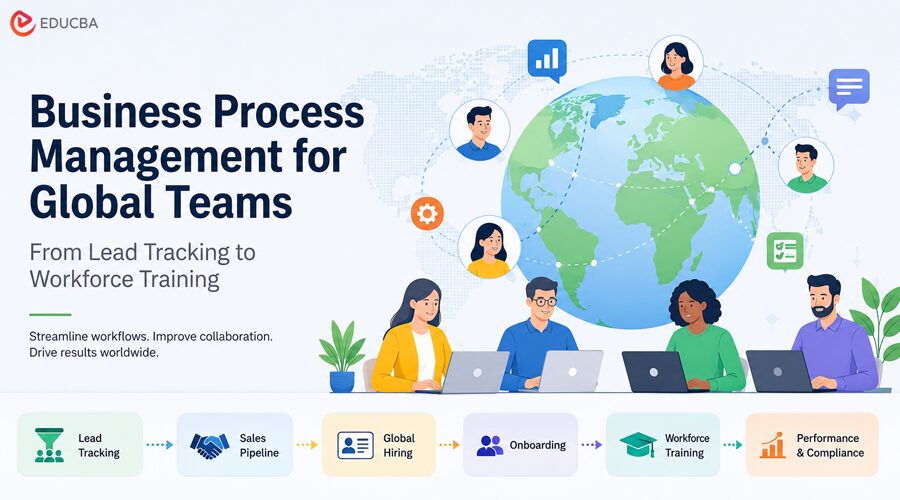
In a global company, processes rarely stay inside one department. Sales activity affects customer onboarding. Hiring decisions affect payroll and IT. Training influences compliance and performance. Because these activities are connected, delays in one area often create problems somewhere else.
Before investing in new systems, many organizations begin with business process mapping to understand how work actually moves across the business rather than how it is supposed to move on paper.
Why Does Manual Work Build Up Across Global Teams?
Few companies intentionally design inefficient processes. Instead, inefficiency grows gradually. A spreadsheet created for one campaign becomes the standard for tracking leads. A shared folder used for a handful of international hires becomes the HR archive. Managers rely on email updates because the team is still small.
Global operations add complexity. Different time zones slow communication. Local regulations introduce exceptions. Regional teams adapt processes to fit their needs, sometimes without documenting the changes. Over time, the organization ends up with dozens of small manual tasks that nobody planned for.
This is where business process management for global teams becomes valuable, as it helps organizations standardize workflows without sacrificing flexibility for regional teams.
Start With Lead Tracking in Business Process Management for Global Teams
Revenue processes are usually among the first areas where weak workflows become expensive. Leads can come from many different sources, including events, website forms, referrals, outbound campaigns, partner networks, and regional marketing teams. As volume increases, even small gaps in the process can have a noticeable impact. Without clear ownership and defined handoff procedures, opportunities may sit untouched, follow inconsistent paths through the pipeline, or receive delayed follow-up from the sales team.
Technology can support these activities, but only after the process itself is defined. For example, sales pipeline software helps organize deal stages, activities, and ownership. However, the team still needs agreed rules around qualification, assignments, and stage progression.
Organizations refining their sales operations may also benefit from understanding how CRM software supports customer information and relationship management.
Standardize Global Employment Operations Before Expansion Creates Admin Debt
International hiring introduces complexity that many companies underestimate.
Managing one overseas employee may not seem difficult. Managing employees across several countries is another matter entirely.
Without clear responsibilities, confusion develops quickly. Managers assume HR owns a task. HR assumes an external provider is handling it. Employees only discover the problem when something important is delayed.
Organizations expanding internationally often use employer of record services to simplify employment in countries where they do not have legal entities. From a process perspective, this changes who owns specific activities and where accountability sits.
At the same time, companies need to balance consistency with local requirements. Global standards are important, but culture, labor laws, and workforce expectations influence employment practices. These broader considerations are part of international HR management and should be reflected in process design.
Make Onboarding Repeatable Without Making it Rigid
Good onboarding sits somewhere between complete freedom and excessive standardization. Every employee should receive the essentials: system access, policies, introductions, and role expectations. Beyond that, the experience should adapt to the individual.
A remote engineer joining from another country may need different support than a sales manager relocating internally. Compliance requirements vary by role. Team structures differ. Senior leaders often require a different onboarding approach than entry-level employees.
Strong business process management for global teams helps companies create onboarding frameworks that remain consistent while still supporting role-specific and regional needs.
Turn Workforce Training Into a Managed Process
Training often receives attention only when compliance deadlines approach or new products are launched.
But workforce development becomes much easier when it is treated as an ongoing process rather than a series of isolated events.
Global organizations may need:
- Product training for sales teams.
- Technical certifications for specialists.
- Compliance refreshers for certain regions.
- Leadership programs for managers.
- Safety training for operational staff.
Tracking all of this manually becomes difficult very quickly.
A training management system can centralize scheduling, registrations, attendance, and reporting. More importantly, it gives managers visibility into who has completed the required learning and where gaps remain.
Training should also support broader business goals. Organizations that approach learning strategically often see better results because development activities are linked to skills and performance. That is one reason why building an employee training program deserves the same process discipline applied to other business functions.
Use Metrics to Improve Business Process Management for Global Teams
Not every workflow deserves immediate attention.
Instead of trying to optimize everything, focus on areas where friction appears repeatedly. Metrics help identify those opportunities.
| Process Area | Useful Metric | What It Can Reveal |
| Lead Tracking | Average lead response time | Whether prospects are waiting too long |
| Sales Handoff | Missing handoff fields | Whether customer context is being lost |
| Hiring | Time from approval to contract | Whether hiring steps are too manual |
| Onboarding | First-week task completion | Whether new hires are getting set up properly |
| Training | Course completion rate | Whether employees are finishing required training |
| Compliance | Expired records or certifications | Whether follow-up tracking is weak |
Simple measurements are often enough to highlight where delays, bottlenecks, or repetitive manual work occur. If managers constantly chase updates, the process itself usually signals that something needs attention.
Final Thoughts
Business process management for global teams is ultimately about creating clarity as organizations grow. Sales, hiring, onboarding, and training may seem like separate functions, but they are connected through a series of handoffs that require information, accountability, and visibility.
Companies do not need perfect processes from the beginning; having processes that people actually understand and can improve is enough.
When workflows are well organized, teams spend less time following up on updates and more time doing valuable work.
Recommended Articles
We hope this guide on business process management for global teams helps you improve workflow efficiency, streamline collaboration, and manage global operations more effectively. Explore these recommended articles for more insights on lead tracking, workforce training, international HR management, business process optimization, and global team coordination.


