


Updated July 1, 2026
AI is no longer sitting somewhere in the future.
It is already embedded in customer support queues, financial reports, marketing workflows, software teams, and daily operations. Teams still need to frame the right questions and spot when the answer does not quite hold up. They have to understand where AI saves time and where it creates risk.
A 90-day AI readiness blueprint gives that shift some structure. It helps leaders avoid “pilot purgatory,” where everyone tests tools but nothing changes. It also gives employees something they badly need during any technology shift: clarity.
The 90-Day AI Readiness Blueprint: An Overview
The goal of an AI readiness blueprint is simple: help people use AI to do better work, with clear safety checks and measurable results, within 90 days.
The plan does not need to feel complicated.
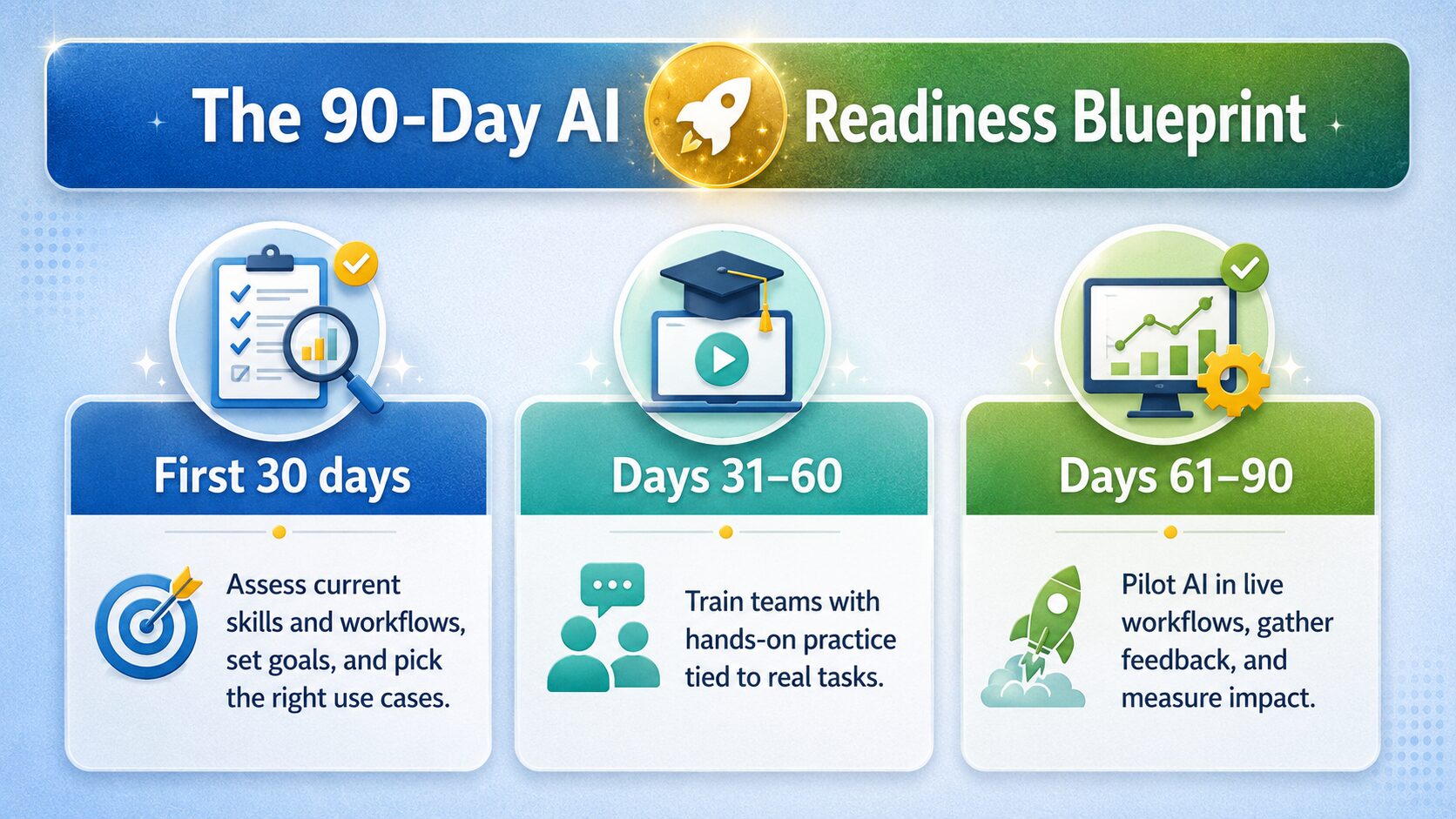
- First 30 days: assess current skills and workflows, set goals, and pick the right use cases.
- Days 31–60: train teams with hands-on practice tied to real tasks.
- Days 61–90: pilot AI in live workflows, gather feedback, and measure impact.
This AI readiness blueprint lowers risk while building momentum. Leaders get visibility. Employees get time to learn. The company gets early proof without trying to redesign everything at once.
Rawad Baroud, CEO of ZeroGPT, ran a 90-day AI readiness program across his organization last year.
He shares, “Giving our workforce the tools and training to work alongside AI transformed our culture. Employees who initially feared replacement became some of our biggest advocates. The structured timeline created momentum while allowing people to adapt at a sustainable pace.”
That matters because AI adoption often fails when it becomes too abstract. People hear big claims about transformation, but no one shows them how their actual work changes on Monday morning.
A 90-day blueprint keeps things grounded.
Phase 1: Assessment and Goal Setting (First 30 Days)
Start by identifying where people perform repetitive manual work: copying data between systems, summarizing, drafting, and cleaning data. Get specific: not “marketing needs AI” but “the team spends six hours a week turning campaign notes into reports.”
- Inventory the work: Survey employees, speak with managers, review support tickets, process documentation, and existing workflows. You do not need a perfect map, just enough insight to identify where AI can deliver the greatest value.
- Pick three to five high-impact use cases: Focus on initiatives that can deliver measurable results within 90 days. Track metrics such as time saved, error reduction, or faster response times. If your industry is regulated, involve compliance teams early. The best pilot projects often eliminate repetitive tasks that employees have simply learned to live with.
- Set measurable goals and clear governance: Define success with specific targets, such as reducing first-response time by 25% or cutting month-end reporting preparation by 20%. Establish clear guidelines for approved data use, workflow ownership, and the points at which human review is required.
- Communicate with transparency: Explain what will change, what will remain the same, and how employees will be supported throughout the transition. Avoid overpromising claims like “AI makes everything easier” that can erode trust when people are concerned about their roles. Instead, acknowledge that some responsibilities will evolve and emphasize the organization’s commitment to helping employees adapt and succeed alongside AI.
Phase 2: Training and upskilling (Days 31–60)
This is where excitement meets reality.
Training is most effective when employees practice AI using the tasks they already perform, rather than sitting through lengthy theory-based sessions. They need practical examples, guidance on writing effective prompts, and the skills to review AI-generated outputs before using them.
At this stage, the AI readiness blueprint shifts from planning to hands-on adoption. Here are a few practical ways to help employees learn, experiment, and apply AI in their daily work:
- Build role-based tracks: AI literacy should be accessible to everyone, but each team needs role-specific examples. Support teams benefit from ticket triage, finance teams from reconciliations and variance analysis, and marketing teams from campaign planning, content creation, audience research, and custom apparel initiatives.
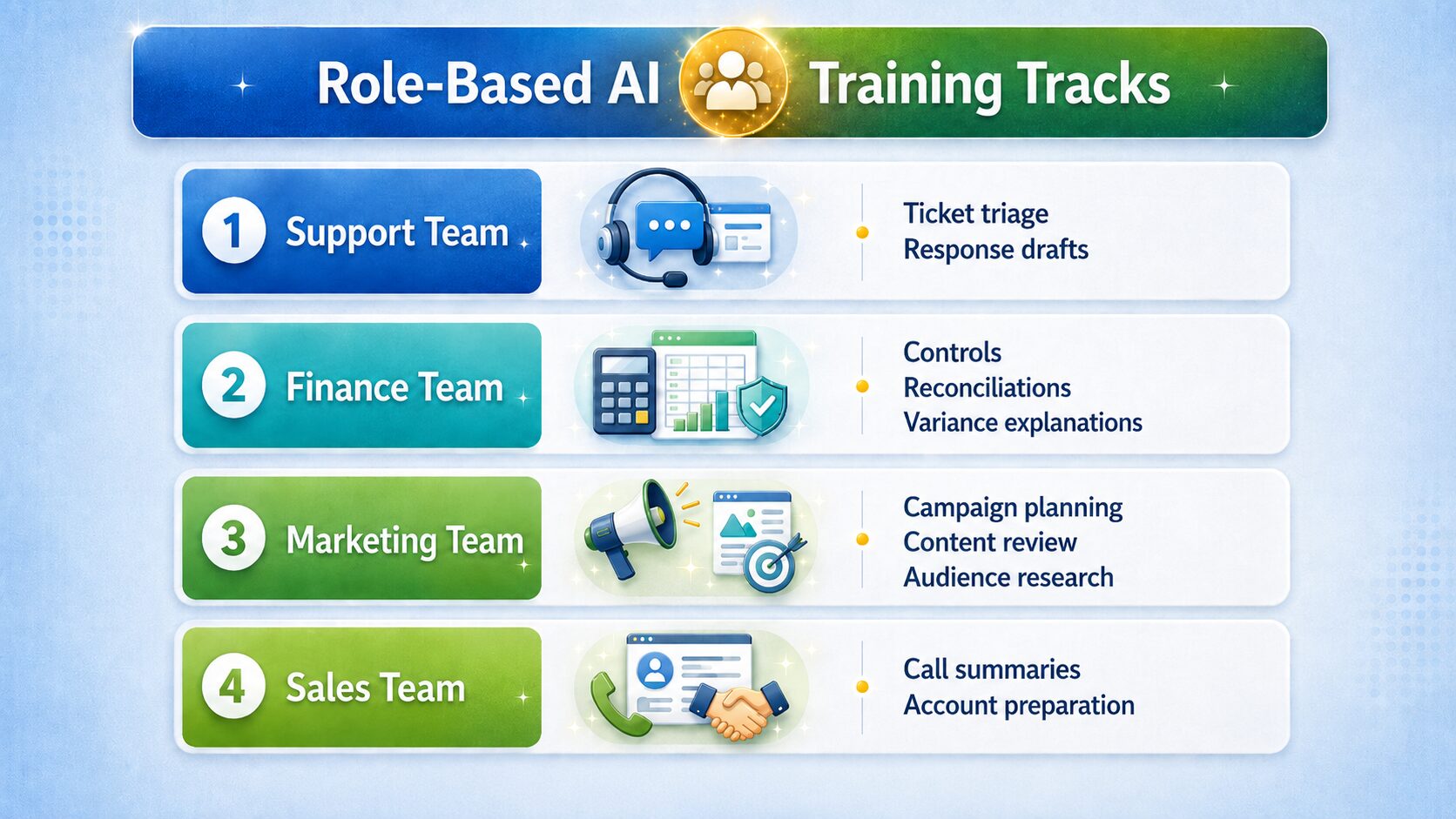
The closer the training is to the role, the faster people understand the value.
- Teach prompt patterns, not magic words: Useful AI work involves shaping the request, providing context, setting boundaries, and requesting a usable format. People should also learn to challenge outputs: what assumption did the tool make, what data is missing, and what needs verification?
- Create a safe practice: Sandboxes and office hours lower the stakes and speed up learning. Some people will experiment quickly, others will need repetition. Both are normal.
- Pair people up: Buddy systems, show-and-tells, and community channels help adoption spread. A simple internal demo often does more than a polished slide deck. Someone shows how they saved 30 minutes, someone else tries it, and another team adapts it.
- Make it accessible: Short modules, captions, and inclusive examples help more people participate, not just the loudest or most technical.
- Bring in a few experts: An internal champion or external partner can accelerate progress on risk, compliance, and tool selection. The goal is not to outsource ownership but to build confidence faster.
Phase 3: Implementation and Reinforcement (Days 61 to 90)
Now the work moves from practice to live workflows. Keep the rollout small enough to control but real enough to show value.
- Set clear guardrails for pilots: Define what success looks like and establish clear escalation paths from the outset. For example, in AI-assisted customer support, specify which responses can be sent after human review, which require escalation to a senior team member, and which must always be handled entirely by a human. Clear boundaries reduce uncertainty and improve consistency.
- Maintain regular feedback loops: Frequent check-ins, both daily and weekly, help identify friction early. Dashboards can provide visibility into adoption trends, but conversations reveal the real story: why teams are embracing the tool, where they are struggling, and what is slowing them down.
- Iterate based on real usage: Refine prompts, templates, and workflows continuously in response to actual performance. If a use case that looked promising during planning fails in practice, it should be retired or redesigned. This is not a setback; it is a valuable insight that improves future decisions.
- Measure and communicate impact clearly: Track key outcomes such as time saved, error reduction, user satisfaction, and adoption rates. Share both successes and challenges openly across the organization. Transparency builds trust, strengthens engagement, and helps leadership make informed decisions about where to scale next.
Best Practices for Sustaining Your AI Readiness Blueprint
The first 90 days build the foundation. After that, the work becomes about habits: what gets reviewed, what gets refreshed, which teams are ready to expand, which risks need tighter controls.
- Keep learning continuously: Add AI fluency to onboarding, refresh prompts and playbooks quarterly, and rotate people through short AI projects. A static training program goes stale fast.
- Stay vendor-agnostic where you can: Tools will change. Teach transferable skills like problem framing, prompt design, verification, and data hygiene. The thinking matters more than the platform.
- Build light but real governance: Define acceptable use, privacy, and review steps. People should not have to guess whether a use case is acceptable or risky.
- Encourage responsible experimentation: Make small pilots easy to start and easy to stop. Some will save time, some will reveal limits. Both are useful.
- Track value like you track budgets: Time saved, quality improved, risk reduced, revenue enabled. If AI adoption is not measured, no one knows what changed.
- Invest in internal communities: Champions, lunch-and-learns, and internal forums keep ideas flowing. People learn from people they trust, and that kind of learning is hard to force but easy to support.
Final Thoughts
A well-designed AI readiness blueprint gives teams the language, tools, and space to learn. It gives leaders a clearer view of impact and risk. Most of all, it shifts the story from replacement to reinforcement.
Start with a simple assessment. Pick a few high-confidence use cases. Train on real work, not abstract demos. Pilot carefully, measure honestly, and adjust with the people closest to the work.
You do not need to get everything right on day one. You need to do this with your people, not to them. When in doubt, test in the smallest possible way with the people who actually do the work. They will tell you in a day what a slide deck will not reveal in a month.
Recommended Articles
We hope this guide on the AI readiness blueprint helps you understand how organizations can build an AI-ready workforce through structured training, real-world use cases, and responsible implementation. Explore these recommended articles for more insights on AI adoption strategies, workforce transformation, digital upskilling, change management, and enterprise AI implementation.


