


Updated July 8, 2026
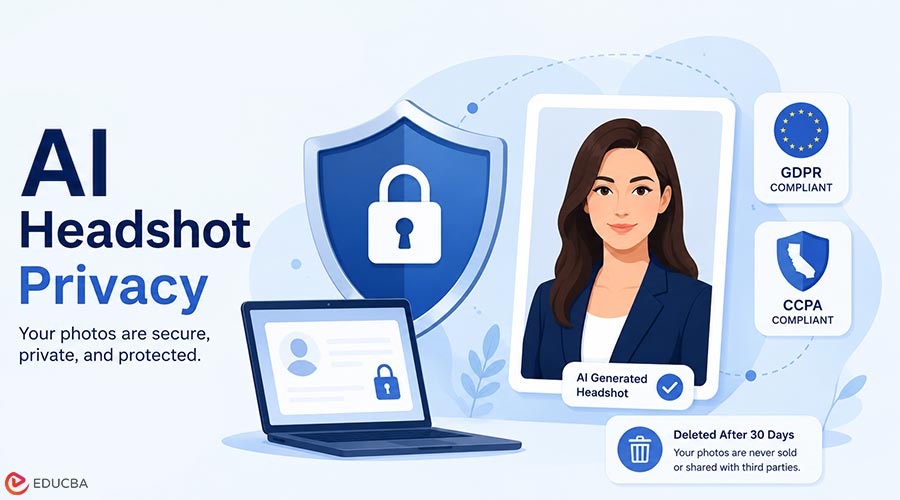
The moment of hesitation is predictable. The upload button sits at the bottom of the screen, and the cursor hovers. Five to twenty casual photos from the camera roll contain faces that have never been shared with an AI service before. The natural question arises: what happens to these images after the headshots are generated? Does the platform train future models on uploaded selfies? Are the photos stored indefinitely? Could they be sold to third parties? These are valid concerns, and AI headshot privacy has become an important factor when choosing an AI headshot generator.
The platform addresses these concerns explicitly and prominently. The platform uses uploaded selfies solely to generate the requested headshots and for no other purpose. The service does not train AI models on user photos or share them with third parties. The platform automatically deletes the images after thirty days. The platform complies with GDPR and CCPA regulations and includes full commercial usage rights for all generated images. These policies formed the basis of my evaluation when I tested the AI professional headshot service, not as a privacy expert, but as a user who wants to understand exactly what happens to personal data.
Understanding the AI Headshot Privacy Process
Understanding the privacy implications requires tracing the complete data lifecycle. The platform processes uploaded selfies in a specific sequence, with each stage having defined privacy protections.
1. Upload and Encryption
The upload process uses encrypted transmission and storage. Since no account registration or email verification is required before uploading, less personal information is tied to the submitted photos. The file picker accepts standard image formats and provides immediate visual feedback when each photo loads.
What Encryption Actually Means?
The platform encrypts and protects images while it uploads them from the user’s device to its servers and stores them for processing. The encryption does not make the images invisible to the platform’s AI systems, the model needs access to the images to train the personalized model, but it prevents interception during transfer and protects against unauthorized access during storage.
2. Model Training and Processing
The AI trains a personalized model based on the uploaded facial features. This training process is the core function of the service without it, the generated headshots would not reflect the user’s actual appearance. The system creates the personalized model temporarily to generate the requested headshots and does not retain it after the session completes.
The Distinction Between Personalized and General Training
The platform explicitly states that it never uses uploaded selfies to train broader AI models. This distinction matters. Some AI services use user-uploaded content to improve their general models, meaning a photo uploaded by one user could influence the output generated for another user. This platform does not do that. The platform creates the personalized model only for the individual user’s session and does not incorporate it into the platform’s general training data.
3. Automatic Deletion After Thirty Days
The system automatically deletes uploaded selfies after 30 days. The deletion applies to the original uploads and the personalized model. The generated headshots remain available for download during this period, but the underlying source images do not persist indefinitely.
Why Thirty Days and Not Immediate Deletion?
The thirty-day window provides a practical buffer for users who may need to regenerate images or request adjustments. The regeneration credits included with each plan allow users to modify specific images, and these adjustments require access to the original model. The thirty-day deletion policy balances user convenience with privacy protection.
Commercial Rights: What You Can Actually Do With the Images?
Privacy concerns extend beyond the uploaded selfies to the generated headshots. The platform grants full commercial usage rights for all generated images. This means users can use the headshots on company websites, press releases, marketing materials, LinkedIn profiles, conference bios, email signatures, and other professional materials without facing additional licensing restrictions.
What Full Commercial Rights Include?
Full commercial usage rights eliminate the licensing uncertainty that sometimes accompanies AI-generated content. Users do not need to credit the platform, do not need to pay additional fees for commercial use, and do not face restrictions on where the images can appear. The user owns the headshots and can use them for any professional purpose.
The Practical Implications for Professionals
For lawyers, founders, doctors, and engineers who use the platform, commercial rights mean the headshots can appear on law firm websites, startup investor decks, hospital directories, and engineering conference materials without legal complications. The one-time payment model includes these rights permanently, no subscription, no recurring fees, no licensing renewals.
Regulatory Compliance: GDPR and CCPA
The platform states that it complies with GDPR and CCPA regulations. These regulatory frameworks establish specific requirements for how personal data is collected, processed, stored, and deleted.
What GDPR Compliance Means for Users?
The GDPR applies across the European Union and ensures that users have greater control over their personal data through consent requirements and rights related to data access, deletion, and portability. The platform aligns its policies with these requirements, processes uploaded selfies only to generate headshots, allows users to request deletion, and enforces an automatic thirty-day deletion policy that provides a clear data retention timeline.
What Does CCPA Compliance Mean for Users?
CCPA applies to California residents and requires businesses to disclose what personal information is collected, how it is used, and with whom it is shared. The platform’s privacy policy addresses these requirements by stating that uploaded selfies are not sold or shared with third parties and are not used to train AI models.
User Testimonials and Trust Signals
The platform has generated headshots for over fifty thousand professionals. The testimonials reflect not only satisfaction with the output but also a sense of trust in the security of the process.
What Users Say About Privacy and Trust?
One user noted being “genuinely nervous uploading selfies” before the results alleviated those concerns. Another described the before-and-after comparison as transformative but did not express privacy concerns. The pattern across testimonials suggests that privacy policies are not the primary driver of user satisfaction the output quality is but the absence of privacy complaints indicates that the platform’s policies are not creating friction.
The Trust-Building Effect of Clear Policies
The platform’s privacy policies are stated explicitly on the homepage rather than buried in a terms-of-service document. This transparency serves as a trust signal for users who might otherwise hesitate to upload personal photos. The policies are also concise, a few bullet points rather than pages of legal language, which makes them accessible to non-specialists.
Limitations and Practical Considerations
The privacy protections are robust, but several practical considerations deserve honest mention.
The Limits of Encryption
Encryption protects against unauthorized access during transmission and storage, but it does not prevent the platform’s AI systems from accessing the images during processing. The AI needs to see the faces to train the personalized model. The privacy protection comes from the platform’s commitment not to retain, sell, or share the images after processing, not from technical measures that make the images invisible to the AI.
The Deletion Window and User Responsibility
The thirty-day deletion window means users should download their generated headshots promptly. The platform does not offer long-term storage for generated images, and the original uploads are deleted after thirty days. Users who lose their downloaded files after the deletion window must upload new photos and generate a new set.
Third-Party Sharing and the “Never Sold” Claim
The platform states that it never sells or shares uploaded selfies with third parties. This claim covers the uploaded source images. Users control their downloaded headshots and can share them however they choose. The commercial usage rights included with all plans permit unlimited sharing and publication.
AI Headshot Privacy Compared to Traditional Photography
Every AI service that processes personal data involves some privacy trade-off. The relevant question is whether the trade-off is reasonable given the service’s value and whether the platform’s policies are transparent and enforceable.
Compared to Traditional Photography
Traditional photography involves different privacy considerations. Studio photographers retain client photos for portfolios, marketing materials, and sometimes for sale as stock images unless contracts specify otherwise. The AI platform’s policy of not retaining, selling, or sharing uploaded selfies is more restrictive than many studio practices. The automatic deletion after thirty days provides stronger privacy protection than the indefinite storage common in traditional photography.
The Risk-Benefit Calculation
The platform processes personal photos to generate professional headshots. The main privacy risk is that others could access, retain, or misuse the images despite the stated policies.Users can generate dozens of professional headshots in under 30 minutes at a fraction of the cost of traditional photography. The platform’s explicit policies, regulatory compliance, and encryption practices reduce the risk to a level that appears reasonable for most professional users.
Who Should Consider the Privacy Implications Carefully?
The platform’s privacy protections are strong, but certain users may have additional considerations.
Professionals With High-Profile Roles
Executives, public figures, and professionals in sensitive roles may have heightened privacy concerns. The platform protects user privacy through encryption, automatic deletion, and a clear commitment not to sell or share uploaded selfies. It also grants full commercial usage rights, allowing high-profile users to use their generated headshots without attribution.
Users in Regulated Industries
Professionals in healthcare, finance, and legal services operate under industry-specific privacy regulations. The platform’s GDPR and CCPA compliance provides a baseline, but users should confirm that the service meets their industry’s specific requirements. The platform’s explicit prohibition on selling or sharing uploaded selfies aligns with many regulated industries’ data handling requirements.
Privacy-Conscious General Users
For users who simply want to understand what happens to their photos, the platform’s policies provide clear answers. The platform uses uploaded selfies only to generate headshots, does not use them to train AI models, does not sell or share them, and deletes them after thirty days. The platform states these policies concisely and prominently, making the privacy implications easy to understand before uploading.
Final Thoughts
Strong AI headshot privacy practices help users feel confident when uploading personal photos. By combining encrypted uploads, temporary AI processing, 30-day automatic data deletion, GDPR and CCPA compliance, and a strict no-sharing policy, the platform prioritizes user privacy and security. Although no online service can eliminate every privacy risk, these safeguards significantly reduce concerns while allowing users to generate high-quality professional headshots with confidence.
Recommended Articles
We hope this comprehensive guide to AI headshot privacy helps you understand how your personal photos are protected. Check out these recommended articles for more insights into AI technology.


