


Updated August 31, 2026
What is Inference Cost?
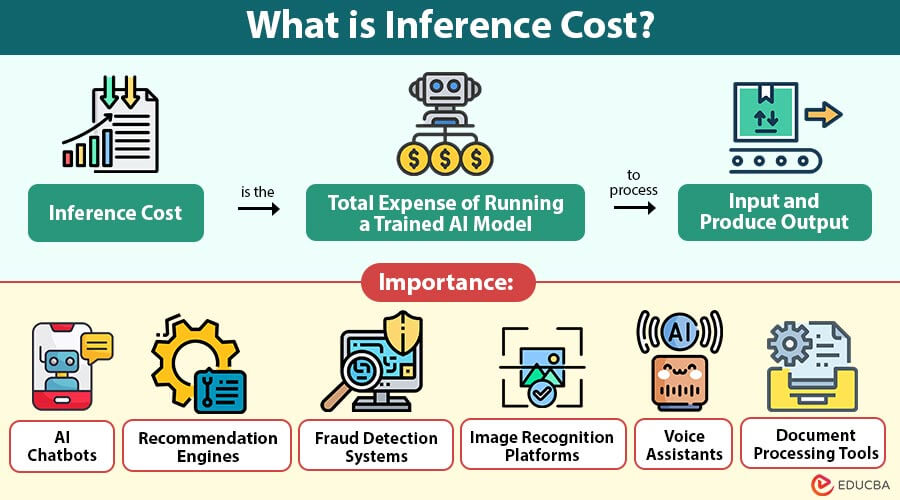
Inference cost is the total expense of running a trained AI model to process input and produce output. In a generative AI application, for example, every time a user sends a prompt and receives an AI-generated response, the underlying model performs inference.
Inference costs can include expenses related to:
- GPU or CPU computing resources
- Cloud infrastructure
- Model API usage
- Memory and storage
- Data transfer
- Energy consumption
- Model serving and deployment
- Monitoring and system maintenance
Exact costs depend on factors such as model size, number of requests, input and output length, hardware, response-time requirements, and deployment architecture.
For example, a chatbot serving 100 users per day may have relatively low inference costs. However, an enterprise application processing millions of AI requests each month can face substantial inference expenses.
Table of Contents:
- Meaning
- Importance
- How is Inference Cost Calculated?
- Factors that Affect Inference Cost
- Common Ways to Reduce Inference Cost
- How Can Businesses Manage Inference Cost?
- Challenges
- Future
Key Takeaways:
- Inference cost depends on model size, request volume, tokens, hardware, latency, and resource utilization.
- Smaller models, quantization, caching, and batching can significantly reduce AI inference expenses.
- Businesses should balance inference costs with accuracy, performance, scalability, reliability, and user experience.
- Intelligent routing and efficient infrastructure help organizations optimize costs while maintaining quality.
Why is Inference Cost Important?
Inference cost directly affects the economics of AI applications. A model may provide excellent results, but if every request is expensive, scaling the application can become difficult.
Businesses need to consider it when developing applications such as:
1. AI Chatbots
Determines how affordably chatbots can handle growing numbers of user conversations while maintaining fast, reliable, and high-quality responses.
2. Recommendation Engines
Recommendation engines process numerous user interactions, so inference efficiency is essential to deliver personalized suggestions without significantly increasing operational expenses at scale.
3. Fraud Detection Systems
Fraud detection systems require frequent predictions, so controlling inference costs helps organizations analyze transactions continuously while keeping security operations financially sustainable.
4. Image Recognition Platforms
Image recognition platforms may process millions of images, making efficient inference important for controlling computing expenses and supporting scalable visual analysis.
5. Voice Assistants
Voice assistants perform inference for spoken requests, so lower inference costs help businesses deliver responsive voice experiences across large user populations.
6. Document Processing Tools
Document processing tools analyze large volumes of files, so managing inference costs is essential to keep automated workflows affordable and scalable.
How is Inference Cost Calculated?
The method for calculating inference cost depends on how you deploy the model.
For API-based models, providers may charge according to the number of input and output tokens. In this case, a simplified calculation can be expressed as:
For self-hosted models, costs may instead depend on infrastructure usage.
A simplified formula is:
Inference cost is the expense of running an AI model to process inputs and generate outputs during inference operations.
Consider an application that processes 100,000 AI requests per month. If the average cost of processing one request is $0.002, the approximate monthly inference cost would be:
100,000 × $0.002 = $200
Although the per-request cost seems small, it can increase considerably as usage grows.
Factors that Affect Inference Cost
Several factors influence how much an AI application costs to operate.
1. Model Size
Larger models require more computational resources, memory, and processing power, generally resulting in higher inference costs for AI applications.
2. Number of Requests
More requests increase overall inference expenses because applications require additional computational resources to process growing volumes of user interactions.
3. Input and Output Size
Longer prompts and responses require more tokens, increasing computational requirements and potentially raising inference costs for language model applications.
4. Hardware
Powerful GPUs and specialized AI accelerators can improve performance but may increase infrastructure expenses depending on workload and usage requirements.
5. Latency Requirements
Applications requiring faster responses may need powerful infrastructure, increasing computational resources and potentially raising inference costs to maintain low latency.
6. Utilization
Poor hardware utilization increases effective inference costs because idle computing resources continue to generate expenses without processing enough requests or workloads.
Common Ways to Reduce Inference Cost
Businesses can use several ways to make AI inference more efficient.
1. Use Smaller Models
Smaller models can handle focused tasks effectively, reducing computational requirements, API expenses, and infrastructure costs without sacrificing necessary performance.
2. Quantization
Quantization reduces model parameter precision, lowering memory requirements and improving inference efficiency while maintaining acceptable accuracy and overall model performance.
3. Model Distillation
Model distillation trains smaller models to reproduce larger models’ useful behavior, reducing computational requirements and lowering production inference expenses.
4. Caching
Caching reuses responses for repeated or similar requests, reducing unnecessary model processing and lowering inference costs for frequently requested information.
5. Optimize Prompts
Optimizing prompts by removing unnecessary content reduces token usage, computational requirements, and overall inference expenses while preserving essential model context.
6. Batch Inference
Batch inference processes multiple requests together, improving hardware utilization and reducing costs for large-scale, non-real-time workloads such as classification.
7. Route Requests to Appropriate Models
LLM routers direct simple requests to affordable models while reserving powerful models for complex tasks, balancing quality, speed, and cost.
How Can Businesses Manage Inference Cost?
Businesses can manage it by continuously measuring usage, optimizing workloads, selecting suitable models, and improving infrastructure efficiency.
1. Establish an Inference-Cost Baseline
Measure current inference spending, request volumes, token usage, latency, and resource utilization to establish a reliable cost baseline.
2. Identify the Most Expensive Workloads
Analyze workloads to identify expensive models, high-volume requests, large prompts, and resource-intensive tasks requiring immediate optimization.
3. Measure Model Performance Against Cost
Compare model accuracy, response quality, latency, and inference expenses to determine whether each model delivers sufficient business value.
4. Optimize Prompts and Context
Remove redundant instructions, unnecessary context, and excessive conversation history to reduce token consumption and improve inference efficiency.
5. Select Appropriate Model Sizes
Choose smaller models for simple tasks and reserve larger models for complex workloads requiring advanced reasoning and higher accuracy.
6. Introduce Caching Where Suitable
Cache frequently requested or similar responses to avoid repeated inference processing and reduce unnecessary model calls and operational expenses.
7. Improve Infrastructure Utilization
Increase GPU and accelerator utilization through efficient scheduling, batching, autoscaling, and workload management to reduce wasted computing capacity.
Challenges in Reducing Inference Cost
Below are the key challenges businesses may face when trying to reduce inference costs:
1. Maintaining Low Latency
Reducing infrastructure costs without affecting response speed can be challenging, especially for real-time applications that require consistently fast inference.
2. Supporting Unpredictable Traffic
Sudden increases in requests can require additional computing resources, making it hard to keep costs low during unexpected demand.
3. Managing Peak Workloads
Peak workloads may require additional infrastructure capacity, increasing expenses while businesses attempt to maintain reliable application performance.
4. Maintaining Response Quality
Using smaller or cheaper models may reduce accuracy, reasoning capabilities, or response quality, affecting overall user satisfaction.
5. Choosing Suitable Hardware
Selecting cost-effective hardware requires balancing processing performance, memory capacity, availability, energy consumption, and workload-specific requirements effectively.
6. Controlling Long-Context Usage
Large context windows increase token consumption and computational requirements, making long-context applications more expensive to operate efficiently.
7. Monitoring Changing Usage Patterns
Changes in traffic, request types, model usage, and user behavior can significantly affect inference costs over time.
Future of Inference Cost Optimization
The following are the key trends shaping the future of inference cost optimization:
1. Specialized AI Hardware
Specialized AI hardware will improve inference efficiency by delivering faster processing, better energy efficiency, and lower costs for AI workloads.
2. Model Compression
Advanced model compression techniques will reduce model size and resource requirements, making AI inference more affordable across various applications.
3. Efficient Inference Architectures
Optimized model architectures and inference engines will improve computational efficiency, helping organizations process AI workloads faster while reducing operational expenses.
4. Smaller Specialized Models
Businesses will increasingly use smaller specialized models for focused tasks, reducing reliance on expensive large models and lowering inference costs.
5. Intelligent Model Routing
AI systems will combine multiple models and route requests based on complexity, balancing response quality, processing speed, and operational costs.
6. Edge AI
Edge AI will process suitable workloads directly on devices, reducing cloud dependency, network delays, and potentially lowering inference expenses.
Final Thoughts
Inference cost is the ongoing expense of running trained AI models. It depends on model size, requests, tokens, hardware, latency, and utilization. Businesses can reduce costs through smaller models, quantization, distillation, caching, prompt optimization, batching, and model routing. Effective optimization balances cost, performance, accuracy, scalability, and user experience for sustainable AI deployment.
Frequently Asked Questions (FAQs)
Q1. Why does model size affect inference cost?
Answer: Larger models typically require more memory and computing resources, increasing the hardware, energy, and infrastructure needed to process each request.
Q2. Does higher inference cost always mean better AI performance?
Answer: No. Larger and more expensive models may provide stronger capabilities, but smaller specialized models can deliver sufficient performance for many specific tasks at lower cost.
Q3. How does token usage affect inference cost?
Answer: For token-based AI services, longer prompts and responses consume more tokens, which can increase the cost of processing each request.
Q4. Can inference costs increase as an AI application grows?
Answer: Yes. As request volumes, users, token consumption, and processing requirements increase, total inference expenses can rise significantly.
Recommended Articles
We hope that this EDUCBA information on “Inference Cost” was beneficial to you. You can view EDUCBA’s recommended articles for more information.


